
Coffee Grounds for Batik
By Pito Agustin Rudiana
It is no exaggeration to call Yogyakarta a haven for coffee lovers in Indonesia. A vast array of coffee businesses, from traditional angkringan street stalls to modern cafes, dot the region. Whether cheap or high-end, options abound. The Jogja Coffee Week (JCW) even estimated that around 3,500 coffee shops were operating across the Special Region of Yogyakarta in 2025.
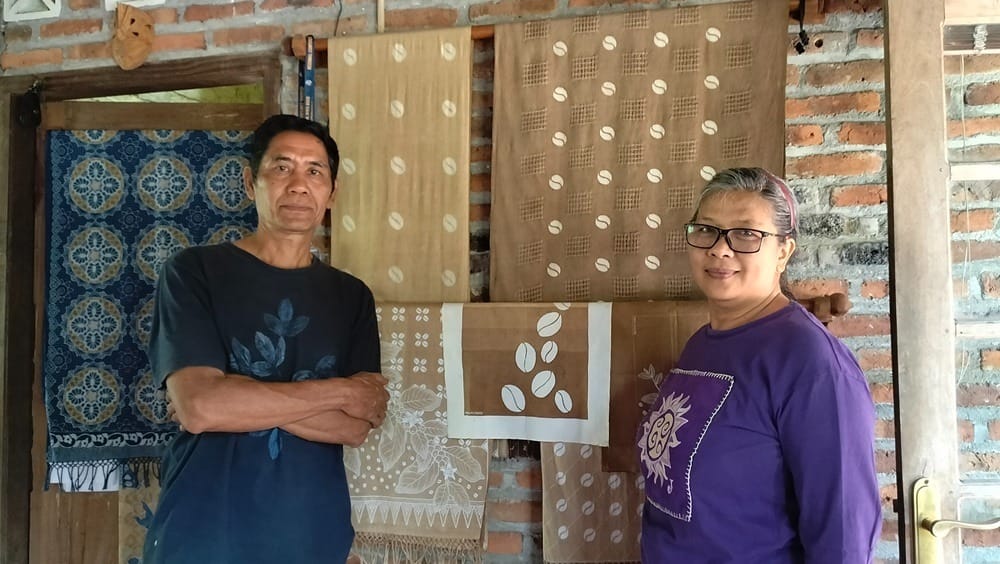
This phenomenon piqued the interest of couple Dedi H. Purwadi and Wineng Endah Winarni. In 2021, the couple—who produce natural-dye batik under the brand "Batik Jolawe"—began experimenting with coffee as a dye.
“At the time, using coffee grounds waste hadn't crossed our minds yet,” said Wineng at her residence, which doubles as their production studio, in Bangunjiwo Village, Kasihan, Bantul, Yogyakarta, on Friday, July 24, 2026.
Initially, Dedi and Wineng had their doubts because raw coffee beans are whitish and lack color pigments. The brown hue in coffee is not its natural color, but rather the result of roasting at various temperature levels: light, light-to-medium, and medium-to-dark.
“We just tried. We thought, if coffee can be used for painting, it should work as a batik dye too,” Wineng said.
They agreed to conduct a trial. They opted against using instant or pre-ground coffee over concerns that commercial coffee powder might be blended with corn or rice, which could alter the resulting shade. Instead, they ran the test using raw green coffee beans, roasting them over a pan themselves.
“We roasted them for so long that the pan cracked,” Wineng recalled.
During the testing process, Wineng noted that Dedi was particularly painstaking. Dedi added tea to the coffee solution because tea contains tannin, a compound that binds colors far more effectively than coffee. The ratio reached 1:18; coffee contains only about 1 percent tannin, whereas tea boasts a tannin content of 15 to 18 percent.
Proving this was simple enough: tea leaves significantly more brown residue on a glass than coffee does.
“A tea drinker’s teeth look different from a coffee drinker’s—they have much more stain,” Dedi chimed in.
To ensure the fabric absorbed the coffee’s brown pigment strongly, they tested it on swatches of white cloth. They followed the standard batik dyeing steps: mordanting (boiling the fabric before dyeing), boiling the natural materials to extract the dye, rinsing, and sun-drying.
Drying took place under direct sunlight. In addition to sun-drying, the fabric swatches were washed using harsh soap containing high levels of active bleach. These final two tests were designed to check whether the color faded easily and to assess the quality of the hue. Based on these results, Dedi and Wineng determined whether the natural dye was viable for batik production.
“Only then did we post the results (on social media),” Wineng said.
Following those posts, orders for coffee-dyed batik began trickling in. Among the early customers was the wife of a Yogyakarta musician, who wanted to gift a coffee-dyed batik udheng (traditional headscarf) to a friend—a coffee entrepreneur in Jember. Beyond ordering the udheng, she brought expired coffee powder to be turned into dye.
Another friend, a coffee business owner from Sumedang, visited to learn the coffee-dyeing craft. Through him, they began sourcing coffee husks that would otherwise be discarded as waste.
“We roast those red coffee husks to make dye as well,” Wineng explained.
Additionally, they began processing spent coffee grounds into dye. Given the massive amount of coffee waste generated across Yogyakarta, putting it to good use seemed logical. According to a 2024 thesis by Andi Tahran Purnomo from the Islamic Economics Department at the Islamic University of Indonesia, titled “Oeripsae: Development of Coffee Ground Waste into Briquettes,” a single coffee shop in Yogyakarta produces an average of 15 kilograms of coffee grounds per month. Across 3,500 coffee shops, that equates to roughly 52,500 kilograms (52.5 tons) of coffee grounds monthly—most of which ends up in landfills.
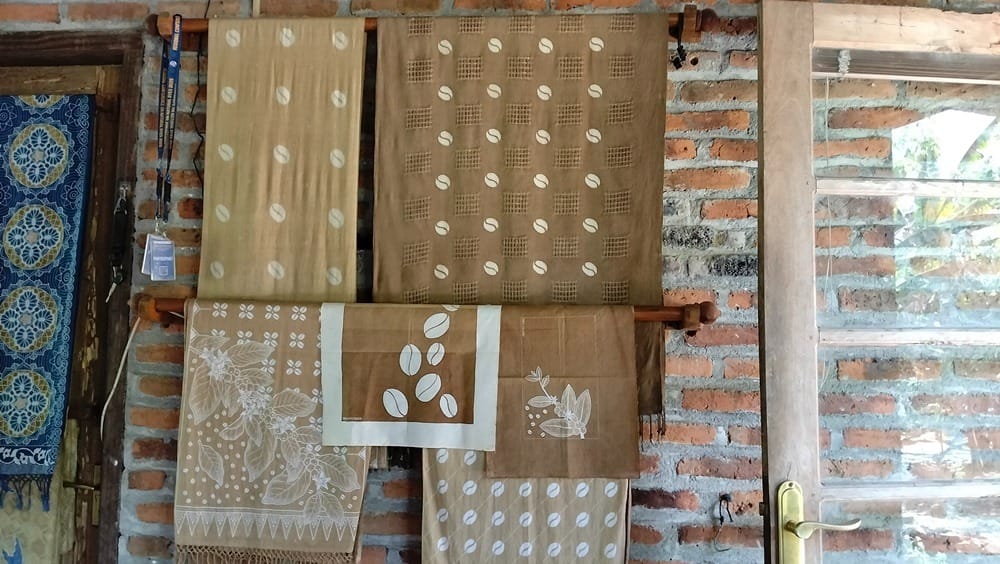
Initially, Dedi and Wineng obtained coffee grounds from a coffee shop in the UGM (Gadjah Mada University) Valley area. All batches underwent the same rigorous testing. The results showed that unbrewed coffee yields a darker brown than spent coffee grounds. This color contrast is visible on the coffee-dyed batik cloths stored at their residence, featuring coffee bean and plant motifs. The interplay of light and dark brown shades enriches their palette of natural batik dyes and expands their collection.
Beyond coffee testing, Dedi has been constantly developing innovative formulas and methods since 2021 to make the batik-making process more efficient and sustainable. According to Dedi, traditional batik making consumes massive amounts of water and takes days to complete. A single long piece of cloth can consume up to 65 liters of water. Producing 10 batik cloths a month would waste at least 650 liters of water.
“We’d rather not make batik at all than be unable to take a bath,” said Dedi, who relies on well water for both batik production and daily needs.
Their breakthrough, known as the Batik Jolawe 4-Saving Method, aims to conserve time, labor, water, and fuel. They achieved this by rejecting mass production, choosing instead to craft just two high-quality batik cloths per month.
“Just recently, we had to turn down an order to dye 10 pieces of batik fabric,” Wineng revealed.
The method simplifies and accelerates every stage. For instance, the mordanting process—which previously took 12 hours or more—now takes just 2 to 5 minutes. Dye extraction takes roughly an hour using a soda ash (sodium carbonate) mixture, eliminating the need to wait for the solution to cool down. The dipping process requires only 1 to 2 immersions to achieve a deep shade, down from the usual 4 to 5 dips. Water consumption drops by 80 to 90 percent.
“And it isn't wasted. The leftover water can be reused,” she added.
Natural dye waste, including spent coffee grounds, can be repurposed as compost. Dedi typically mixes it with dry leaves. However, leftover water from coffee dye extraction reserved for reuse should be used within three days to avoid foul odors.
“If it runs out, it can be discarded safely. The waste is far safer than synthetic dye effluent,” Dedi noted.
The Batik Jolawe efficiency method and formula have been submitted for patent registration. Nevertheless, Dedi and Wineng continue to share the knowledge and experience gained from years of experimentation in their home ‘laboratory’—covering both natural dye materials and water-saving methods—through workshops. Participants range from schoolteachers and community groups to foreign nationals hailing from the United States, Japan, Serbia, Australia, France, Germany, the United Kingdom, and the Chechen Republic.
“Before they arrive, we ask them: what natural dye materials are available in their home country? That is what we prepare for the training,” Wineng said. For example, if a participant from Darwin, Australia, has access to coconut coir and avocado leaves, those are the materials taught.
When Wineng first learned batik making in 2009, she used synthetic dyes. Ten months in, an alarming incident triggered her shift to natural dyes. A brand-new wax frying pan stored in her warehouse was found eaten through with holes, leaving behind a residue of ash. Directly above the pan sat a plastic bag of caustic soda (sodium hydroxide), commonly used to dissolve Naphtol dyes. Caustic soda is highly corrosive.
“It was an aluminum pan. What if it touched our skin or bodies?” Wineng recalled.
Synthetic dye waste is equally hazardous due to its toxicity. They worried that discharged waste soaking into the soil would contaminate their well water.
“We drink that water. Eventually, we'd just be earning money to pay for medical bills,” she said.
Since 2010, Wineng and Dedi have studied natural dye materials to replace synthetic ones. They attended various training programs and scoured international academic journals. In doing so, they discovered that natural dye materials were essentially organic waste—unused and routinely discarded—easily found around them.
On a recent morning, Dedi displayed an array of dried natural batik dye materials covering a wooden table in their living room. Alongside coffee were coconut coir, ketapang (sea almond) leaves, pomegranate rinds, tamarind bark, tingi wood, and mangosteen rinds—all arranged in besek (woven bamboo baskets). Each material underwent two weeks to a month of testing for batik application.
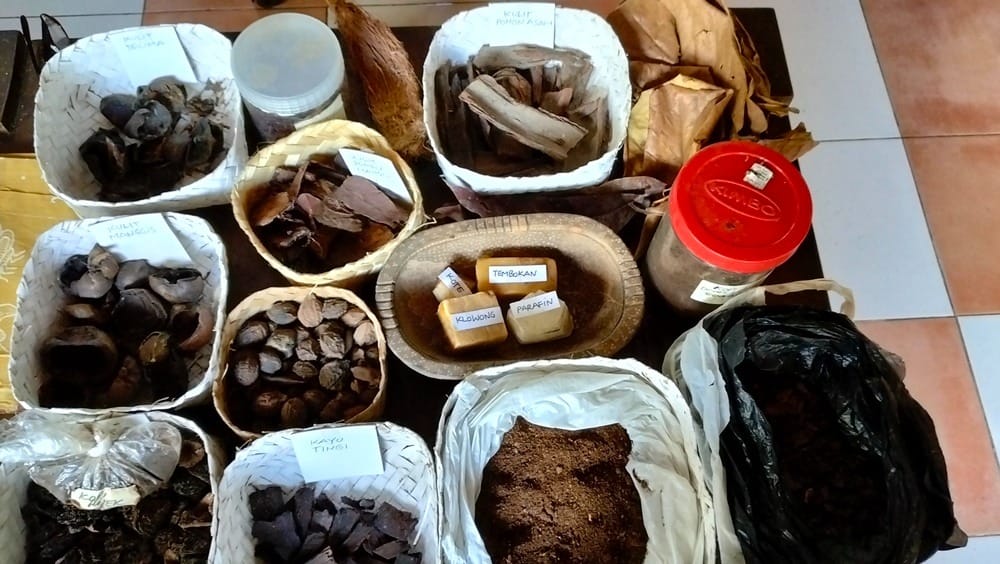
Some materials proved unsuitable because their pigments failed to bind to fabric, such as secang (sappanwood) and dragon fruit. Others yielded unstable shades sensitive to water pH, such as turmeric. There were also materials that worked well but were deliberately passed over, such as green banana peels.
“We didn't like the color. It looked dingy and dull,” Wineng laughed.
These natural dye materials yield batik fabrics in various sizes, with prices ranging from Rp300,000 to Rp3 million per piece.
Despite utilizing natural dyes and pioneering conservation techniques, Dedi refrains from claiming his natural-dye batik business is 100 percent eco-friendly. The reason: certain raw materials must still be purchased, generating transport emissions. Furthermore, some waste is still discarded, even if it poses no environmental threat.
“It isn't 100 percent eco-friendly yet. But if you ask whether it is safer than synthetic dye, absolutely,” Dedi said with conviction.
On Thursday, June 18, the community hall in Kampung Cokrodiningratan, Yogyakarta City, buzzed with activity. Dedi Purwadi was busy sharing his craft with local residents.
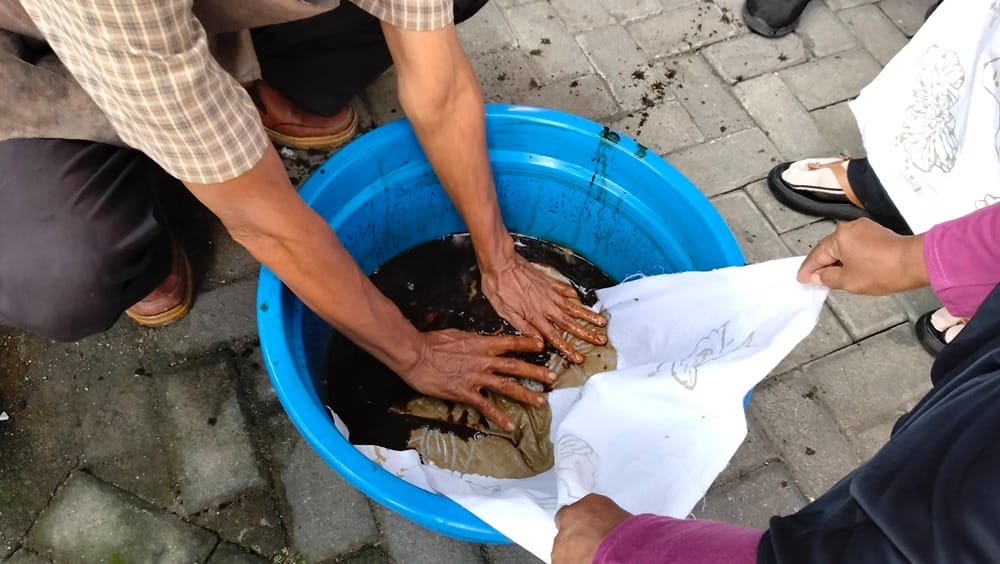
Workshop participants worked on 30 x 30 centimeter swatches of white fabric. After applying batik wax to the plain white canvas, the fabric swatches were submerged in dye baths. A dozen swatches were immersed in buckets containing liquid coffee dye, carefully pressed beneath the surface to achieve an even coat.
The participants then hung the swatches on clotheslines, clamping both ends with wooden pegs to keep them secure in the breeze. Any remaining coffee grounds clinging to the fabric were gently wiped away with a sponge in a single direction.
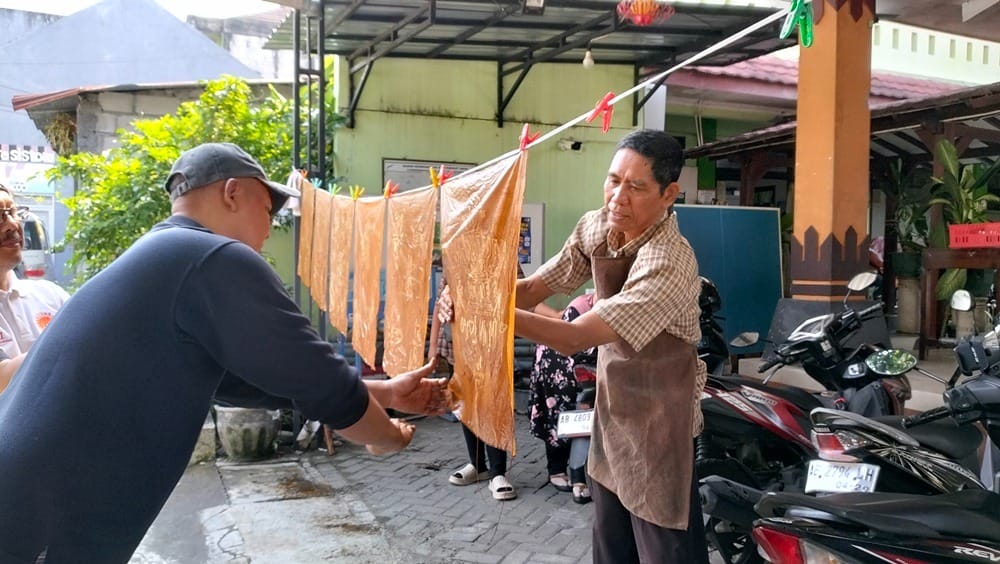
Sriyati, a participant in the two-day workshop, expressed enthusiasm for applying the techniques at home. A daily drinker of two cups of coffee, she previously threw away used coffee grounds with her regular household trash.
“It’s great that coffee grounds can be repurposed for batik—even if I only wear the batik myself,” the 63-year-old said.
Meanwhile, Erwan Widyarto from the Environmental and Preservation Division of the Indonesian Tourism Industry Association (GIPI) Yogyakarta highlighted the broader benefits of coffee waste. He explained that spent coffee grounds contain valuable nutrients for soil and plants, including organic carbon, nitrogen, phosphorus, and potassium, which can be turned into fertilizer to nourish soil structure and replenish organic matter.
“Coffee grounds offer great environmental benefits. Economically, they can be utilized for souvenirs while serving as an educational tourism package,” said Erwan, who also served as a speaker at the Cokrodiningratan workshop.