
Octopus Sasi in the Mentawai Islands
Febrianti
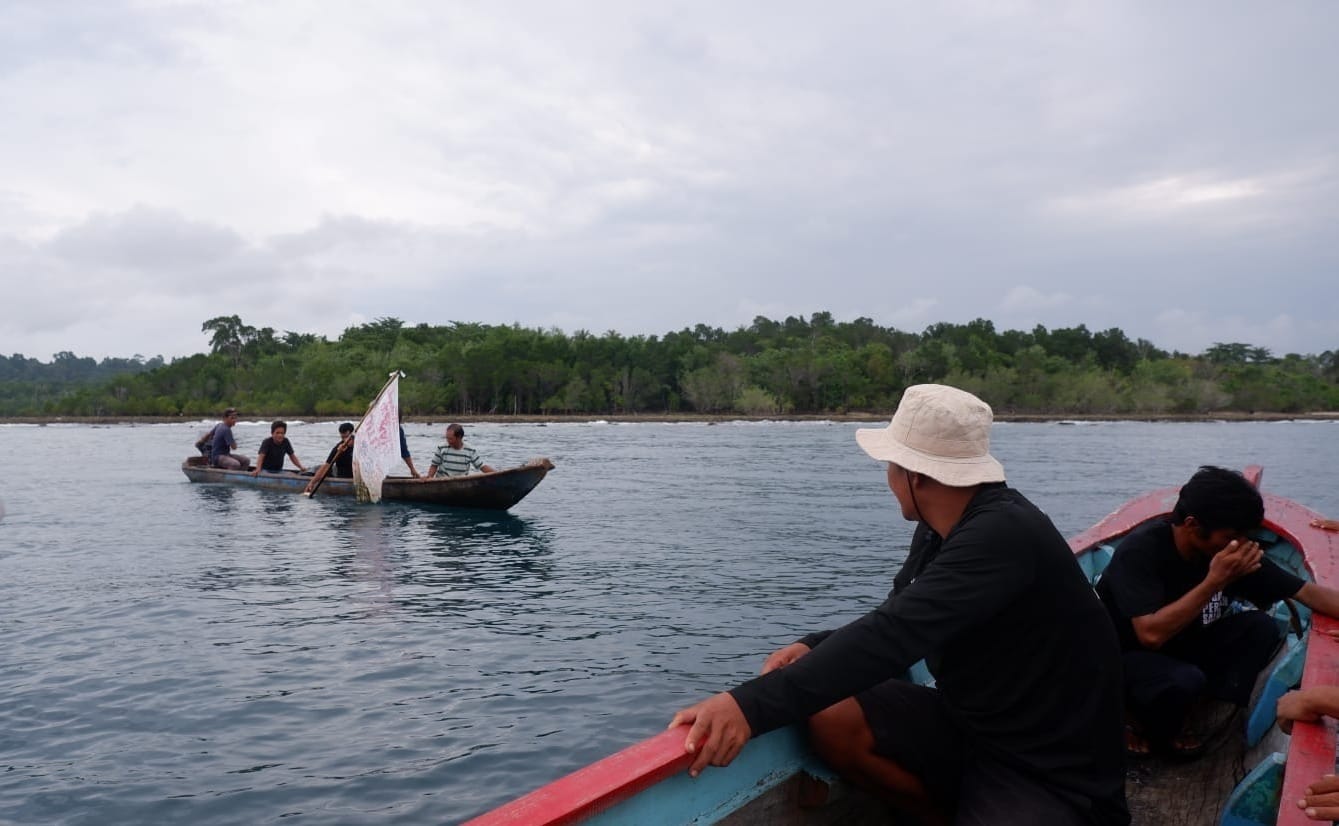
On Tuesday morning around 10 a.m., three wooden fishing boats cut through the open water, leaving behind Simatapi Island in Sinaka Village, South Pagai, Mentawai Islands, West Sumatra. Carrying over a dozen passengers, the boats halted about 500 meters offshore, right in front of a white flag attached to a buoy. The flag, bobbing up and down with the waves, bore red lettering: “Temporarily Closed. No Fishing in this Area.”
Sinaka Village Head Tarsan Samaloisa and a local resident reached out to grab the flag. “With this, we officially open the six temporary closure zones in Sinaka waters,” Tarsan declared as he rolled up the flag on Tuesday, July 7, 2026.
The buoyed flag served as a marker for the octopus fishing ban—locally known as sasi—which had been in place across Sinaka waters for the past three months. Six such flags had been anchored off six closed fishing spots spanning six hamlets, encompassing a total closure area of roughly 870 hectares.
“This temporary closure allows octopuses and other marine life to breed properly, and lets the octopuses grow larger,” Tarsan said. “This is for our economy—the people of Sinaka.”
With the three-month sasi period concluded, fishers were once again permitted to catch octopuses in those designated waters. The marine creature serves as the economic backbone for Sinaka's coastal community.
Sinaka has practiced periodic octopus fishing closures since 2023. The entire village, composed mostly of fishermen, agreed to the practice to secure their long-term economic future. Since then, the village has carried out four rounds of sasi for octopus fishing, each lasting three months.
During a sasi period, fishers are barred from catching octopuses and fish within the six designated zones. However, they remain free to fish in unclosed areas. To enforce the rules, a local watch team dubbed Si Jago Koat—comprising 10 young men and fishermen from Sinaka—conducts regular patrols.
Sinaka Village is the primary producer of octopuses in the Mentawai Islands. The waters around this southernmost village feature the largest octopus grounds in the region, with populations spread across 20 small islets and 100 sandbars (gosong) off Sinaka’s coastline.
According to Idris Maulana, Chair of the Sinaka Village Consultative Body and a local octopus buyer, locals used to catch only one or two octopuses a day for household consumption, much like regular fish. But starting in 2000, traders began flocking to Sinaka to purchase octopuses.
Following the influx of buyers, dozens of Sinaka fishermen shifted their focus to hunting octopuses. Harvesting intensified around 2007, when the price reached Rp5,000 per kilogram.
“Back then, octopuses were abundant,” recalled Idris. “Just off Simatapi Island, close to the shore. I used to dive for them often,” he added, noting that he could harvest 20 kilograms in just half a day's work.
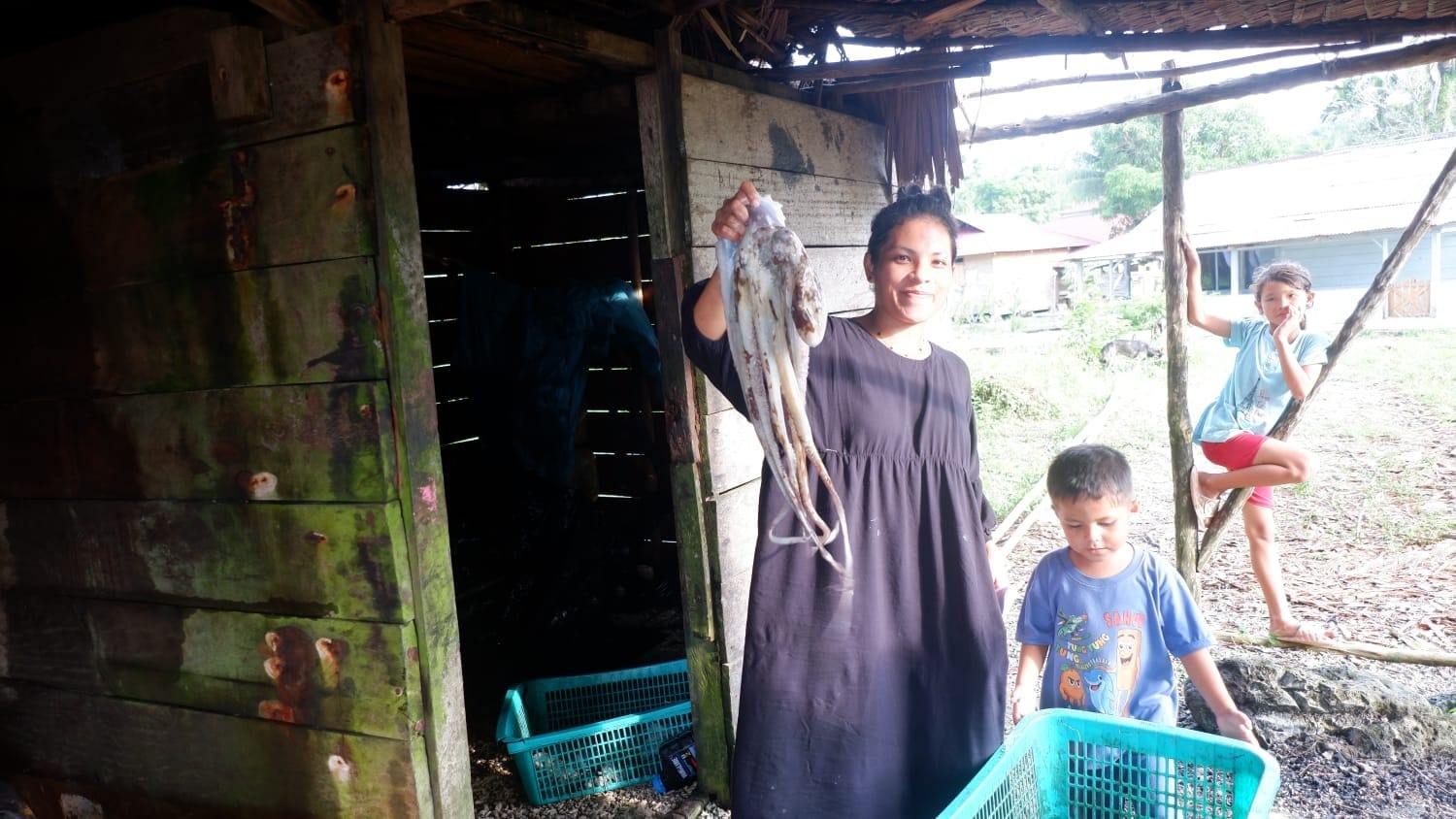
Fishing vessels from Padang would anchor at Tanopo Bay facing Simatapi Island, waiting to buy catches directly from local fishers. At the time, Idris said, octopuses were not seasonal. “They were always there whenever you looked.”
Today, octopus stocks have dwindled significantly, peaking only during specific seasons—from January to April and October to December.
A major surge in octopus harvesting occurred in 2018 when prices climbed to Rp65,000 per kilogram. Local fishermen raced out to sea, competing to pull in as much catch as possible. In a single day, a Sinaka fisherman could earn up to Rp1 million.
However, relentless harvesting led to depleted stocks and shrinking sizes. “In the past, a single octopus could weigh up to five kilograms. Nowadays, 1.2 kilograms is the heaviest you’ll find, and even that is rare,” Idris said.
Beyond octopuses, Sinaka was once renowned for sea cucumbers and lobsters. But those glory days have faded.
“Now, sea cucumbers are just a memory, and lobsters—once booming—are gone,” Idris lamented. “We don’t want octopuses to become just a memory too.”
To curb unchecked exploitation, in 2023, the Sinaka Village Government partnered with residents, supported by the Citra Mandiri Mentawai Foundation (YCMM), to draft a village regulation. The goal: regulate octopus and seafood harvesting to prevent overfishing and environmental destruction.
YCMM provided assistance for sustainable fisheries management in two Sinaka hamlets: Sinaka and Korit Buah. According to YCMM data collected between April 2022 and June 2023, the total octopus catch in the two hamlets reached over 23 tons, valued at approximately Rp36.5 billion.
Rifai, Chair of YCMM, noted that octopuses have become a primary livelihood for Sinaka residents alongside lobster, sea cucumber, and fish. However, local fisheries remain poorly managed, leaving the area vulnerable to overfishing that threatens remaining stocks if left unchecked.
In response, YCMM assisted the Sinaka Village Government in crafting regulations to manage traditional fishing grounds sustainably. Implementing temporary spatial closures—or sasi—across selected locations emerged as a core strategy.
“Temporarily closing octopus fishing spots gives octopuses and fish time to grow, since all fishing activity in the area is paused—including in mangrove areas that serve as hatchery grounds for fish and shrimp,” Rifai explained.
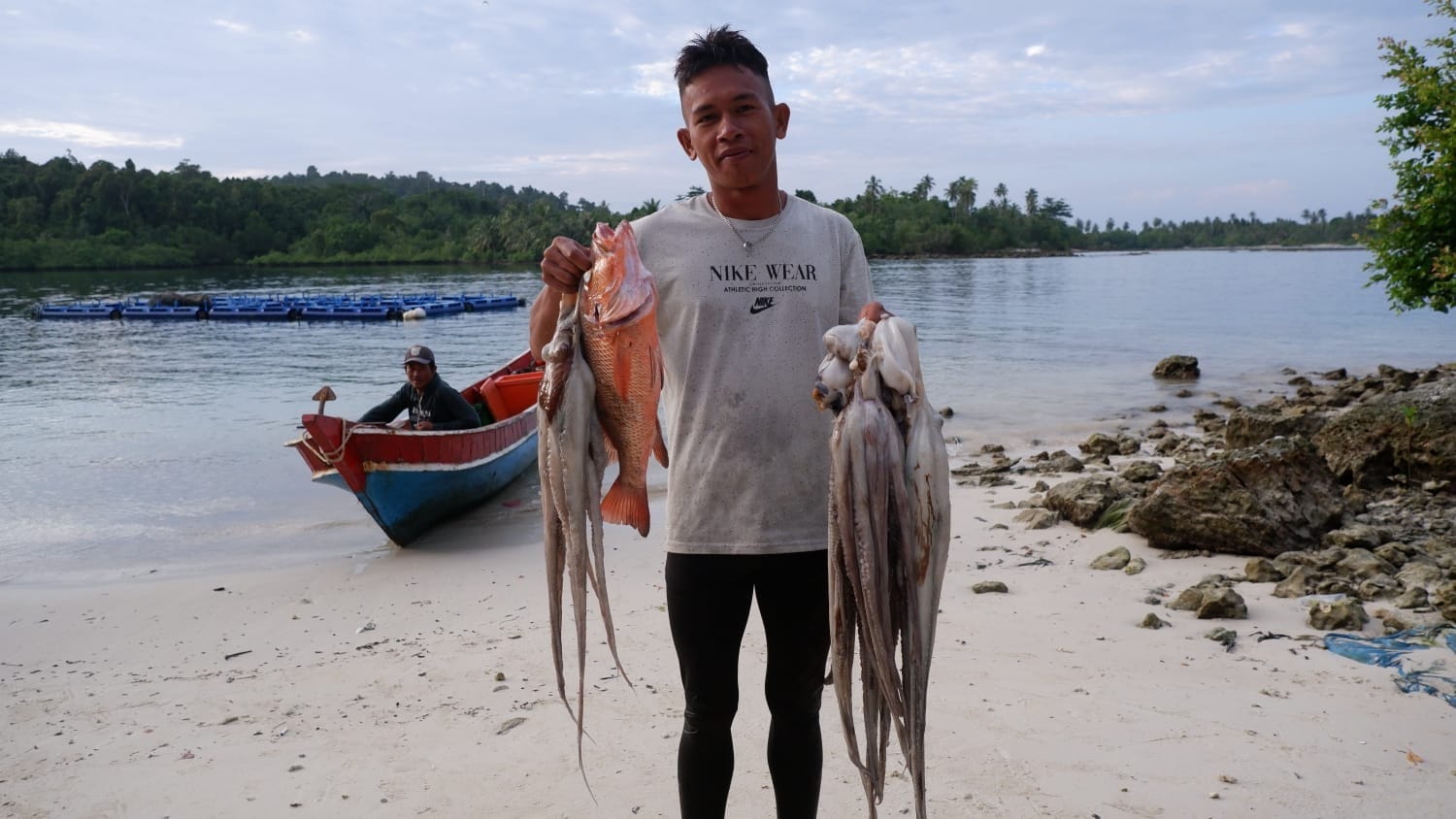
On July 8, the day after sasi was lifted, Iwan Sababalat dove into the waters off Buge Island—one of the previously closed spots—armed with a spear and line. Within half a day, he brought home 12 kilograms of large octopuses, selling his haul immediately to a buyer in Magka Baga for Rp782,000. “For half a day’s work, that’s not bad,” the 30-year-old said.
While diving, Iwan spotted many small octopuses, some of which snagged on his line. He released them back into the sea. “Let them grow big first. They’ll be for us later anyway,” he said.
He expressed surprise at finding so many sizable juvenile octopuses, noting that July is typically off-season due to rough seas brought by southerly winds. Normally between June and August, fishermen only target fish for personal consumption.
Other fishermen also landed substantial catches. Reinal, another Sinaka resident, returned with six large octopuses weighing a total of 10.5 kilograms.
“I dove near a sandbar with a spear today. There weren’t many octopuses because it’s off-season, but the ones I found were huge,” the 20-year-old said.
Selling his catch at Rp90,000 per kilogram that day, he pocketed nearly Rp1 million.
Local fishers broadly support the temporary closures. “Banning octopus catches in certain spots is good—it lets them grow and gain weight,” Reinal noted. “Though some fishermen still sneak out to catch them at night. That’s what needs to be tackled.”
Idris Maulana admitted he would prefer closing all octopus fishing grounds for six months straight, allowing only small-scale fishing for personal consumption. “I guarantee the octopus population will bounce back. I’ll propose it at the next village meeting,” Idris said.