
Cooking for the Planet
By Purwani Diyah Prabandari
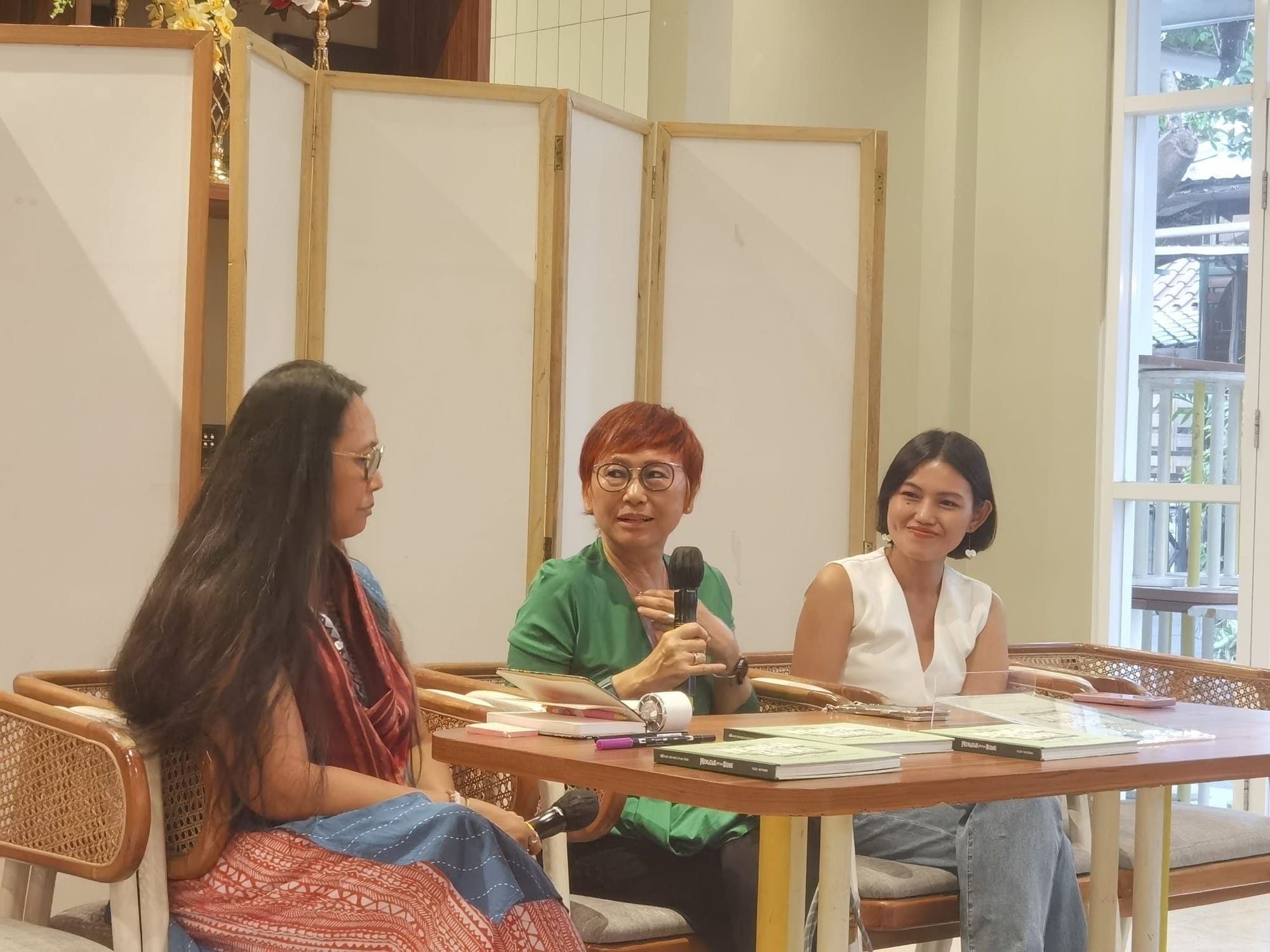
On a Saturday evening last June 6, guests gathered at Twin House in Cipete, South Jakarta. On a table sat a large platter loaded with cupcakes. After the presentation wrapped up, the platter made its rounds.
“These are made from banana peels,” said Olin Montero, the book’s editor, who served as the evening’s moderator. They were delightfully soft, light, and not overly sweet—hardly distinguishable from any other delicious cupcake.
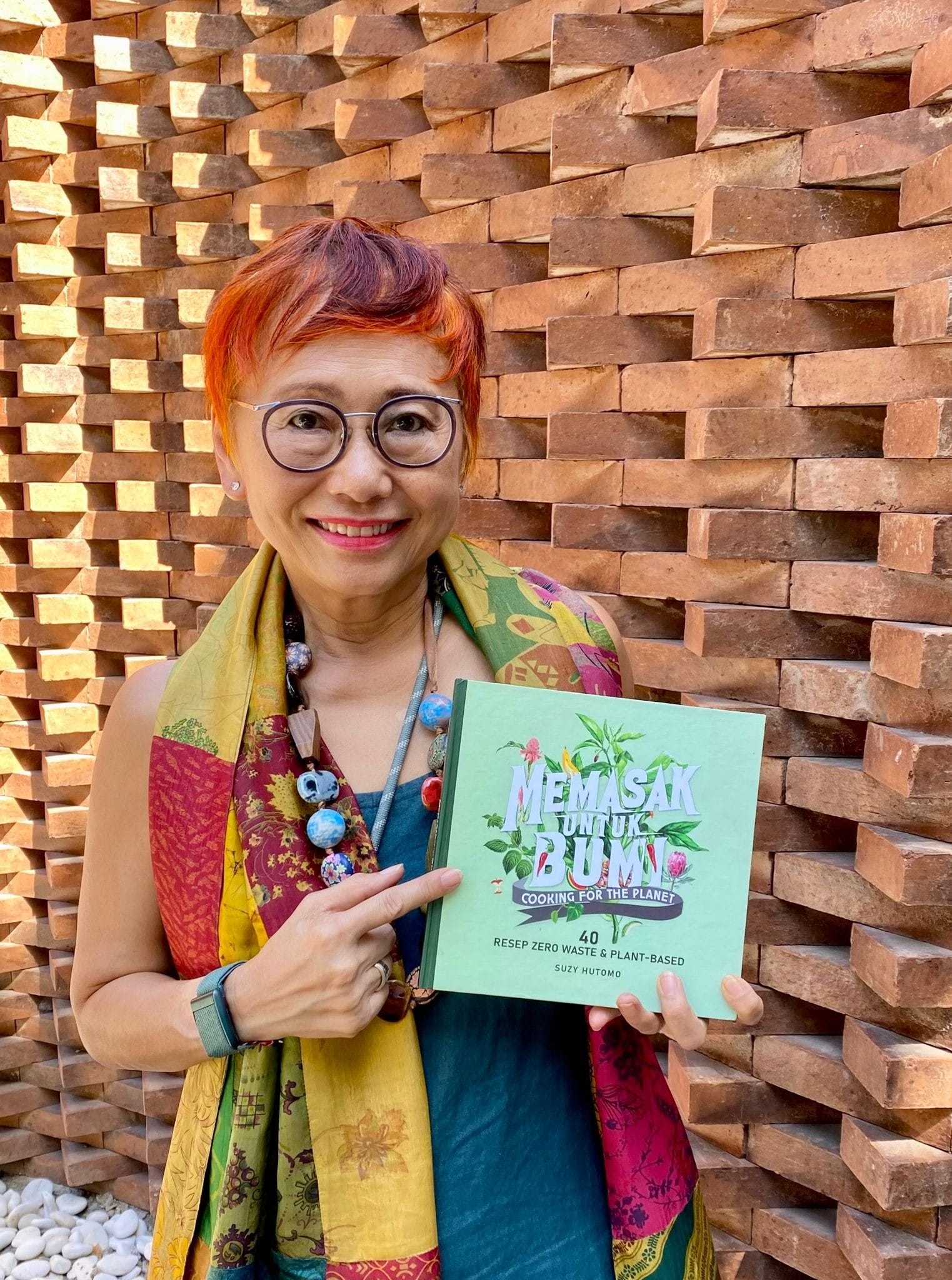
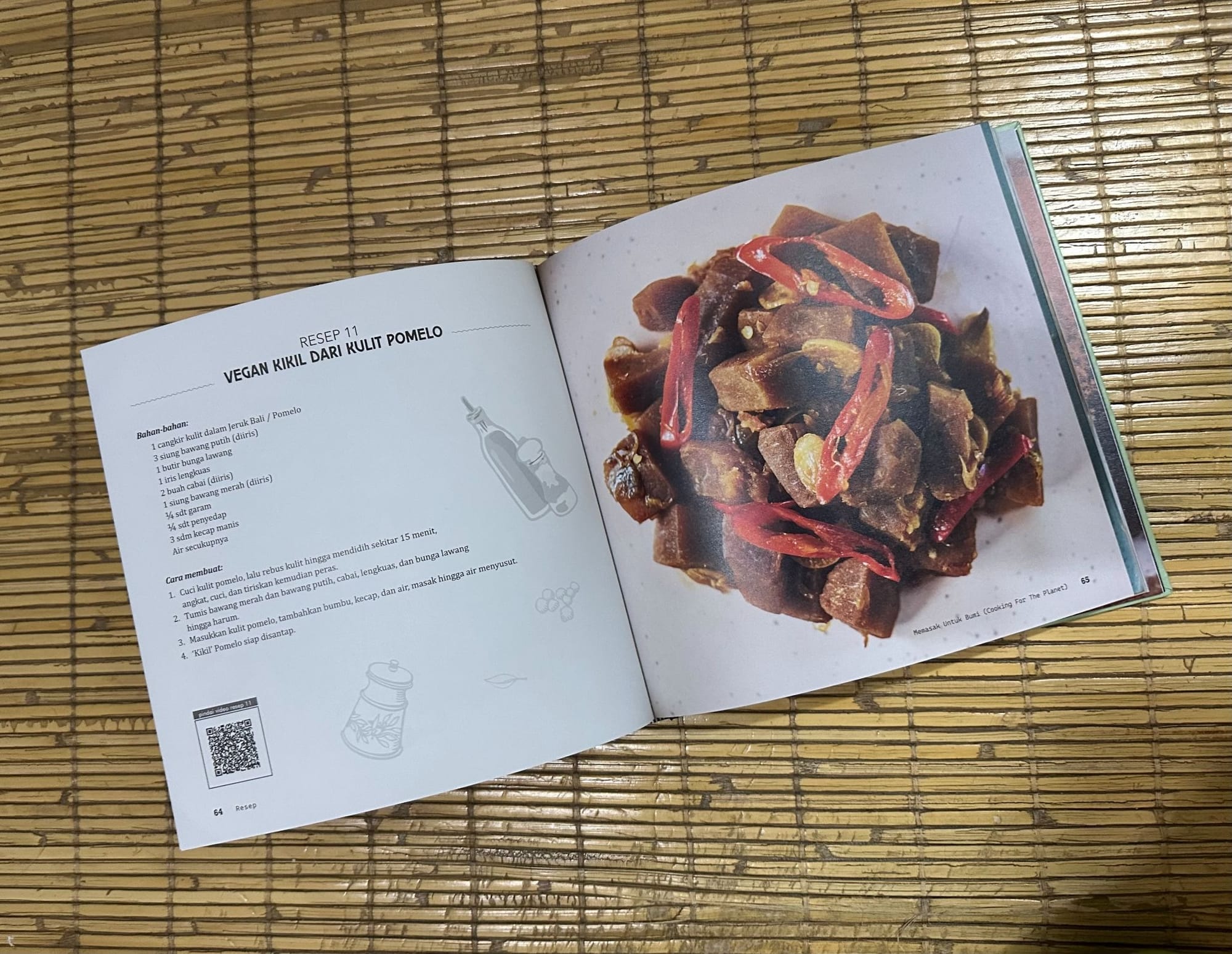
It was Suzy Hutomo who baked them. The cupcakes were an adaptation of one of the recipes featured in the book she launched that evening: Memasak untuk Bumi (Cooking for the Planet). In it, she offers 40 recipes, all centered around zero-waste and plant-based concepts. The menu includes banana peel pancakes, banana peel cilok (chewy tapioca balls), watermelon rind kimchi, watermelon rind curry, shredded jackfruit rind dendeng (jerky), spent coffee ground cake, banana blossom dendeng, pomelo rind kikil (plant-based tripe), and more.
She also lays out the core issue behind her book’s premise: saving the planet through food. She touches on everything from the environmental impact of our diets, the pervasive use of plastics and microplastics in our daily lives, and food waste, to the simple act of growing what we eat.
“When we choose what to eat, we are reminded that every dish comes with an environmental footprint,” writes Suzy, who also leads The Body Shop Indonesia. “A plate of steak isn’t just a slab of grilled meat; there’s a long, resource-heavy chain behind it.”
Her passion for green living is something she tirelessly advocates, especially through her Instagram account, @sustainable_suzy. She posts regularly on various environmental issues, including zero-waste and plant-based cooking. In one video, she shows how to make jelly out of dragon fruit peels. In others, she crafts crackers from juice pulp and alcohol-free beer from orange rinds. “Say no to food waste,” she writes.
On Monday, July 7, 2026, Purwani Diyah Prabandari from Tanahara.org caught up with the founder of Eco Tourism Bali via phone for an online interview.
What inspired you to write Cooking for the Planet?
I started practicing a green lifestyle through the easiest entry point: growing what I could eat. That habit picked up momentum during the Covid-19 pandemic. I had already been favoring organic food, so I decided to start growing my own.
The more I immersed myself in it, the more I realized that the single most impactful thing we do is choosing what we put on our plates several times a day. Every food choice carries a massive chain of environmental consequences. I’m not telling people to completely stop eating meat, but we need to be conscious of its footprint and how its carbon emissions compare to other alternatives so we can make better-informed decisions.
What worries you most about our food system today?
What concerns me most is the endless plastic packaging and the sheer volume of ultra-processed foods that are no longer natural because they're packed with chemicals. The longer and more complex the processing pipeline, the more resources are wasted. Beef, in particular, carries a massive carbon footprint, especially when imported. That’s why I included dedicated chapters in my book covering plastics and microplastics, carbon footprints, and the environmental toll of meat consumption.
Just how significant is meat consumption’s impact on the environment?
From a carbon standpoint, the disparity is stark. The resources required to produce one kilogram of beef compared to one kilogram of legumes or tempeh are worlds apart. Tempeh requires a miniscule carbon footprint, especially if made from locally sourced soybeans and fermented right here. The carbon footprint gap between beef and plant-based options can be anywhere from 30 to 50 times higher. Even eating eggs carries a drastically lower carbon footprint because distribution usually doesn't require long-distance transport.
The second factor people rarely consider is livestock feed. Cattle are fed corn and other crops that require vast amounts of water to cultivate and process into feed. The cows themselves consume enormous amounts of water. The overall water footprint of beef production is staggering. In fact, right behind palm oil, the leading driver of deforestation today—especially in South America—is land clearing for cattle ranching to supply fast-food chains in North America.
Can a low-carbon diet be adopted anywhere, even in arid, less fertile regions?
Absolutely. It all comes down to working with local context and calculating which options carry the lowest carbon footprint in that specific country. Take Yemen, for instance—what’s available locally? Milk, eggs, a few vegetables, or specific nuts. Culture or tradition with thousands of years of history have always devised their own sustainable food systems—think couscous, chickpeas, dates, or pistachios, which originally thrived in the Middle East. The options are always there.
What are the challenges?
The real hurdle is our global culture, which often equates social status with meat consumption, like the trend of dining at steakhouses. The key is leaning into locality. Just track two primary metrics: water and carbon. If local fish carries a lower carbon footprint in a given region, eat fish or chicken.
How did you come up with the idea of cooking with banana peels?
I stumbled upon some research highlighting that banana peels are packed with nutrients and can be turned into various dishes. It struck me as a two-in-one solution: it offsets eating meat or other resource-intensive foods while repurposing something that normally gets tossed in the trash. It’s a double benefit.
Did it work on your first try?
To be honest, no one wanted to eat it at first! Back then, we didn't know that you had to scrape off the inner white lining of the peel first. It turned out bitter and astringent. After digging into research online, we figured out the technique. That inner peel is actually rich in fiber, protein, and essential minerals. In the book's second edition, I plan to do deeper research to map out the exact mineral and vitamin content of various fruit and vegetable peels.
What did you end up making with it?
We experimented with meatballs first, but the texture wasn't quite right. Eventually, we settled on meatball spaghetti. It turned out delicious. In fact, many people I served it to had no idea it was made from banana peels—they assumed it was chicken because it lacked that distinct beefy aroma.
Out of all the recipes in the book, which was the trickiest to master at first?
The banana peel recipes were definitely the trickiest initially because of the learning curve in prepping them. But generally, the zero-waste recipes I included in this book aren't too difficult because I intentionally picked easy ones so that anyone could recreate them
Some of the most exciting recipes are the jackfruit rendang, jackfruit katsu, and jackfruit sate lilit. Jackfruit is incredibly versatile and tasty. We use young jackfruit for the rendang. As for mature jackfruit, you can separate the fibrous strands inside the rind and cook them into dendeng (jerky).
How often did your kitchen experiments fail?
We definitely had our share of flops. Durian seeds, for example—when cooked, they released this slimy residue and tasted awful, so they didn't make the cut. On the other hand, jackfruit seeds, when boiled and mashed, make perkedel (fritters) as a potato substitute, or you can toss them in balado chili sauce to mix things up.
You also dedicate space in your book to food waste...
Food waste has been on my radar for about five years now. We urgently need to curb it. Here in Indonesia, our food waste numbers are staggering. Part of it stems from our cultural inclination toward hospitality—when we host meals or buffets, we tend to overprepare.
What was your biggest challenge while writing the book?
Packaging the message in an engaging way. In the initial draft, the theoretical and educational sections were twice as long as the recipe section. When I showed it to my kids, they asked point-blank, "Mom, are you trying to write a textbook or a cookbook? If it’s this dense, people who aren't already passionate about sustainability aren't going to read it."
That feedback hit the nail on the head. My goal with this book was to reach people who aren't yet environmental advocates, rather than just preaching to the choir, or talking to the converted. So we revamped the format. We condensed the introductory material, loaded it with vibrant visuals and color, and expanded the recipe count to 40, complete with appetizing photography.
Is adopting a plant-based and zero-waste diet easier in Indonesia given the abundance of local produce?
Precisely. The variety here is incredible, and you don't even have to grow it yourself—you can easily buy it locally. The key is being mindful of what you buy and understanding the impact of your choices. Ask yourself: What does this plate mean for the planet, or for Indonesia? Sourcing locally means a significantly lower carbon footprint. That’s a mindset shift we all need to make as consumers.
Suzy Hutomo is no stranger to environmental activism. Watching the documentary "An Inconvenient Truth" served as a stark wake-up call that the planet was in crisis. In 2009, she attended the Climate Reality training in Melbourne, Australia, and became a certified Climate Reality presenter. She had also served on the boards of Greenpeace Southeast Asia, the Kehati Foundation, and other NGOs in Indonesia.
Her business ventures are equally aligned with green living. In 1992, she spearheaded The Body Shop Indonesia. She expanded her advocacy by establishing Sustainable Suzy in 2017 and Eco Tourism Bali in 2022.
How did your journey into environmental activism begin?
I’ve been passionate about the environment for as long as I can remember. Growing up, my family had a deep connection with nature, so that appreciation was baked in early on.
The major catalyst was studying abroad. Every time I returned home to Indonesia, my heart sank seeing the rapid environmental degradation. The forests in Puncak (Bogor Regency) were disappearing, the natural spots where I played as a child were gone, and the Ciliwung River was flooding with increasing frequency. The ecological carrying capacity of Puncak and Jakarta—where I lived—was eroding rapidly. My journey as an environmentalist grew out of that deep sense of grief and urgency.
How did you launch The Body Shop Indonesia?
It happened somewhat organically. Thanks to my time studying abroad, I was already familiar with The Body Shop brand. Years later, working at my previous job, I was tasked with finding a retail tenant for a location in Pasar Baru. I thought, "Why not reach out to The Body Shop?" since I personally loved the brand.
I wrote them a letter, and they welcomed a meeting. Their representative came out, and I pitched our company background and the site. But she paused and said, "We aren't actually looking for real estate partners; we're looking for a franchisee, someone who can keep this brand and shares our core values."
Then she looked at me and said, "Why don't you do it? You look like the right type." The opportunity landed right in my lap. I went straight home to discuss it with my husband. When I brought it up, he said, "Oh, that green shop you're always visiting?" I said, "Yes, exactly!" That’s where it all started.
What was your experience like working with The Body Shop?
Getting to know Anita Roddick (the late founder of The Body Shop, human rights advocate, and environmental activist) was transformative. She always reminded us never to shrink back from taking action, no matter how small. As Gandhi said, "Be the change." Anita loved to say, "If you think you're too small to make a difference, try sleeping with a mosquito." Walking alongside The Body Shop allowed my environmental activism to truly take root and grow. Over time, that evolved into an even greener, healthier lifestyle.
Were you not living that way before?
Well, my mother had always leaned toward a natural, healthy lifestyle. She ate mostly vegetables, raw food, and embraced a natural way of living.
Our family spent a lot of time outdoors—my parents owned a plot of land in Megamendung (Bogor, West Java) where we loved planting things—so living naturally came effortlessly. That’s why I always stress that the most vital step is fostering a sense of connection to nature. When we're connected, we intuitively spot what's unsustainable. You recognize what's harmful because you know what a healthy ecosystem looks like—one where everything thrives and supports each other.
So the definition of "good" encompasses both human health and planetary health?
Exactly—good for you, good for the planet.
Suzy Hutomo steps out of her car and walks into her open, spacious home, phone in hand. As she walks, she occasionally points her camera at various household items that showcase her daily green practices. "This bag is made from upcycled plastic packaging," she notes.
Heading into the backyard, she points out fruit trees—mango, jackfruit, and avocado. She then walks through her edible garden, featuring spinach, basil, pandan, chilies, sweet basil, lamtoro, and sesbania flowers. "This one is the absolute best. Extremely high in antioxidants and delicious," she says, zooming in on Japanese papaya leaves (Cnidoscolus aconitifolius).
Turning to another corner of the yard, she shows off her large composting setup. "We’ve been sorting our waste at home for about 10 years now," she explains.
What does green living look like in Suzy’s daily routine?
I’ve been driving electric vehicles for a long time. Today, we have an EV and a hybrid. I also installed solar panels 13 years ago that cover roughly 50 percent of my household’s electricity needs.
During the Covid-19 pandemic, I converted my ornamental landscape into an edible garden using pots with a minimum diameter of 30 centimeters. I grow eggplants, bird's eye chilies, kemangi, pandan, aloe vera, spinach, basil, Japanese papaya leaves, lamtoro, and sesbania flowers—perfect for making pecel. This garden supplies about 10 to 20 percent of our household produce.
Anything else?
We've also been sorting waste for over a decade. Organic waste goes into our on-site composter, recyclable materials are collected by Eco Bali, leaving us with a residual waste output of just 10 to 15 percent.
On top of that, I follow a strict "buy-nothing-new" rule whenever possible. Whether it's dull knives, worn shoes, or clothes that no longer fit, I always take them to local repair shops or tailors instead of throwing them away. I also avoid polyester clothing because it's essentially plastic, opting instead for natural cotton or linen that can safely biodegrade at the end of its lifecycle.
Do you have any personal green living goals or dreams you're still working toward?
Personally, I really long for green travel. Having Zoom helps, but it’s still tough to reduce carbon emissions. Every year, my family and I plant around 250 mangrove trees—at least to offset our carbon footprint. So, by my calculations, we’ve got it covered. Still, I really hope to see green travel become a reality.
Beyond that, my goal is to promote sustainable tourism in Bali. It should be easy for travelers who want to travel green to do so, allowing them to enjoy their trips while leaving a positive impact, perhaps by planting trees along the way. Travel should bring happiness, not sadness.