From Circular Economy to Waste-to-Energy Innovations
By Eko Widianto
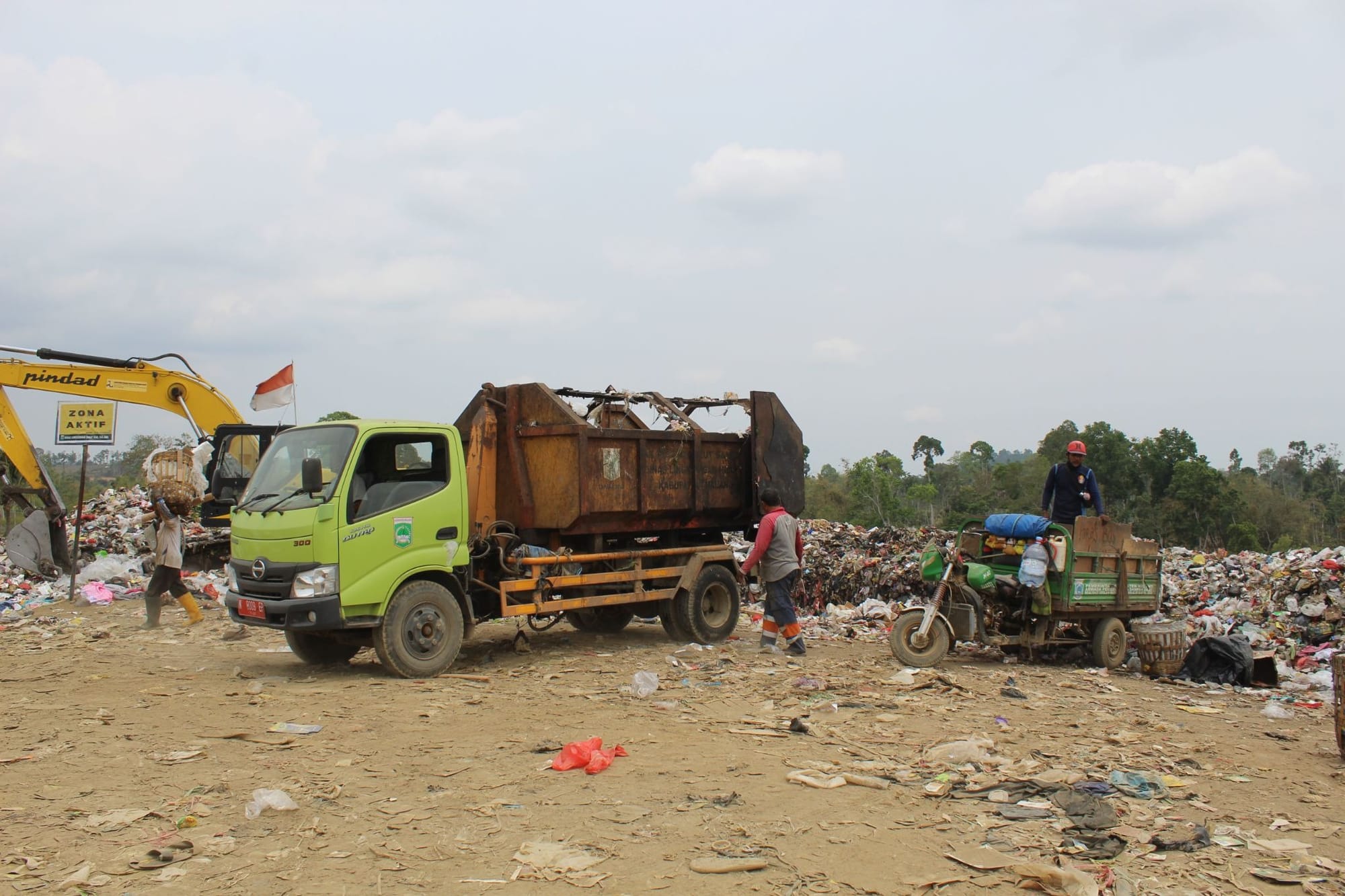
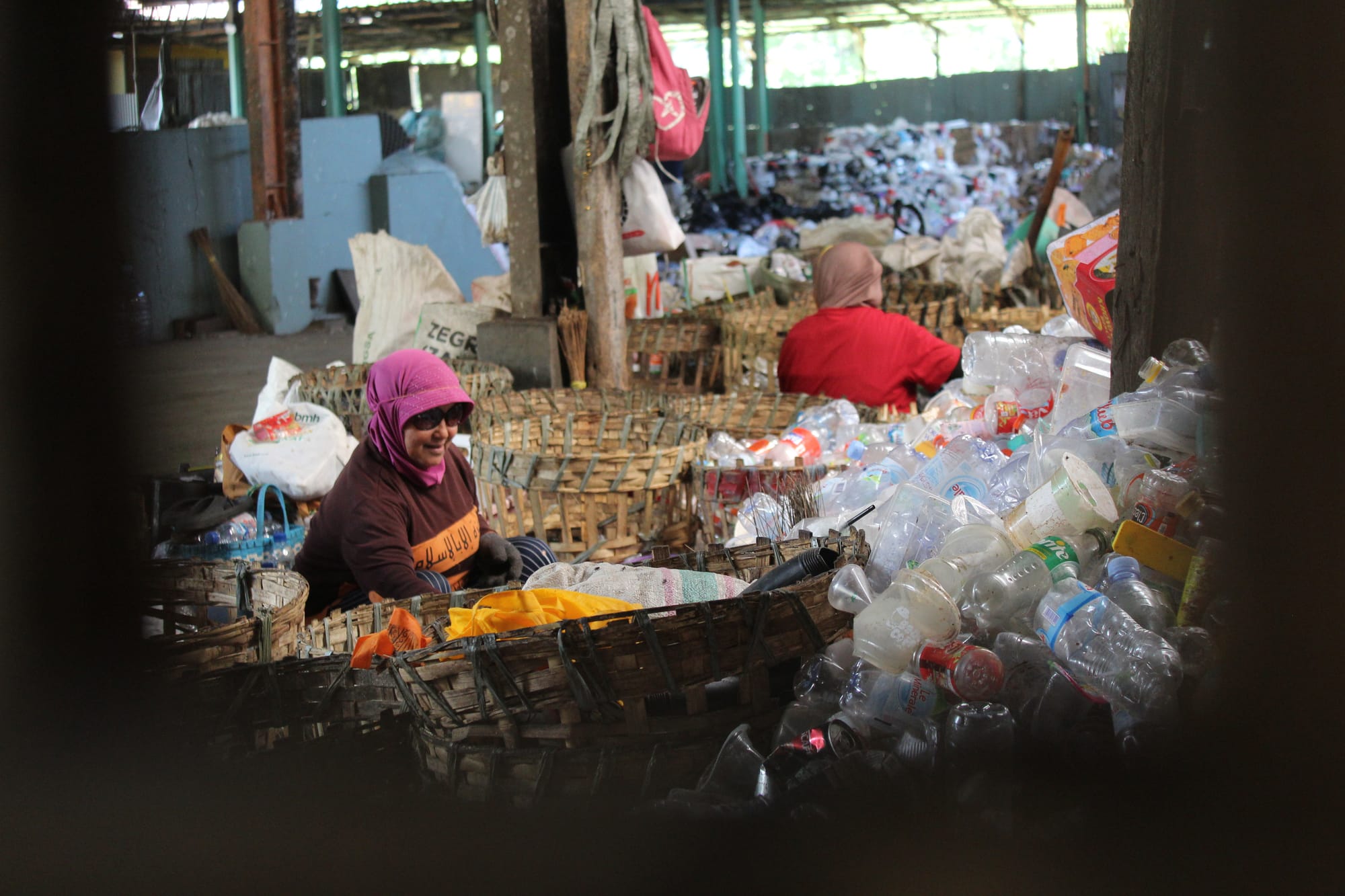
TRUCKS loaded with trash streamed continuously in and out of the Paras Final Processing Site (TPA) in Poncokusumo, Malang Regency, East Java, on Thursday, October 8, 2026. Dozens of waste pickers sorted through towering mounds of refuse, searching for economically valuable inorganic waste. Between the heaps, they had built semi-permanent structures to organize the materials they gathered. The facility operates as a controlled landfill, a system that compresses waste and covers it periodically with soil layers.
With a population of 2,755,440, Malang Regency generates approximately 1,100 to 1,500 metric tons of trash every day. Apart from Paras, municipal waste ends up at the Talangagung and Randuagung landfills, each processing roughly 750 metric tons daily. "On average, each person produces half a kilogram of waste per day," said Ahmad Dzulfikar Nurrahman, Head of the Malang Regency Environmental Office, on Wednesday, October 7, 2026.
The agency is currently mapping waste generation, collection point (TPS) infrastructure, and waste management practices across 390 villages in Malang Regency. The resulting database will serve as the foundation for policy decisions. "By early next year, we must have precise, rigid data," Nurrahman, who is commonly called Avi, said.
To improve overall governance, Avi is advocating for waste sorting right at the source: in households. While the Environmental Office works on infrastructure, institutional frameworks, and regulations, it is also urging village administrations to enact local village regulations (Perdes) on waste management.
"Part of our campaign focuses on changing community behavior so people sort and process their waste independently," Avi explained.
The education initiative includes providing different bins, designated bins for organic and inorganic waste, alongside specialized collection fleets to haul sorted trash. Organic waste is directed to processing facilities to be converted into livestock feed and compost.
THE Malang Regency Government is executing a range of measures to tackle its waste problems. The Alliance to End Plastic Waste (AEPW) provided a $1 million grant through its Bersih Indonesia (Clean Indonesia) Program.
To streamline operations, the regency government established a Regional Public Service Agency (BLUD) for Waste Management in Paras, Poncokusumo. According to Avi, the BLUD status provides business flexibility, allowing the entity to handle its own operations independently without waiting for bureaucratic approvals.
Meanwhile, the government can offer financial support through the Regional Budget (APBD), giving the BLUD a foundation to build a self-sustaining business model. "The goal is for the agency to become financially self-sufficient rather than relying on government funding," Avi noted.
Additionally, environmental cadres have been deployed for door-to-door public education, teaching residents how to segregate waste and apply waste management principles. The BLUD aims to serve 20,000 households.
Beyond education, cadres provide monitoring and mentoring to keep the processing ecosystem running smoothly. "Over the past year, we have served roughly 6,000 households," Avi added.
The Bersih Indonesia Program reduces approximately 300 metric tons of waste daily. Built on green funding principles, the grant directly funds waste processing infrastructure. The Paras Waste Management BLUD maintains the entire system—from infrastructure development and household collection services to extraction, sorting, and sales of recyclable materials such as plastics, metals, glass, and paper.
So far, the program has cleared 31 informal dumpsites and diverted 13,500 metric tons of unmanaged waste to the Paras TPA. "If we don't establish a waste-sorting ecosystem soon, our rivers and mountains will suffer. Unmanaged waste inevitably flows into our waterways," Avi warned.
The BLUD and local Reduce-Reuse-Recycle Waste Processing Facilities (TPS3R) form a critical defense line to reduce the volume of residual waste sent to landfills. Residual waste can be converted into Refuse Derived Fuel (RDF), which serves as an alternative fuel or co-firing material to replace coal in cement factories and coal-fired power plants (PLTU).
Building on this progress, AEPW is continuing its support through the Solid Waste Management for Sustainable Urban Development (SWM-SUD) Program. The Malang Regency Environmental Office is working alongside the Ministry of Public Works and Housing to compile planning documents, including feasibility studies, readiness criteria (RC), and detailed engineering designs (DED).
Avi explained that AEPW’s involvement strengthens long-term sustainability, while his team provides technical assistance on the ground. The SWM-SUD initiative, scheduled for launch next year with an $18.5 million grant, will construct four major facilities.
"Operations are planned to begin in 2028, with facilities built in Talangagung and Paras, along with two transfer stations in Jabung and Pakisaji," Avi said.
DUE to the heavy volume of waste produced across Greater Malang (Malang City, Malang Regency, and Batu City), Danantara has expressed interest in constructing a waste-to-energy power plant (PLTSa), or a waste-to-electricity facility (PSEL) in the region. Daily waste production reaches 1,200 metric tons in Malang Regency, 800 metric tons in Malang City, and 200 metric tons in Batu City.
A suitable PSEL site requires specific technical conditions, including an adequate water supply, a safe distance from residential areas, and easy access for waste haulers from all three municipalities. The Malang Environmental Office carried out multiple location searches to meet these requirements.
An initial proposal in the Tumpang area was canceled because the site fell within the Operational Safety Zone (KKOP) for landing and takeoff routes at Abdulrachman Saleh Air Force Base and Airport. Authorities feared facility operations could interfere with aviation safety, particularly military flights.
A second site in Bululawang was rejected due to its proximity to residential areas and strong opposition from local residents. "Local residents objected out of concern over negative impacts like air pollution," Avi said.
A third location in Pakisaji was scrapped because it sat adjacent to an industrial park, raising potential land-use conflicts.
Eventually, authorities selected a site in Wagir near Malang City's Supit Urang TPA. The location is strategic, sitting close to the borders of both Malang City and Batu City.
Processing 1,000 metric tons of waste daily requires roughly 250 truck trips, assuming four metric tons per truckload. However, the location of the Supit Urang site is not ideal, necessitating a new bridge. With the deadline to select a location fast approaching, bridge construction considerations led to a deadlock that remains unresolved.
Technologically, Avi said that turning waste into electricity can be done without damaging the environment or human health, as incineration emissions can be treated with advanced filtration systems. Technologies under consideration include wedge grabbers to feed waste into furnaces, plasma gasification, and electrostatic precipitation filters. Gas filtration systems are widely used across Europe for waste-to-energy projects.
“Then there are those using air filters to curb exhaust emissions. The higher the tech, the more complex the maintenance—and the better the outcome, for sure,” Avi said.
Organic waste will not be burned; instead, recommendations call for processing it into animal feed or synthetic briquettes. Currently, the primary focus remains on building a sorting ecosystem at the household level through the Bersih Indonesia program—combining infrastructure development, community education, and processing at landfills.
EVERY morning at the Mulyoagung TPS3R facility in Dau, Malang Regency, dozens of workers sort piles of trash inside a specialized hangar. They separate organic and inorganic items into distinct categories. Pickup trucks move in and out, delivering waste collected directly from homes.
Operating since 2008, the facility originally dumped waste along the banks of the Brantas River watershed. Heavy rains caused landslips that pushed waste straight into the river, prompting the Environmental Office to ban illegal dumping and mandate formal processing.
"We were warned that if we didn't process the waste, we would be reported to the police for polluting the Brantas River," said Nugraha Wijayanto, Chairperson of the Mulyoagung TPS3R Self-Reliance Community Group (KSM).
Today, the Mulyoagung facility serves 4,810 households and 176 businesses, including cafes, restaurants, recreational parks, hotels, caterers, and boarding houses. Generating an average of 30 metric tons of trash per day, the facility processes 80 percent of the residents’ waste. "The remaining 20 percent—about six tons of residual waste—is transported to the Talangagung TPA," Nugraha explained.
Using eight pickup trucks and two dump trucks for collection, the facility converts organic waste into multiple products. Leaves are composted, while food scraps are fed to maggot larvae, ducks, and pigs. Fruit and vegetable waste alone accounts for five to six metric tons daily. Every day, 70 plastic bags (roughly 750 kilograms) of food waste are supplied to eight local duck and pig farmers, while compost is sold to nearby residents.
Excess food and produce waste are also fed into a 650-liter biodigester reactor mixed with molasses to capture methane gas. The resulting methane powers stoves for up to 4.5 hours at temperatures around 200 degrees Celsius.
Nugraha is also developing eco-enzymes from fruit and vegetable scraps, adding foam boosters and fragrances to create liquid organic fertilizers, liquid soaps, and bar soaps. While currently used internally by staff and distributed free of charge to local mosques, broader commercialization remains on hold.
"Our soap passed antibacterial tests, but it lacks a license from the Food and Drug Authority (BPOM), so we cannot sell it commercially yet," Nugraha said.
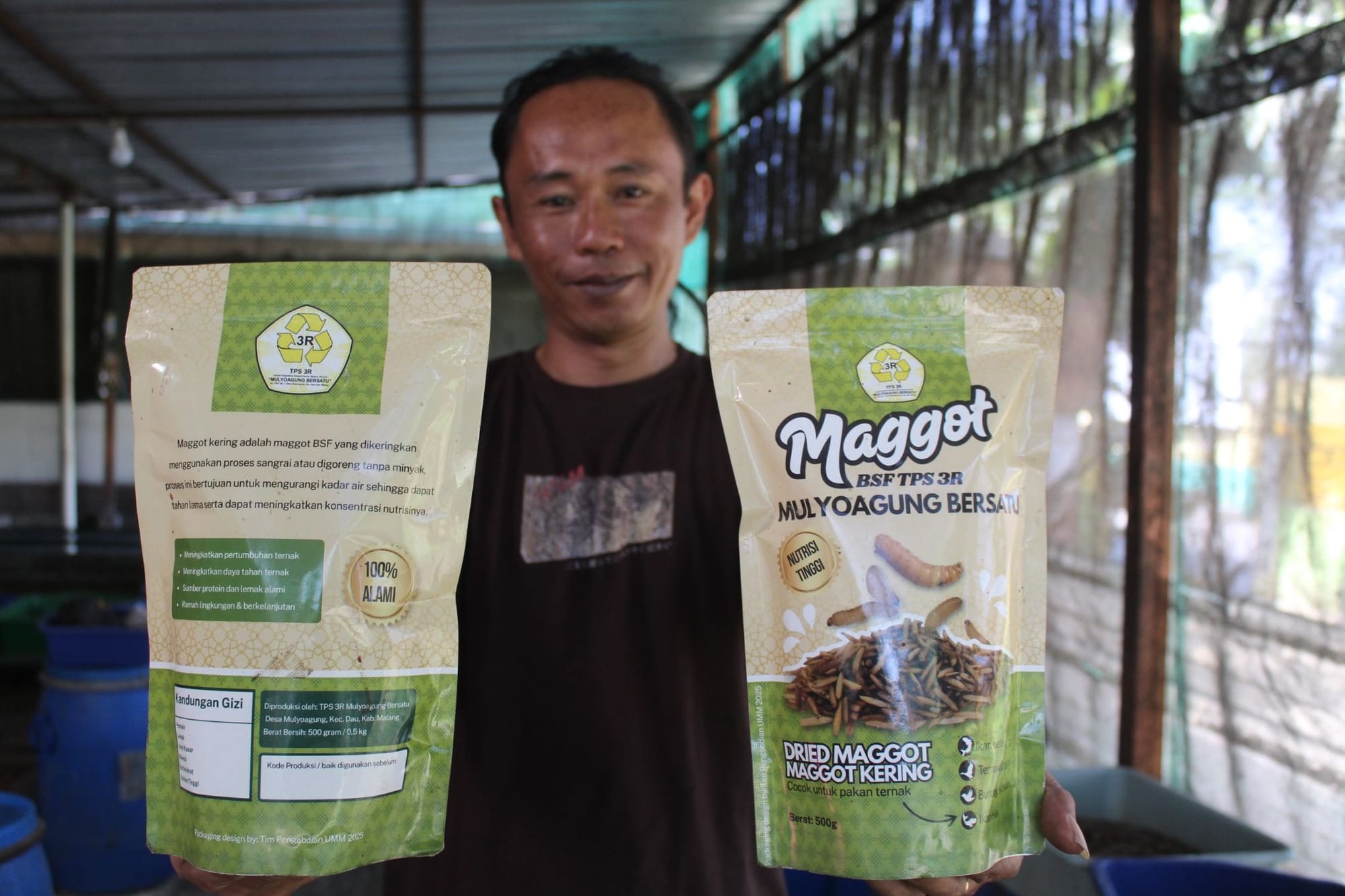
In another integrated loop, food waste feeds Black Soldier Fly (BSF) larvae, also known as maggots. The maggots are processed into fish feed pellets and sold commercially. Because the larvae have a short life cycle of about five days before becoming flies, they are dried to extend their shelf life to six months for livestock feed.
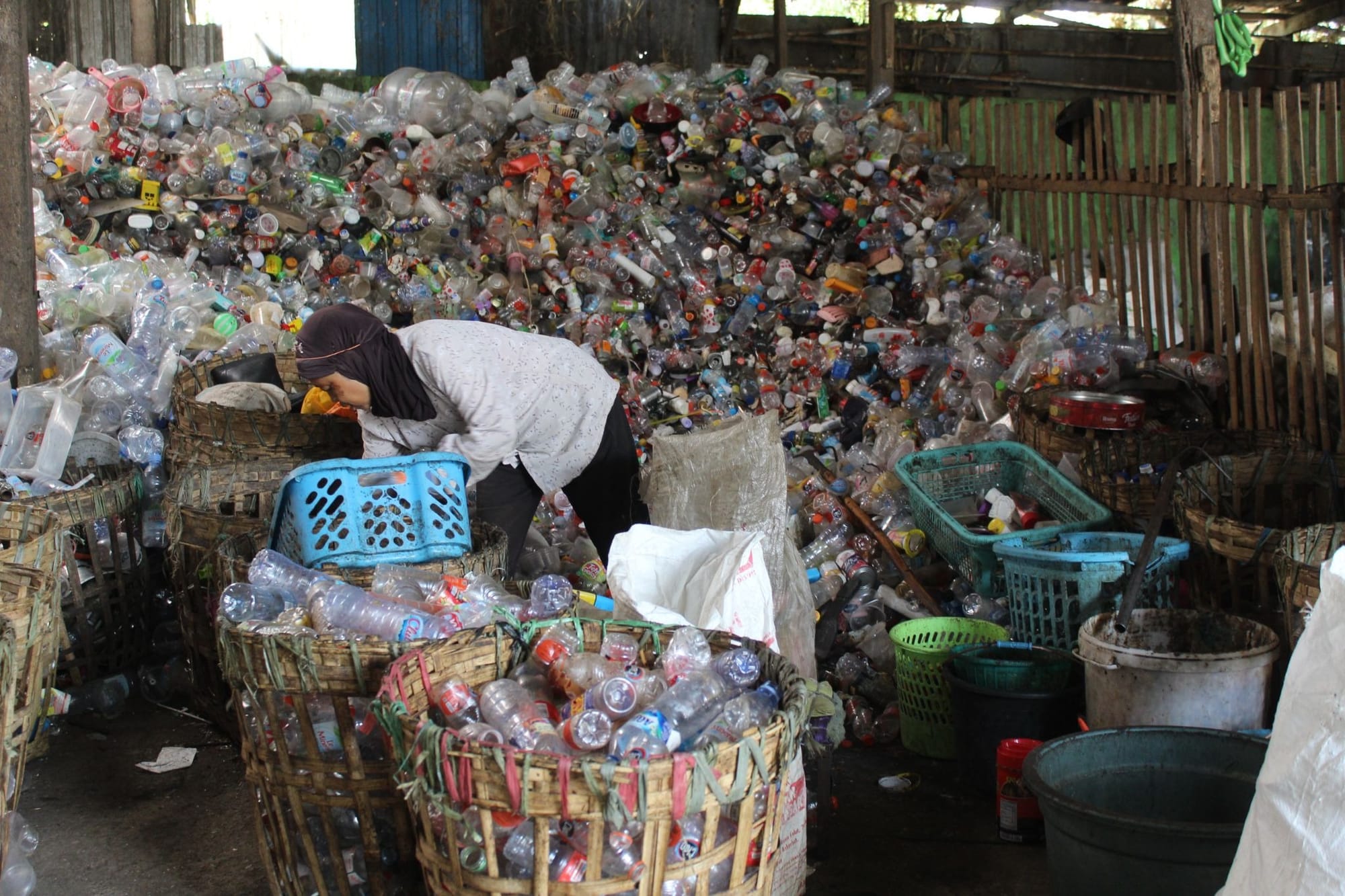
Meanwhile, inorganic waste—including plastic bags, bottles, styrofoam, tetra pak cartons, electronics, glass, and ceramics—is sorted, packed, and sold to recycling companies.
The facility is currently testing a pyrolysis unit provided by a university in Malang to convert low-value multilayer plastic waste into diesel-equivalent fuel. Though still in development, the system is nearly 80 percent complete and aims to reduce multilayer plastic residue from 20 percent down to 15 percent. However, testing is temporarily paused while searching for cheaper fuel alternatives, as using LPG for pyrolysis currently offsets the economic value of the diesel produced.
To tackle the remaining 20 percent residue—comprising coconut shells, rigid mica plastic, multilayer plastic, paper cups, and spoon bones—Nugraha is partnering with universities. Coconut husks and shells, which account for four percent of the residue, are being turned into cocopeat growing medium and charcoal briquettes.
The Mulyoagung TPS3R generates an average monthly revenue of Rp200 million (US$12,800), with 60 percent coming from customer collection fees and 40 percent from the waste processing. Operating independently, the facility employs 56 workers, including school dropouts, elderly residents, and low-income community members.
Drawing on his banking background, Wijayanto digitized the facility's administrative and financial management systems three years ago. Digital tracking for fee collection and employee attendance has much decreased financial leaks and fraud. The custom software was funded through a university community outreach grant.
The facility also doubles as an educational destination, hosting elementary and middle school field trips to teach students waste sorting, composting, and eco-enzyme soap making. “Educating people to manage waste from an early age,” Nugraha said.
ALAIKA Rahmatullah, spokesperson for Ecological Observation and Wetlands Conservation (ECOTON), is urging the Malang Regency Government to pass local regulations mandating extended producer responsibility for packaging waste.
Under Ministry of Environment and Forestry Regulation No. 75/2019 on the Waste Reduction Roadmap by Producers and Law No. 18/2008 on Waste Management, manufacturers are required to take back packaging waste and submit reduction roadmaps.
“Producers must make a waste reduction roadmap document. Producers who violate this will be subject to production suspension and other administrative sanctions," Alaika said. Thus, through the Regional Regulation on Waste Reduction, the Malang Regency Government has a tool to put pressure on producers.
A year ago, ECOTON conducted a survey of the Brantas River watershed. The findings revealed that the Brantas River had turned into a giant garbage dump. Plastic waste—ranging from small sachets to plastic bottles—had piled up all the way to the Sutami Dam, Karangkates, and Sumberpucung in Malang Regency. The brand audit results identified five major manufacturers, starting with Wings, Unilever, Orang Tua Group, Mayora, and Torabika Eka Semesta.
Roughly 75 percent of the recovered waste consisted of multilayer plastic packaging from single-use sachets and snacks. Multilayer plastics are notoriously difficult to recycle, requiring complex technology and high operational costs. Producers, he said, must take responsibility for collecting waste, building washing facilities. “Producers are also demanded to redesign packaging to be recyclable," Alaika emphasized.
Data from the 2022 National River Expedition ranked the Brantas River as the most microplastic-polluted river in Indonesia, with contamination levels reaching 636 particles per 100 liters of water across 14 regencies and cities in East Java.
Rachmad Kristiono Dwi Susilo, an environmental sociologist at the University of Muhammadiyah Malang, echoed the call for stronger enforcement mechanisms to hold corporations accountable.
"There must be a clear system of rewards and punishments," Susilo said, noting that without firm enforcement, waste generation will continue to surge. He stressed the importance of policy monitoring, acknowledging that environmental issues are often viewed as politically unpopular among local leaders.
Susilo pointed out that collective awareness alone is not enough and takes time to build. Citing Japan's waste management model, he noted that compliance relies on clear regulations. The government establishes a waste collection scheduling system. “When studying in Pajan, we couldn’t just throw away trash recklessly,” he said.
The government also provides automated recycling facilities at supermarkets that reward citizens with shopping vouchers.
Susilo said Indonesia can replicate this model. “The state must be strong and solid. Both in policy and execution,” said Rachmat.