The Hidden Threat Behind High-Sugar Packaged Drinks
By Hanindito Arief Buwono
INSTANT coffee, packaged tea, soft drinks, and isotonic beverages have long been marketed as refreshing, healthy, and convenient choices to consume anywhere, anytime. With their sweet taste, these products are perceived as effective thirst-quenchers enjoyed by people of all ages. Yet beneath that indulgent sweetness lies a quiet health threat lurking right under our noses.
A single can of soda can pack up to ten teaspoons of sugar—enough to deliver a drastic calorie spike to the body. Unsurprisingly, obesity rates in Indonesia have tripled over the past two decades. Beyond obesity, Indonesia also records millions of adults living with diabetes.
The government is not entirely without efforts to stave off non-communicable diseases like diabetes. An excise tax on sugar-sweetened beverages (SSBs) is one such measure. Regrettably, its rollout keeps getting delayed. Since 2016, the Ministry of Finance has pledged to impose an SSB tax to curb high-sugar drink consumption. To date, however, that commitment remains unfulfilled under the pretext of ongoing economic instability.
Ari Subagyo Wibowo, Chairman of the Indonesian City Citizens Forum (FAKTA), argues that these repeated postponements highlight the government's weak commitment to public health. Through an SSB excise tax, he emphasizes, the government ought to protect the public from the harmful impact of excessive sugar consumption.
What Are Sugar-Sweetened Beverages?
According to the U.S. Centers for Disease Control and Prevention (CDC), sugar-sweetened beverages (SSBs) encompass all types of drinks containing added sugars in various forms. Added sugars include granulated table sugar, syrups, honey, as well as concentrated fruit or vegetable juices.
Examples of packaged sugar-sweetened beverages include, but are not limited to:
- Regular soft drinks
- Fruit-flavored drinks
- Sports drinks
- Energy drinks
- Sweetened waters
- Coffee and tea beverages with added sugars
The American Diabetes Association explains that SSB consumption spikes blood glucose levels and contributes hundreds of calories in just a single serving. For instance, a standard 12-ounce can of regular soda contains roughly 150 calories and 40 grams of sugar—the equivalent of 10 teaspoons of sugar.
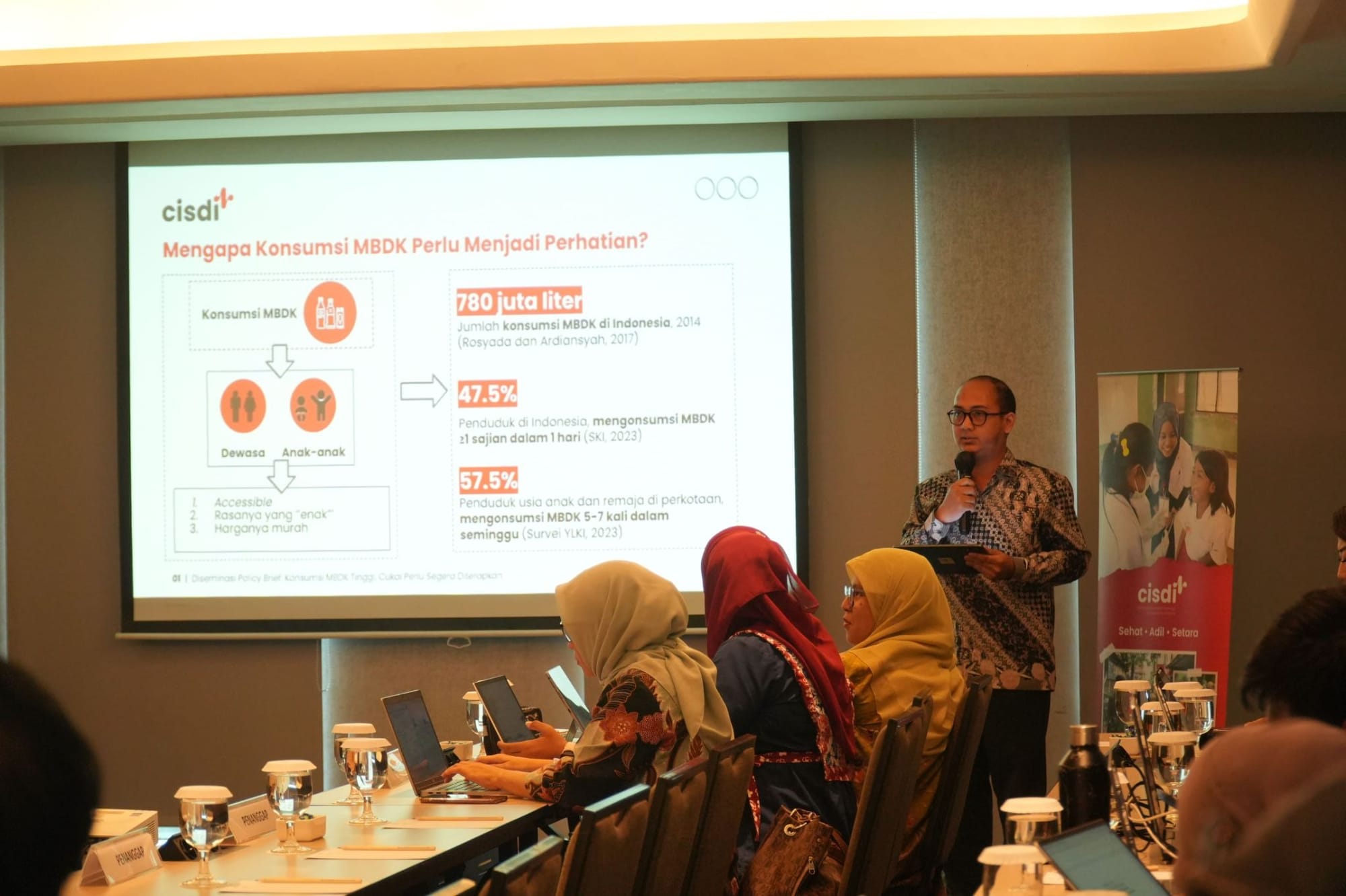
In Indonesia, data from the 2024 National Socio-Economic Survey (Susenas) reveals that 68.1 percent of households consume at least one type of SSB every week. By category, instant coffee ranks as the most popular SSB product among households (42.0 percent), followed by packaged tea; carbonated soft drinks (22.9 percent); sweetened condensed milk (20.3 percent); packaged fruit juice, health drinks, and energy drinks (18.8 percent); and commercial liquid milk (9.6 percent).
Why Is Consuming Sugar-Sweetened Beverages Dangerous?
A study released by UNICEF highlights that Indonesia is experiencing a sharp surge in overweight and obesity cases—a primary risk factor for non-communicable diseases (NCDs). The rising prevalence of NCDs, obesity, and overweight conditions in Indonesia is largely driven by a shift in consumer habits toward food and beverage products high in sugar, salt, and fat.
UNICEF's research aligns with findings from the 2023 Indonesian Health Survey (SKI), which shows that the proportion of obese Indonesians has tripled in two decades. In 2007, 10.5 percent of the population was classified as obese; by 2023, that number surged to 36.8 percent. Furthermore, 2025 data from the International Diabetes Federation (IDF) ranks Indonesia fifth globally in adult diabetes cases, standing at 20.4 million people.
The spike in non-communicable diseases tied to high-sugar drink consumption also imposes a staggering fiscal burden. In 2024 alone, primary and referral healthcare costs for managing diabetes and hypertension covered by BPJS Kesehatan reached Rp35.3 trillion ($2.3 billion).
The Case for an Immediate SSB Excise Tax
The government faces a major piece of unfinished business as plans to introduce an SSB tax have languished for nearly a decade. Yet 2022 research by the Center for Indonesia's Strategic Development Initiatives (CISDI) demonstrates that raising prices on sugar-sweetened beverages is an effective lever to drive down public sugar intake.
In that study, CISDI analyzed seven SSB categories—commercial liquid milk, sweetened condensed milk, packaged tea drinks, carbonated soft drinks, packaged fruit juices, health drinks, and energy drinks—to estimate potential state revenue. The findings showed that an SSB tax policy could generate up to Rp3.6 trillion ($235 million) in state revenue.
Moreover, a 2024 modeling study by CISDI indicated that an SSB excise policy could prevent up to 3.1 million cumulative diabetes cases over a decade. Concurrently, the policy has the potential to save up to Rp40.6 trillion ($2.6 billion) in economic costs associated with diabetes treatment.
An excise tax on sugar-sweetened beverages could also serve as a policy mechanism to boost state revenue targets this year—particularly after last year's tax collection fell short. Total tax revenue in 2025 reached only 87.6 percent, or Rp1,917.6 trillion (US$125 billion), against the State Budget target of Rp2,189.3 trillion (US$143 billion). Fauzi Amro, Vice Chair of House Commission XI, noted that implementing an SSB excise tax could yield Rp7 trillion to Rp8 trillion ($455–520 million) in state revenue.
Given its dual benefits of safeguarding public health and bolstering state coffers, there is little justification for the government to stall the SSB excise tax any longer. Every further delay jeopardizes the long-term health of the public while compounding the financial strain of managing non-communicable diseases.
The original article was published on cisdi.org on March 31, 2026
CISDI has published a policy brief encouraging and supporting the government to implement the SSB excise tax without delay. Read the full study via this link.