Gayo Coffee Drops Under Climate Strain
By Dody Hidayat
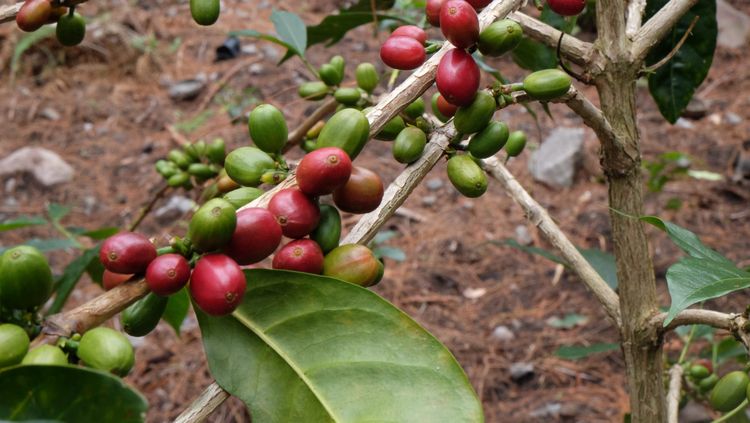
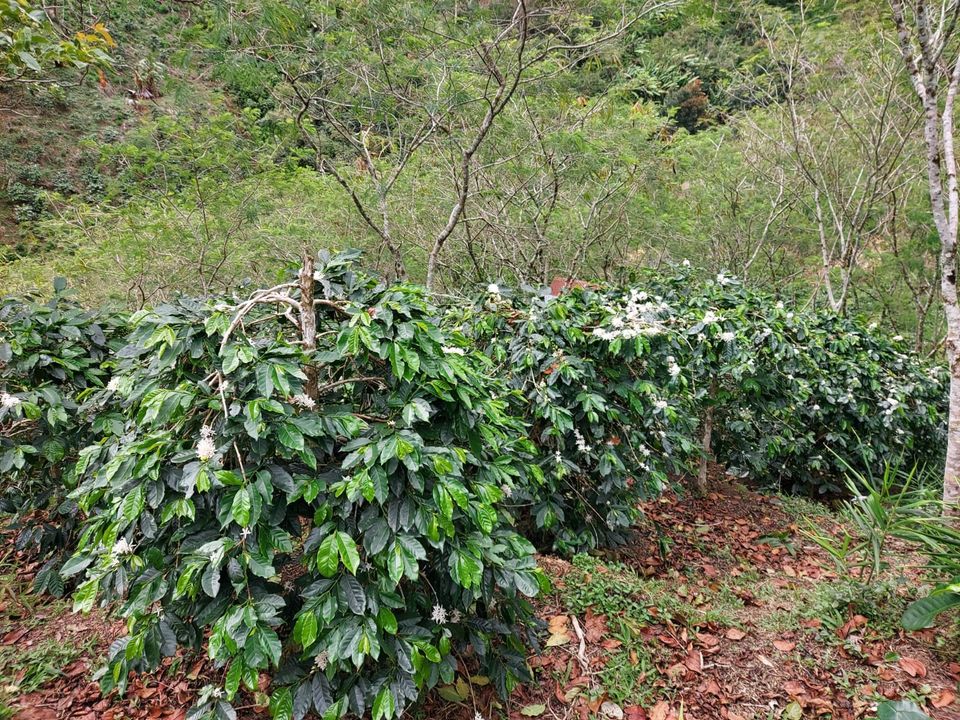
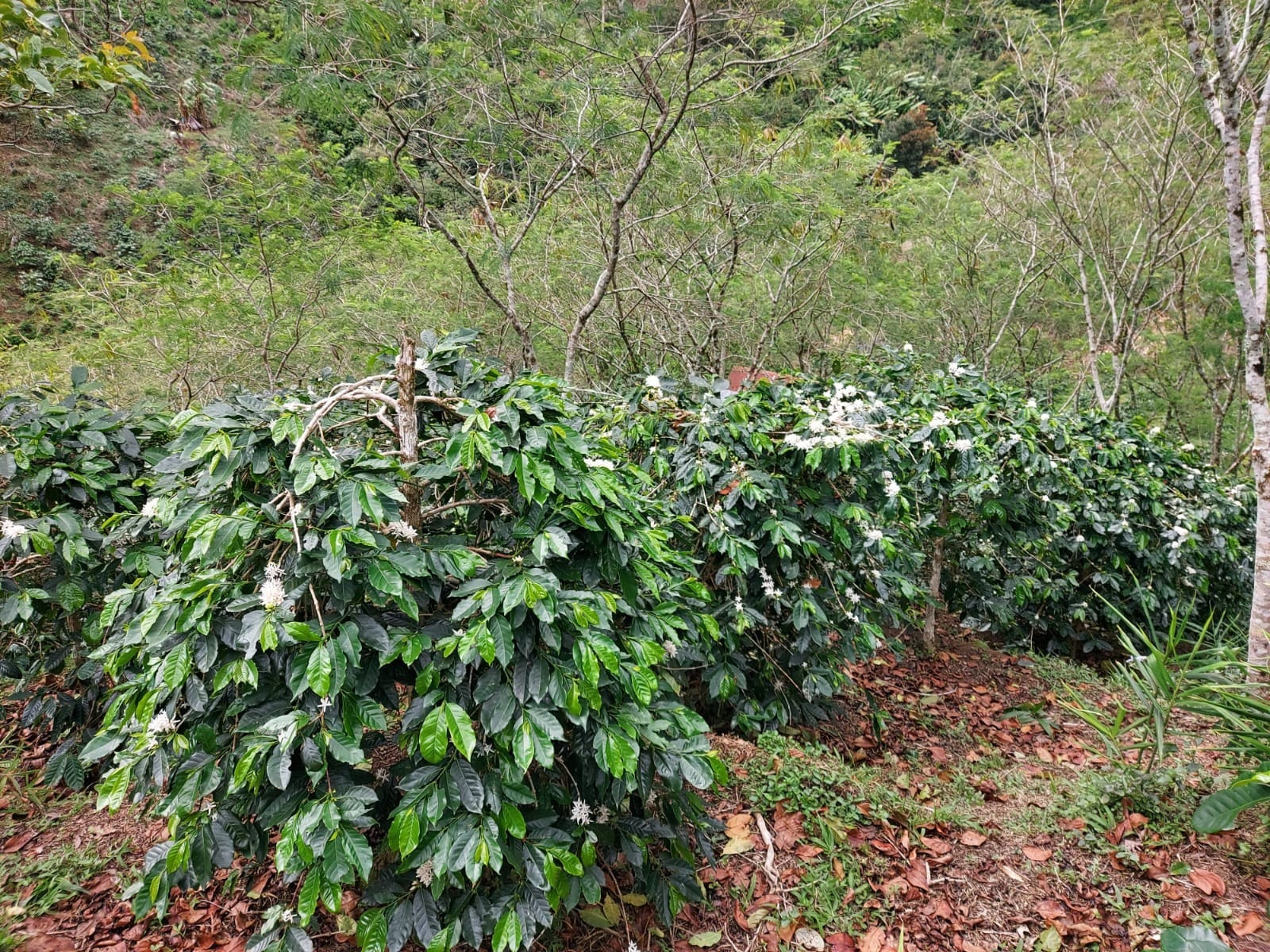
A cloud of anxiety hung over Nanar Hamdani Isra as he surveyed his coffee farm. The delicate white blossoms of Arabica coffee trees, which had been blooming since April, were dropping in droves.
Comparing them to the abundant blooms of the previous year, the 52-year-old farmer could already foresee a steep decline in yield during the upcoming peak harvest season, expected around December or January 2027, across his farm in Tingkem Asli Village, Bukit Subdistrict, Bener Meriah Regency, Aceh.
"The blooms aren't nearly as lush as last year’s. Even though we had floods and landslides back then, the flowering was good," Hamdani said when contacted on Monday, July 13, 2026. "Now, rain is still heavy when it should already be the dry season. This is likely climate change in action."
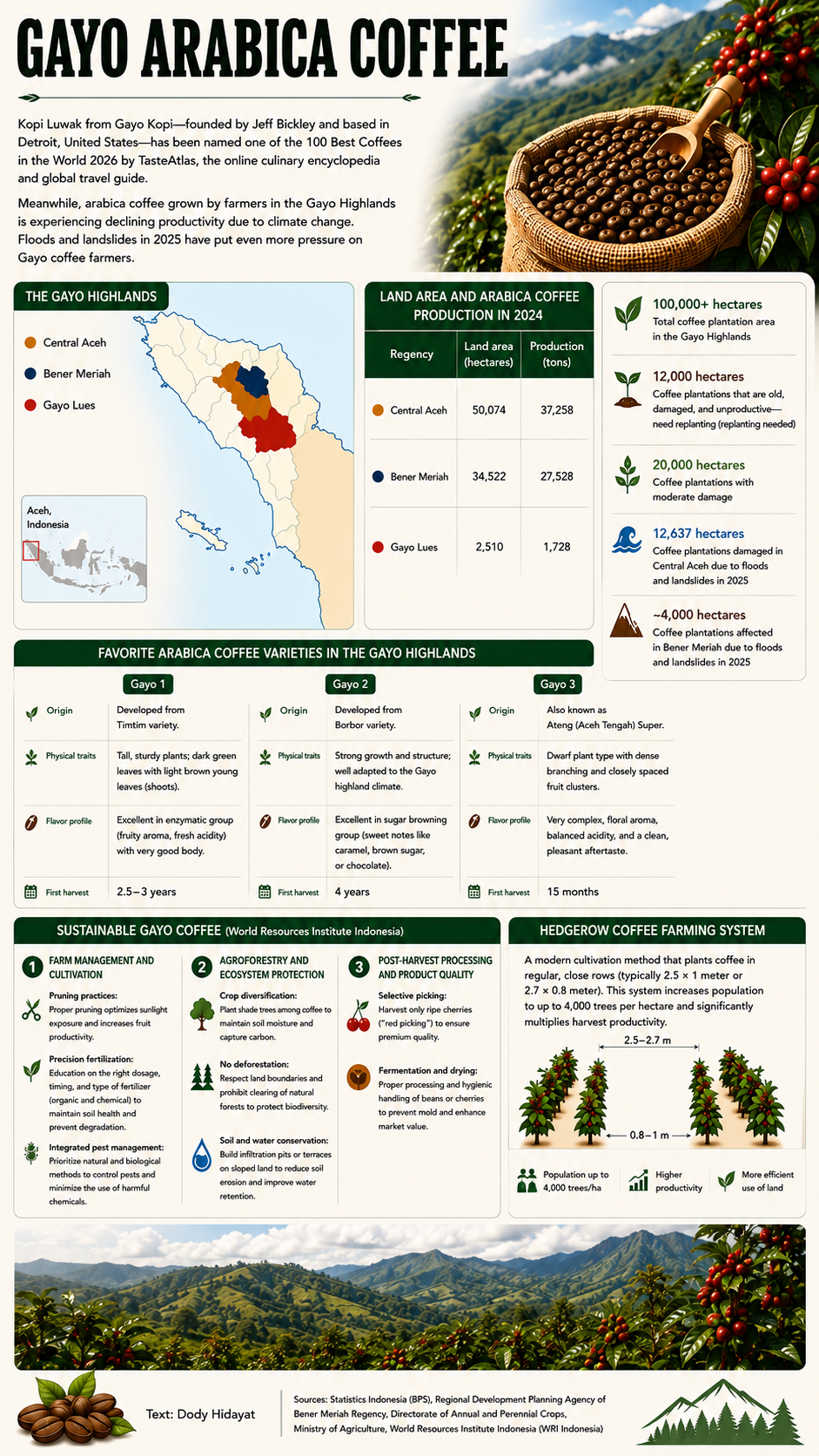
Hamdani’s three-hectare farm sits at an altitude of 1,450 meters above sea level on a 30 to 40 percent slope. It houses roughly 5,000 coffee trees scattered across the terrain, mostly comprising Ateng Super (Gayo 3) and Bourbon, with a few plots of Gayo 1 (Timtim). Half of the trees are nine years old and highly productive, while younger ones planted two years ago are just beginning to bear fruit.
Under normal circumstances, Hamdani estimated he would have harvested 1.5 tons of green beans last season. However, severe weather conditions across Aceh, North Sumatra, and West Sumatra triggered devastating flash floods and landslides. While his farm escaped direct destruction, access was cut off entirely. A small ditch located 300 meters below his farm swelled into a raging river.
According to Hamdani, in the Gayo region, the coffee picking season usually begins in November, peaking between December and January. A brief lull follows in February or early March, before a second major harvest wave hits in April and winds down by June.
"We pick the coffee cherries every two weeks," Hamdani explained.
The disaster that struck Sumatra between November 25–30, 2025, severed the critical Bireuen–Takengon highway, which runs through Bener Meriah and Central Aceh. The KKA road (also known as the Oregon road) passing through Tingkem Asli was similarly rendered impassable by multiple landslide points. It was the primary route Hamdani used on his motorcycle to reach his plot.
It wasn’t until last February that the main road became passable again. “I don’t know where the heavy equipment went—it suddenly disappeared, and we had no way to clear the landslide. And yet, the farm is, on average, only three kilometers from the regional general hospital,” said Hamdani, a member of the Puncak Maju Farmers’ Group.
To cross the widened stream, local farmers joined forces to build a makeshift log bridge. "Just enough to get a motorcycle across," he added. With the peak harvest approaching, they are preparing to reinforce the structure to hold heavier loads.
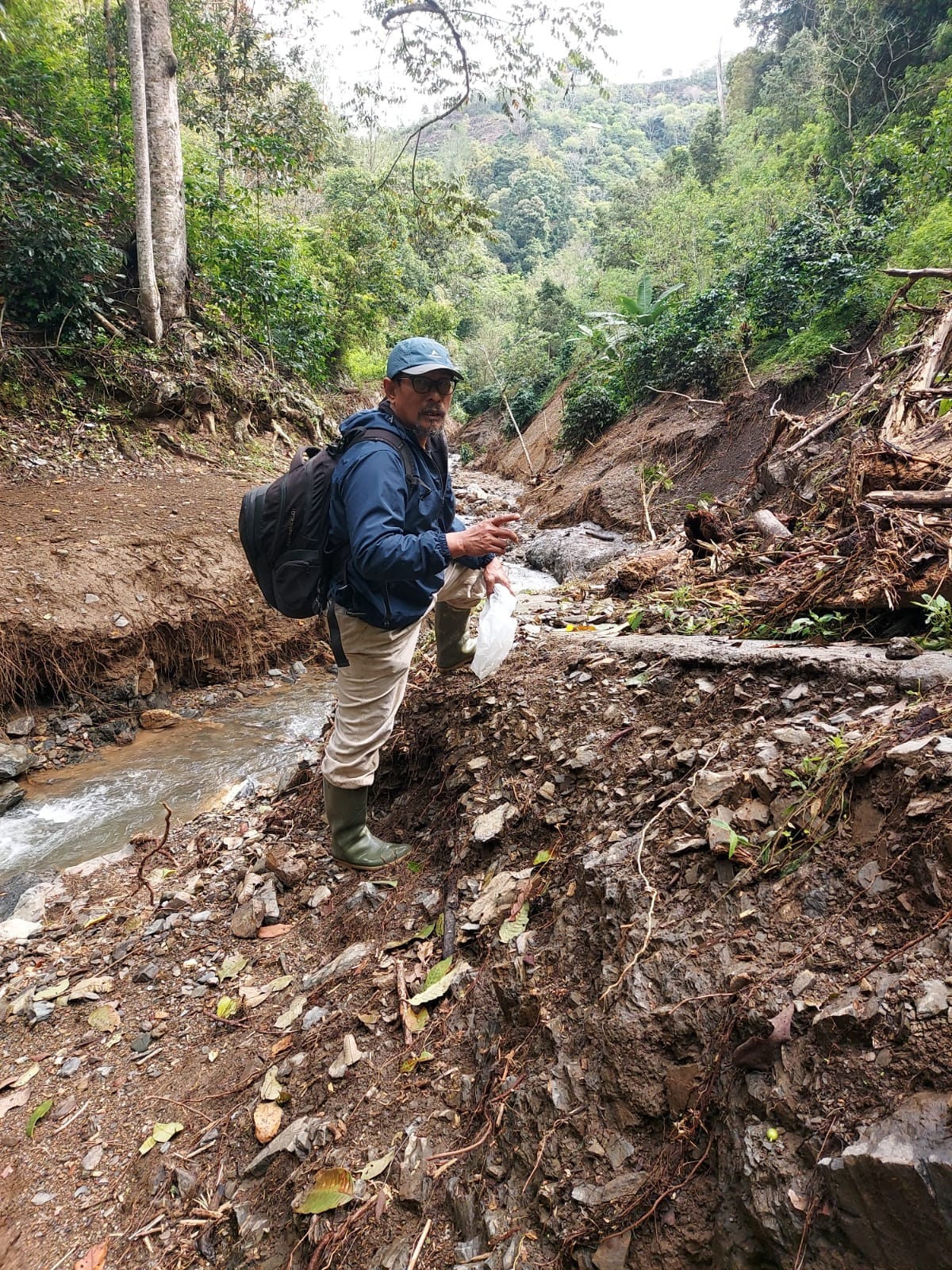
For Hamdani, both the hydrometeorological disasters that cut off access to his farm and the climate change that caused his coffee blossoms to fall are triggered by deforestation. “Deforestation is everywhere,” said Hamdani, who switched careers from researcher to coffee farmer in 2016.
For Hamdani, who left a research career in 2016 to become a coffee farmer, both the hydrometeorological disasters that isolate his farm and the rising temperatures dropping his coffee blooms are triggered by deforestation. "Deforestation is everywhere," he lamented.
A similar struggle is unfolding for Hendra Sudrajat, a coffee farmer from Bale Redelong Village in Bukit Subdistrict, Bener Meriah. Hendra noted that his 0.8-hectare farm, situated at 1,500 meters above sea level, has felt the crunch of climate change over the past five years.
For the first time, his plot is under attack by the coffee berry borer (Hypothenemus hampei).
"About one percent of the crops here are showing signs of berry borer infestation," Hendra shared during a Zoom conference on Friday, July 17, 2026. "Bale Redelong used to be the coldest spot around.”
The temperature in his farm has now risen, making it a favourable environment for the pest, which bores holes in the tips of coffee cherries to lay its eggs. “ In the past, our harvest was completely untouched by these bugs," he said
At altitudes above 1,000 meters, temperatures historically ranged between 15 and 22 degrees Celsius. However, regional warming across the forested slopes of Mount Burni Telong has created ideal conditions for the pest.
"Seven to ten years ago, your breath would turn into visible steam in the morning. That doesn't happen anymore," Hendra remarked.
Alongside shifting thermal baselines, erratic rainfall patterns have thrown farm management off balance.
"When it's hot, it bakes; when it rains, it pours relentlessly. It’s overcast right now and about to rain, even though we’re in the middle of the year, heading into August," said the father of two.
Excessive rainfall damages coffee plants by knocking off fragile blossoms. Hendra, who cultivates Gayo 1 and Gayo 3 varieties, noted that balancing soil moisture has become increasingly unpredictable.
Abubakar Karim, Head of the Coffee and Cocoa Research Center at Syiah Kuala University in Banda Aceh, confirmed that climate change is severely impacting the growth conditions and productivity of Arabica coffee in Gayo Highland. Based on rainfall and temperature trend analysis alongside deep-interview field studies, his team concluded that local growers are actively confronting climate change effects.
"The primary visible indicator is the emergence of specific diseases and pest surges," Abubakar stated in a written response on Wednesday, July 15.
Since the 2000s, Gayo coffee plants have faced heightened exposure to leaf rust caused by the fungus Hemileia vastatrix and white root fungus (Rigidoporus microporus). Meanwhile, the coffee berry borer has emerged as the most dominant pest threat.
According to this lecturer at Syiah Kuala University's Soil Science Department, these outbreaks correlate directly with shifts in temperature and rainfall patterns. "Ultimately, this leads to a noticeable decline in Gayo Arabica yields," he said.
This assessment aligns with findings from Sri Mulato, Director of the Coffee and Cocoa Training Center. In an article titled "Impact of Climate Change on Coffee Bean Quality" published on cctcid.com, Mulato noted that severe droughts driven by El Niño and extreme rainfall caused by La Niña reduced national coffee outputs by 10 percent and 80 percent, respectively.
"Climate change manifests through a significant degradation of both physical and organoleptic bean qualities," Mulato wrote.
Mulato explained that photosynthesis slows down when ambient temperatures cross 35 degrees Celsius, stunting bean growth and keeping bean sizes below 5 millimeters, compared to the healthy benchmark of over 7 millimeters. Warmer conditions also force premature fruit ripening, depriving beans of the time needed to develop vital chemical compounds like caffeine and chlorogenic acid, which act as natural pest deterrents.
Under extreme precipitation, excess water causes ripe cherries to crack before harvest. Rainwater penetrates the pulp, leeching out natural sugars. The remaining sugars oxidize into acids, giving the brewed coffee a sour off-taste. Torrential downpours also knock mature fruit off the branches before pickers can reach them.
The worsening conditions have spurred several institutions to intervene, including the World Resources Institute (WRI) Indonesia. Rahmat Alfajri, an agronomist and Good Agricultural Practices Specialist at WRI Indonesia, explained that his team is working to bolster local farming resilience through climate-adaptive cultivation practices. Through the Sustainable Gayo Coffee initiative, WRI Indonesia is conducting field schools and demonstration plots (demplot) in Bale Redelong Village.
The sustainable coffee cultivation practice that WRI offers to smallholder farmers is agroforestry with a live-fence system similar to that in Brazil. 'This is actually a role model because if a standard model were used, we worry that farmers would return to the old tradition, specifically shifting cultivation,' said Rahmat, a native Acehnese, via a Zoom conference on Friday, July 17, 2026. 'This agroforestry scheme allows farmers to make the most of their existing land.”
Rahmat compared the coffee cultivation practices usually used by farmers, where 1,600 coffee plants are planted in one hectare of land. While with the live-fence agroforestry system, it can double to 3,000–3,500 plants.
'The drawback is that with the old method, coffee plants can last up to 20 years. Meanwhile, in this agroforestry system, the lifespan of coffee plants cannot exceed 15 years,' he said
Ricky Pasha Barus, Lead Project officer for Sustainable Gayo Coffee at WRI Indonesia, described the field school—held May 18–23, 2026, with 70 participants—as a hands-on adult education framework.
"We practice good agricultural practices together in the demonstration plot. We demonstrate, they execute, and the goal is for them to replicate the techniques on their own farms," Ricky explained via Zoom from Banda Aceh on Thursday, July 16, 2026.
WRI Indonesia’s demonstration plot spans two rantai (approximately 50 x 25 meters) and contains 400 Ateng Super (Gayo 3) coffee plants, currently a year old and expected to yield their first harvest within six months. Shade canopy cover is provided by lamtoro gung (river tamarind), avocado, and suren (red cedar) trees.
"While this fence system succeeded in Brazil, farmers in Bener Meriah naturally want local proof before fully adopting it," Ricky said.
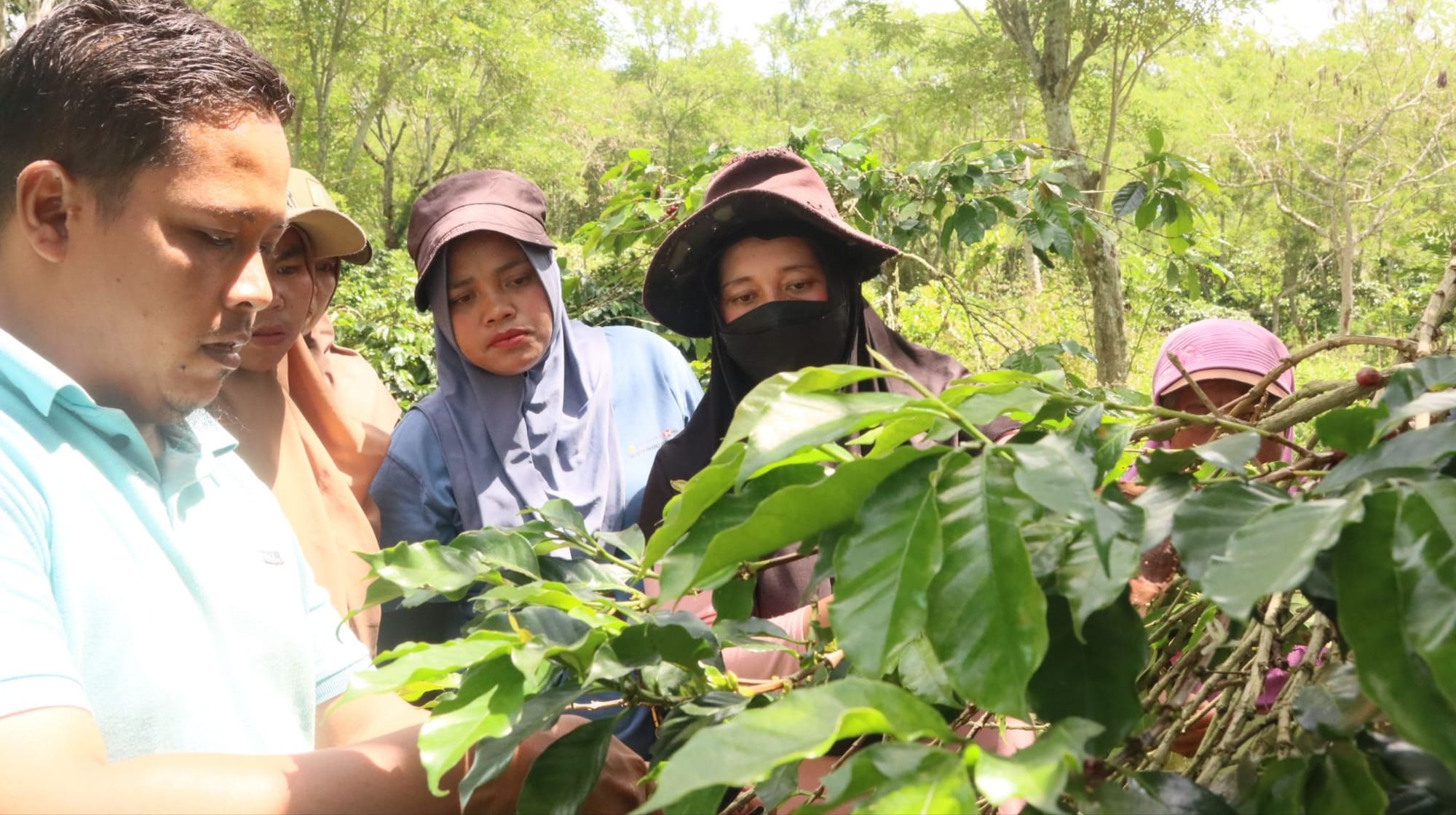
The participating farmers hail from two villages nestled near forest boundaries: Bale Redelong and Waq Pondok Sayur. Both villages were selected because they fall under WRI Indonesia’s assistance footprint and have secured formal village forest management rights from the government. Bale Redelong manages 833.31 hectares of village forest, while Waq Pondok Sayur oversees 813.63 hectares.
According to Ricky, Bale Redelong and Waq Pondok Sayur are actually sub-sections of the Mount Leuser National Park landscape, known as the Redelong Landscape. Serving as the upstream area of the Peusangan Watershed, the Redelong Landscape is part of the Mount Burni Telong buffer zone.
"Interestingly, their coffee grows at an altitude of 1,300 meters above sea level, classifying it as specialty coffee. So, with just a bit more processing refinement, the coffee's flavor profile will improve," he said.
Bukti Bagja, Supply Chain and Livelihood Transformation Senior Manager at WRI Indonesia, stressed that the field school aims to serve as a proof of concept showing that agroforestry models that align with regenerative agriculture can remain commercially viable.
"Our mission isn't to push coffee farms deeper into protected forests," Bagja stated via Zoom on Thursday, July 16. "Rather, we want to bring the wisdom of the forest back into the farm."
For Hendra Sudrajat, who serves as a farmer champion in WRI’s initiative, the training has offered vital tools to overhaul his operations.
"Our focus now is maximizing yields on limited land," Hendra reflected. "The bottom line is to move away from selling raw coffee cherries—by processing the beans ourselves, we can secure far better prices in the market."