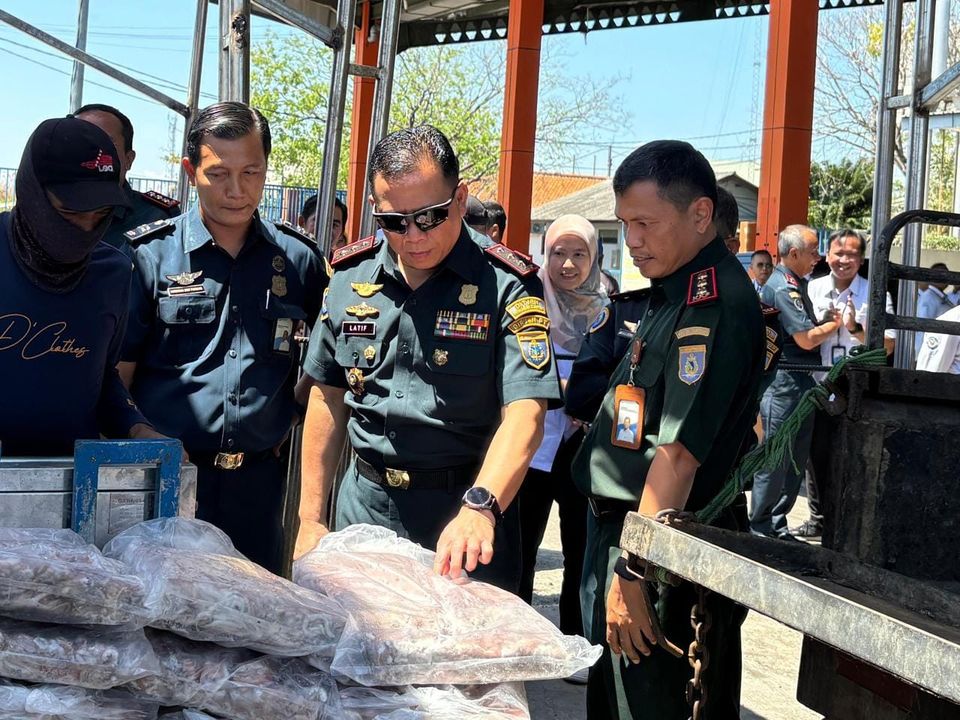
Lotharia Latief: Shrimp Trawlers Must Not Infringe on the Rights of Arafura Fishers
Abdus Somad
Foreign shrimp-catching vessels are once again sailing the Arafura Sea. Some fly the flags of Thailand and China—countries whose fishing fleets were previously banned from operating in Indonesian waters due to a litany of violations. Their track record is severe: ranging from illegal fishing, transshipments, fuel smuggling, forced labor, human trafficking, and tax evasion.
Now, after years of restrictions, a number of foreign-made vessels have secured new permits to harvest shrimp in one of Indonesia's most lucrative fishing grounds. What changed? The Director General of Capture Fisheries at the Ministry of Marine Affairs and Fisheries (KKP), Lotharia Latif, provided a written explanation to Jaring.id on Tuesday, June 30, 2026.
"We have received information and complaints from fishers in Maluku, Papua, and Java regarding the activities of outrigger shrimp trawlers in the Arafura Sea. They report that local fishing gear often gets snagged and damaged by them. What is your response?"
The KKP has yet to receive formal reports concerning those fishers’ complaints. However, if such operational hurdles are indeed occurring, the KKP will conduct field verifications and further investigations so that follow-up actions can be taken in accordance with prevailing regulations. Indonesia’s fisheries management is executed based on the principles of sustainability, equity, and legal certainty, as mandated by Law No. 31 of 2004 on Fisheries—amended by Law No. 45 of 2009—and Government Regulation No. 27 of 2021 on the management of the maritime affairs and fisheries sector.
The double rig trawl (JHUB) is a fishing gear whose use is legally permitted within specific zones and under certain conditions, as regulated by Minister of Marine Affairs and Fisheries Regulation (Permen KP) No. 36 of 2023 regarding the placement of fishing gear and fishing aids in measured fishing zones and Indonesia's fisheries management areas in inland waters. Nevertheless, its deployment must strictly adhere to zoning laws, designated fishing lanes, and must not disrupt the activities of other fishers.
According to reports from local fishermen, the dominant catch hauled in by these JHUB vessels is actually fish, not shrimp. How do you account for this?
Bycatch remains a global challenge in fisheries management to this day. In the case of JHUB utilization, shrimp is the primary target. However, in a tropical ecosystem like the Arafura Sea, we cannot close our eyes to the fact that bycatch is entirely unavoidable, given that Indonesia’s marine resources are highly diverse and multi-species in nature.
Under Permen No. 28 of 2023 on the implementing regulation of Government Regulation No. 11 of 2023 on Measured Fishing, all catches, both target and non-target species, must be recorded and reported by the ship's skipper. Therefore, if there are indications that the catch composition is overwhelmingly dominated by fish rather than shrimp, it will serve as data for a technical evaluation regarding gear selectivity, operational zones, fishing seasons, and compliance with catch reporting.
Catches from JHUB-equipped ships—such as those operated by Avona, KM SPL, KM Binama, KM TMP, KM IGP, and other fleets—are alleged to be predominantly bycatch. Yet, it is suspected that this goes unrecorded at the ports where these JHUB vessels dock. How could this happen?
As we have stated previously, bycatch remains a global challenge in fisheries management. Currently, the KKP has implemented a catch reporting system through fishing logbooks, fish landings at ports, port authority verifications, vessel monitoring system (VMS) tracking, onboard observer programs, and continuous monitoring.
Permen KP No. 33 of 2021 explicitly mandates fishing vessels to log all catches obtained during operations. If there are indications that catches are going unreported, or are being reported inconsistently with actual conditions, we will conduct catch data audits and compliance inspections on the vessel in question.
You have issued a circular letter regarding the zoning of JHUB operations, but local fishers feel that these boundaries still overlap with their traditional fishing grounds, creating a high risk of friction and gear damage. What is your take on this?
We have issued a Circular Letter of the Director General of Capture Fisheries No. B.315/MEN-DJPT/PI.220/IV/2026 regarding the operation of fishing vessels utilizing double rig trawls (JHUB) in zone 03 of WPPNRI 718, as its annex has been adjusted via Circular Letter No. B.328/MEN-DJPT/PI.220/IV/2026 regarding the adjustment of the annex to Circular Letter No. B.315/MEN-DJPT/PI.220/IV/2026 regarding the operation of fishing vessels utilizing double rig trawls (JHUB) in zone 03 of the fisheries management area of the Republic of Indonesia (WPPNRI) 718.
This circular letter stresses that JHUB fishing activities can only be carried out within specific areas determined by exact coordinates, using designated gear, and operators are strictly required to mind the presence of other fishing vessels in their vicinity.
The KKP also obliges all business actors utilizing JHUB to use gear that matches the specifications outlined in the regulations, maintain security, order, and safety during operations, and prevent any potential conflict with other fishermen in the area.
The KKP is fully committed to ensuring that JHUB operations are carried out in accordance with statutory provisions, do not trample on the rights and activities of traditional fishermen, respect indigenous communities, and preserve the sustainability of fish stocks in the Arafura Sea and the WPPNRI as a whole.
We discovered and obtained information that vessels like TKG 01, TKG 02, and the Avona fleet have begun arriving from China, heading toward Merauke and Maluku. Why are these ships coming from China able to obtain permits and fish in Indonesia so easily?
All parties have equal opportunities to engage in the capture fisheries business in Indonesia. Permits for vessels built either domestically or abroad to operate in Indonesian capture fisheries are processed in accordance with statutory provisions. These regulations include Government Regulation No. 5 of 2021 on the implementation of risk-based business licensing, Minister Regulation No. 10 of 2021 on business activity and product standards in risk-based business licensing, and Minister Regulation No. 33 of 2021 regarding fishing logbooks, onboard monitoring, inspections, testing, and the management of fishing vessel crewing.
All parties have equal opportunities to engage in capture fisheries operations in Indonesia. Vessels built domestically or abroad that will engage in capture fisheries operations in Indonesia must obtain the necessary permits in accordance with applicable laws and regulations. These laws and regulations include, among others, Government Regulation No. 28 of 2025 on the implementation of risk-based business licensing, Minister of Marine Affairs and Fisheries Regulation No. 10 of 2021 on standards for business activities and products in the implementation of risk-based business licensing in the marine affairs and fisheries sector, and Minister of Marine Affairs and Fisheries Regulation No. 33 of 2021 concerning fishing logbooks, monitoring on fishing vessels and fish transport vessels, inspection, testing, and marking of fishing vessels, as well as the management of fishing vessel crews.
We also obtained several videos, photos, and accounts from fishers in Papua showing that the vessel KM Binama 08 ran aground on the coast of Muara Kladar, Waan, Merauke. The location is allegedly inside the Kolepom Conservation Area. What is the KKP's stance on this incident?
Based on VMS tracking data from the monitoring period of April 1, 2026, to June 18, 2026, the KM Binama 08 was never detected entering the Kolepom Marine Conservation Area, nor was it ever recorded as being aground near the coast of Muara Kladar, Merauke.
Regarding the circulating reports that the ship ran aground in Muara Kladar, our cross-checks with the Tual Marine Resources and Fisheries Surveillance (PSDKP) Base and the Merauke Surveillance Unit revealed that they never received any information regarding the grounding of KM Binama 08 on the Muara Kladar coast in Merauke.
However, if there is evidence that the vessel entered a conservation area or a zone where fishing activities are restricted, fisheries inspectors will conduct a further investigation.
It is also suspected that KM Binama 08 did not activate its VMS or AIS (automatic identification system) during its operations, up until it reportedly washed ashore in Muara Kladar. Did the KKP monitor this?
Based on monitoring data from the Ministry of Marine Affairs and Fisheries’ Fisheries Vessel Monitoring Center, specifically regarding the KM Binama 08, the vessel’s position could still be tracked via the VMS system throughout 2026. However, emerging information regarding the alleged inactivity of the device during operational activities will still be subject to further investigation and verification to obtain a complete and objective picture of the situation. The government is committed to ensuring that every process is conducted professionally, based on data, and in accordance with applicable regulations.
If a fishing vessel fails to activate its VMS in accordance with the rules, it faces administrative sanctions as stipulated under Minister Regulation No. 26 of 2022 regarding the imposition of administrative sanctions in the marine affairs and fisheries sector. As for the deactivation of the AIS device, the law enforcement authority for such violations falls under the jurisdiction of the Ministry of Transportation.
The original interview was published on jaring.id on July 2, 2026.