Managing Waste from Homes
By Pito Agustin Rudiana
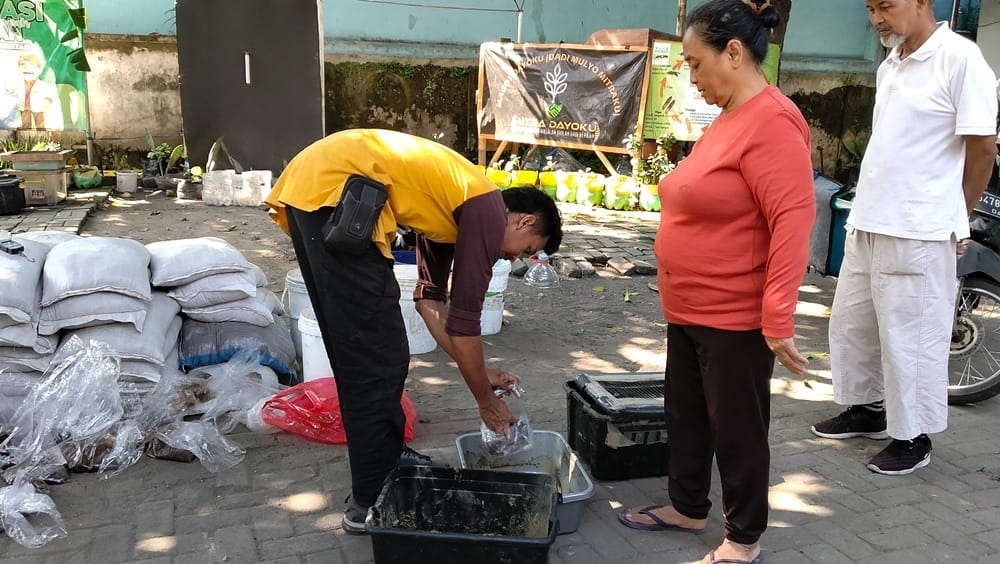
Sudarmini smiled broadly. The two-week-old maggots, or black soldier fly larvae, she harvested on Sunday afternoon, June 7, 2026, weighed a whopping 5.76 kilograms. Her harvest was clean, with barely any frass—maggot feces—mixed in.
Every kilogram of maggots is valued at Rp6,000. Additionally, for every kilogram harvested, she and other breeders can take home one ounce of baby maggots to rear, with each ounce valued at Rp5,000. All transactions are meticulously recorded in each member's savings book.
"I’ll take three," the 69-year-old woman said as she picked up three clear plastic bags filled with baby maggots.
Meanwhile, her harvest had been transferred into a collector's 25-kilogram paint bucket, joining the yields of fellow residents in Cokrodiningratan Hamlet, Jetis Sub-district, Yogyakarta City.
One by one, residents arrived at the yard of an abandoned house whose owner had moved to Jakarta, carrying plastic boxes covered with wire mesh. This spot serves as the biweekly gathering point for maggot breeders to deposit their yields. It is also the venue for the waste bank monthly meetings, and the garden filled with potted fruits and vegetables managed by a farming group in the hamlet.
"Before this, I never knew what to do with organic waste. The waste collectors refused to take it, so I ended up burying it," Sudarmini said.
Her household waste is compounded by tenants renting rooms in her house. On any given day, leftover meals, fruit peels, and vegetable scraps can fill more than half a bucket. Meanwhile, neighborhood waste collectors will only haul away residual waste.
This dilemma prompted Sudarmini to join the maggot breeding group during its ninth harvest cycle. Beyond her family and tenants, neighbors also chip in their kitchen scraps. She has also enlisted as a member of the local waste bank.
"Now, only the residual waste goes to the cart-puller (waste collector)," added Sudarmini, who pays Rp35,000 a month for the collection service.
Rearing maggots has become a necessity for Sudarmini and many other residents of Yogyakarta City. In January, Yogyakarta Mayor Hasto Wardoyo enacted a policy banning organic waste from city waste depots or temporary disposal sites. The move aligns with the municipal government's commitment to stop dumping waste into the Piyungan Integrated Waste Treatment Facility (TPST) in Bantul by early 2026.
On June 12, Hasto tightened the screws by issuing a waste-reduction mandate targeting large-scale waste producers. This includes manufacturers, retailers, shopping malls, modern storefronts, traditional markets, hotels, restaurants, cafes, catering services, and commercial zones.
"This is our way of curbing waste generation so that waste management becomes sustainable," Hasto said.
The grassroots practices adopted by Sudarmini, alongside the government’s stringent policies, are the ripples of the prolonged closure of the Piyungan TPST between July 23 and September 5, 2023.
According to data from the Indonesian Forum for the Environment (Walhi) Yogyakarta, the TPST—which serves as the main disposal hub for Yogyakarta City, Sleman, and Bantul—could no longer handle the load. Daily waste volume from the three regions averaged 700 tons, occasionally peaking at 1,000 tons. This triggered protests from neighboring residents who had long endured air pollution and toxic leachate flooding.
The slogan 'Jogja Waste Emergency' echoed across the region. For nearly two months, trash overflowed from city depots onto roadsides. Sanitation workers, paralyzed by the lack of alternative disposal sites, left the piles untouched.
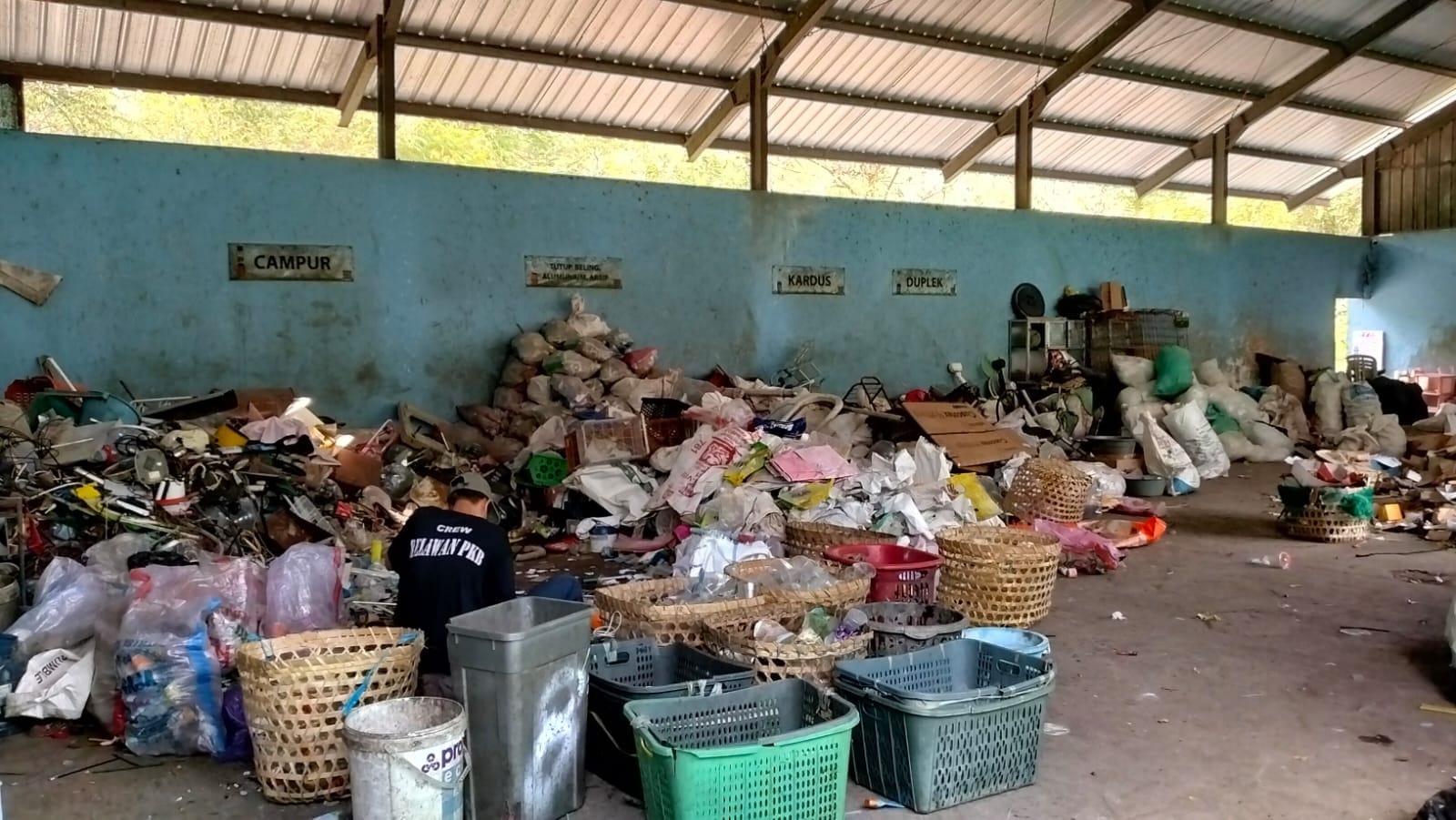
Data from the Special Region of Yogyakarta's Statistics Indonesia (BPS) in 2025 estimated daily waste generation across the province at 1,390 to 1,560 tons. This breaks down to Sleman (550–600 tons), Bantul (380–420 tons), Gunungkidul (120–140 tons), Kulon Progo (80–100 tons), and Yogyakarta City (260–300 tons).
The crisis forced each municipality to manage its own trash. This presents a massive hurdle for Yogyakarta City, which lacks expansive tracts of land for processing facilities. From 2023 through late 2025, the city relied on a dispensation to dump up to 600 tons at Piyungan, while forcing itself to process the remainder independently.
The residents of Cokrodiningratan had already pivoted long before the "Jogja Waste Emergency" siren wailed. Anwar Setyowantono, the head of the Cokrodiningratan neighborhood unit, recalled that the village previously operated several waste banks. However, poor administrative management caused residents to withdraw.
"It went into a coma, and eventually died, simply because the savings were never distributed," Anwar recalled during the maggot harvest.
In 2022, as the head of neighborhood association 03, Anwar attempted to revive the program. Fortuitously, the neighborhood had a vacant 600-square-meter plot that residents frequently used as an illicit dump.
Alongside several residents, he reclaimed the plot to jumpstart a new waste bank.
"Back then, I made it clear: I take full responsibility. Six months into the program, the savings must be distributed.” That was how Anwar won them over.
Starting with just 10 participants—all of whom were board members—the numbers grew to 25 by the third month. Today, 90 percent of the neighborhood has joined. The waste bank, named Dadi Mulyo, has since scooped up multiple municipal awards in Yogyakarta.
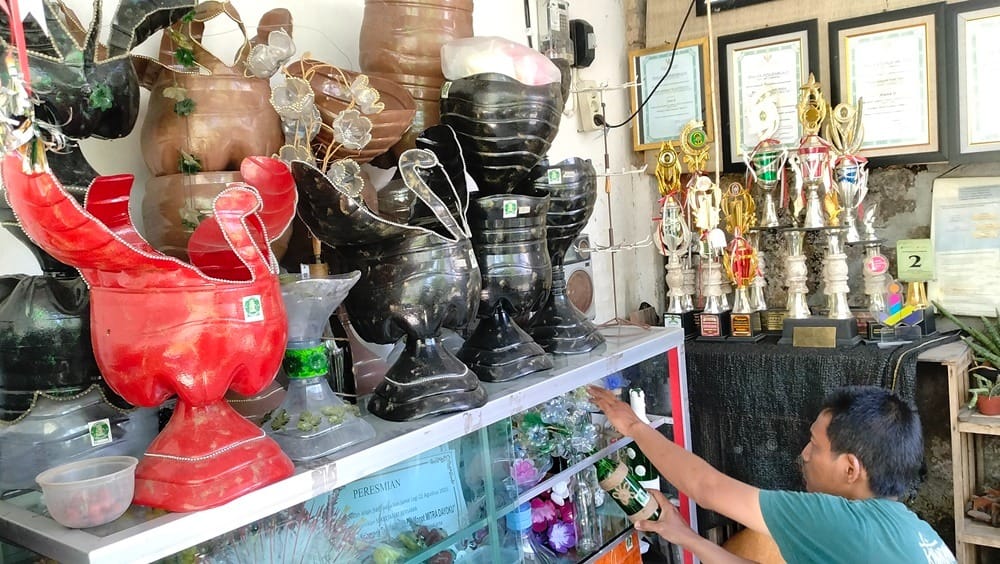
Fitri, the coordinator of the Dadi Mulyo Waste Bank, encourages participants to go beyond merely saving inorganic waste by upcycling it into commercially viable souvenirs. Mineral water bottle caps are cast into keychains retailing for Rp5,000–Rp10,000. Glass bottles salvaged from nearby cafes are transformed into decorative lamps adorned with inorganic waste, fetching between Rp25,000 and Rp60,000. They also craft tissue boxes and beverage cases from discarded bottles, selling them for Rp25,000–Rp35,000.
Six months later, the Sami Mulyo Farming Group was formed to tap into organic kitchen waste. The vacant plot mutated into an integrated agricultural and livestock hub. Lush rows of eggplants and chilies grew alongside fruit trees like sapodilla and citrus. The plot also houses chickens, muscovy ducks, rabbits, and catfish—all thriving on organic waste feed. The neighborhood harvests the bounty together.
"Sometimes we use the harvest as a reward for waste bank participants. They can barter their waste for fresh vegetables," said Lukman Hidayat, the 68-year-old coordinator of the Sami Mulyo farming group.
Yet, managing the plot was not without hitches. More than half of the discarded waste was organic kitchen scraps. Utilizing a stacked-bucket composting system, residents found themselves drowning in liquid leachate. It exceeded the needs of the crops, and discarding it would only cause pollution.
Maggot farming became a solution. But as the project progressed, only Anwar and Lukman remained to manage the demonstration plot. Eventually, maggot farming became the responsibility of each household.
To entice residents to breed maggots at home, Anwar knew there had to be an economic incentive.
"Without profit, the project would collapse," Anwar said with a chuckle.
Anwar partnered with a commercial maggot farmer who supplied baby maggots at a price of Rp5,000 per plastic bag. Residents raised the maggots by feeding them their kitchen waste. At harvest time, the adult maggots were purchased, and the residents made a profit.
"I promised them: I will buy back the harvest every two weeks. By the sixth harvest, you would secure a personal savings of Rp10,000 each," Anwar recalled of his initial pitch.
By the fourth month, the breeders were formalized as partners under the banner Mitra Dayoku. Fortnightly Saturday harvests now operate under pricing guidelines: a clean kilogram of adult maggots fetches Rp6,000, while a kilogram mixed with frass goes for Rp5,000.
Today, the partnership boasts 60 active members. "Waste is the root of the problem. But if you sort it and process it, it becomes a blessing that adds to your income. So like it or not, make friends with waste," Anwar concluded.
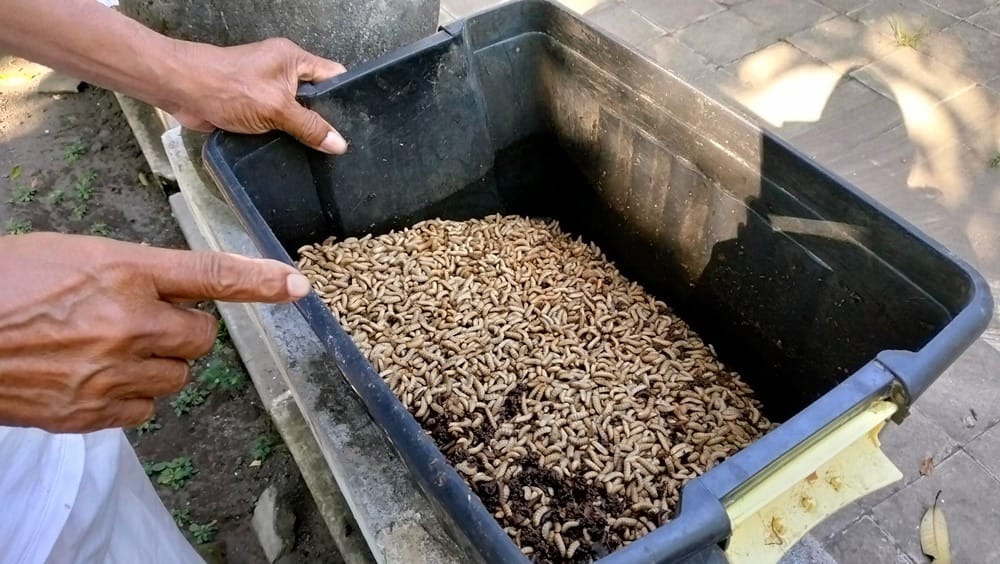
The wave of self-reliant community waste management is also breaking in other pockets of Yogyakarta, including Guwosari Village, Pajangan, Bantul Regency. Local discussions on waste management began in 2019 following previous stalled attempts. The renewed urgency was sparked by the planned expansion of the State Islamic University (UIN) Sunan Kalijaga campus within the village.
With an influx of 35,000 students and lecturers on the horizon, coupled with rapid residential growth, action was imperative. "That was the trigger. It would have been a ticking time bomb if we didn't prepare early," said Hendri, Director of the Guwosari Village-Owned Enterprise (Bumdes), when contacted on June 22.
Using village-owned land, the Bumdes launched a collection service, hauling unsorted waste from customers' homes for a monthly fee of Rp30,000. Workers at the temporary disposal site (TPS) manually separated the kitchen scraps to feed a maggot farm. The remaining residual waste was hauled to the Piyungan TPST, as the facility lacked processing machinery.
In 2021, the village authority launched a campaign advocating for organic and inorganic waste separation at home. "But terms like 'organic' and 'inorganic' were too abstract for the elderly and young children to put into practice," Hendri said.
To bridge the gap, they coined a vernacular sorting system using simple, everyday words divided into four categories: rosok, bosok, popok, and godhong thok. Rosok refers to recyclable inorganic items like plastic bottles, glassware, scrap metal, and paper, while bosok covers decaying kitchen waste and food scraps. Meanwhile, popok comprises non-recyclable residual waste like diapers and sanitary pads, whereas godhong thok translates to purely yard waste like dry leaves and vegetable trimmings.
To keep residents motivated, the Bumdes bought these sorted streams from households. Operating under a Reduce, Reuse, Recycle Waste Treatment Facility (TPS3R) framework, the venture was named TPS3R Go Sari or TPS3R Guwosari.
"Since 2021, we committed to zero dumping at Piyungan," said Hendri, noting strong backing from the village administration.
Each stream is treated differently: bosok feeds the maggots, godhong thok is composted, and rosok is baled and sold to recycling factories. Meanwhile, popok or residual waste—accounting for 15 percent of the total volume—is incinerated at 800 degree Celsius.
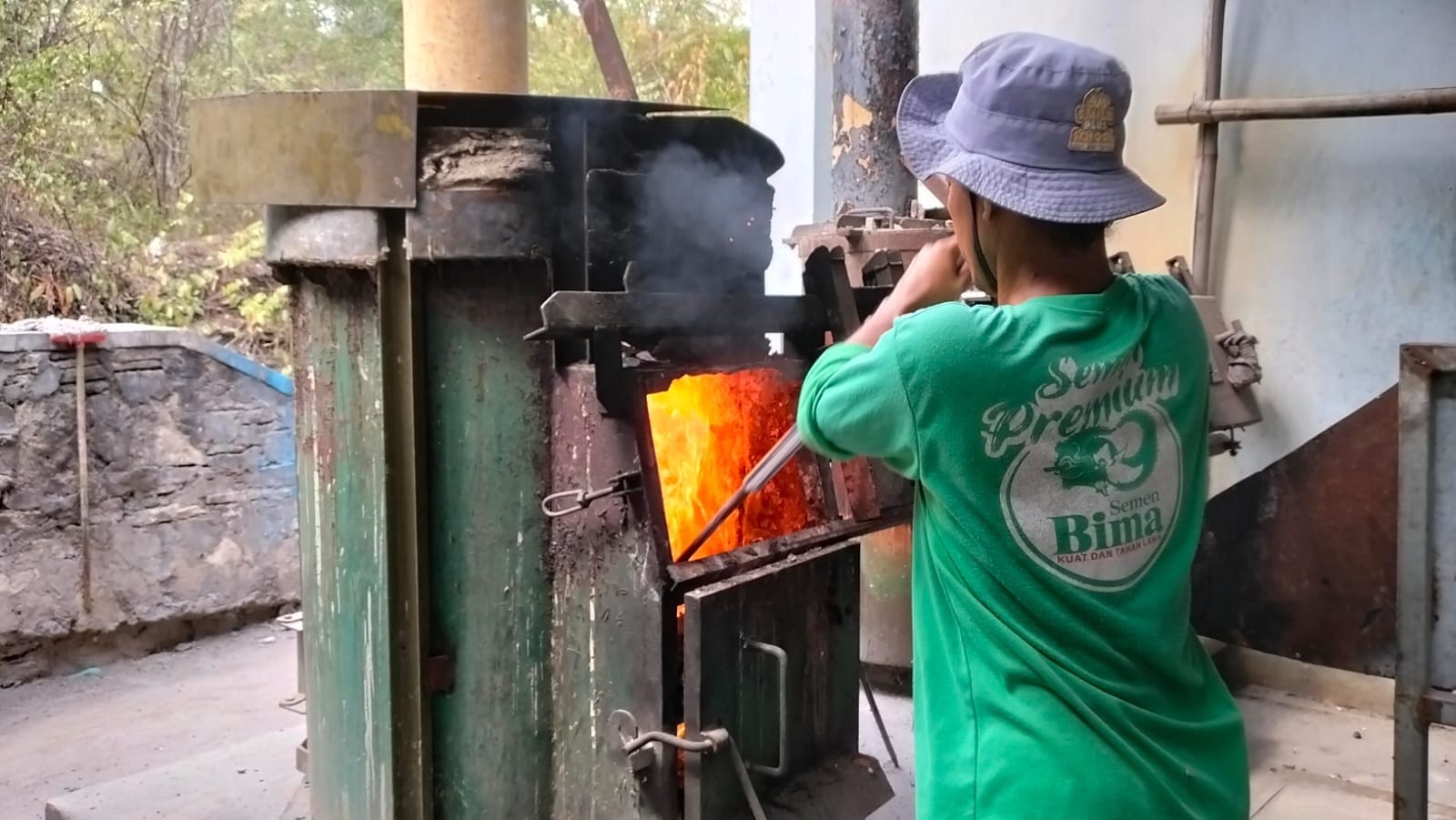
Today, the facility operates three incinerators funded by corporate social responsibility programs. The first two process 400–500 kilograms a day, while the third handles 1.4 tons daily.
TPS3R Go Sari has flourished. Its workforce has ballooned from two employees to 27, while its customer base skyrocketed from 50 households to 1,500.
The facility is now financially self-sustaining. Trading 4 to 5 tons of rosok a month yields Rp20 million–Rp25 million, while the biweekly maggot harvest of 40–60 kilograms brings in Rp8,000–Rp11,000 per kilogram. The facility's total monthly operational cost of roughly Rp60 million is entirely covered by its waste-processing revenues.
Erwan Widyarto, Secretary of the Special Region of Yogyakarta Waste Bank Association, acknowledged that the waste emergency has spurred a boom in neighborhood waste banks. In Yogyakarta City alone, the "one RW, one waste bank" policy saw numbers jump from 415 to over 700 units, with some neighborhoods operating multiple stations.
The association’s formal network has expanded to include 190 registered waste banks under the Ministry of Law.
"But everyone faces the same wall: residual waste," Erwan said when contacted on June 26, 2026.
Residual waste consists of non-recyclable, non-compostable items like diapers, sanitary pads, also ruined mattresses and pillows.
Most community waste management is limited to basic organic and inorganic sorting. Organic waste is digested by maggots or composted using vertical pipes (losida), stacked buckets, or communal biopore holes, while inorganics are managed through waste banks.
While a few creative communities upcycle residual materials, their output is negligible. Even advanced facilities like TPS3R ultimately dump their residual streams into incinerators.
"That just spawns a new problem, because it (incineration) is still far from eco-friendly," Erwan warned.
Erwan dismisses national projects pushed by the central government—such as Waste-to-Energy installations (PSEL) or Refuse-Derived Fuel (RDF) plants—as an illusion rather than a solution.
He argues, as well as being processed by incineration to generate energy, the scheme also requires large quantities of waste – 1,000 tons per day. “In essence, it encourages the public to produce more waste,” said Erwan.
This directly contradicts the spirit of Law No. 18/2008 on Waste Management, which mandates waste reduction and minimization at the source.
"The technical blueprints remain murky, and there isn't a single successful example to point to," Erwan added.
Rather than PSEL and RDF, Erwan explained, the focus is on waste management that begins with sorting at the source (homes or villages). This involves sorting waste into categories such as “bosok” (organic waste), “rosok” (inorganic waste), “momok” (hazardous and toxic waste), “popok” (residual waste), and “elok”—waste suitable for creative reuse or conversion into marketable products.
“In fact, simply sorting organic waste at home solves half of our waste problem,” he added, noting that more than 50 percent of Indonesia’s waste is organic.
He also stressed the importance of mindful consumption to prevent food waste.
"Take only what you can eat, and finish your plate. Don’t let there be any food waste,” he urged.
Yogyakarta Mayor Hasto Wardoyo has requested to delay the implementation of the PSEL project in Yogyakarta. Combined waste streams from Yogyakarta City, Bantul, and Sleman fail to meet the requirement of 1,000-ton daily threshold.
"We have asked for time to review it," Hasto confirmed.
Wahyu Yanuar, an advocacy campaigner for Walhi Yogyakarta, backed Hasto's cautious stance. He believes this is an opportunity for the regional government to overhaul its waste management paradigm. For decades, the strategy has relied on downstream processes: collect, haul, dump. Since 2024, Yogyakarta City has merely shifted the burden to temporary depots, Bantul has leaned heavily on TPS3R facility, while Sleman has offloaded the responsibility onto residents without adequate infrastructural support.
"The focus must pivot entirely to reducing waste at the upstream source. The primary targets must be the producers generating the bulk of the waste," Wahyu concluded.