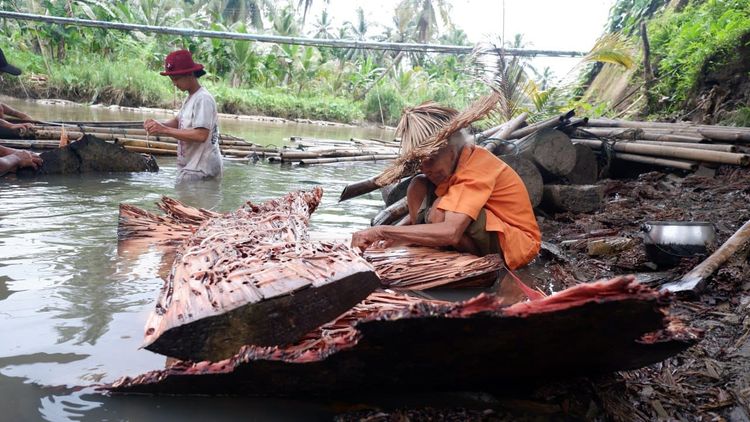
The Influx of Shrimp Trawlers in the Arafura Sea
By Abdus Somad
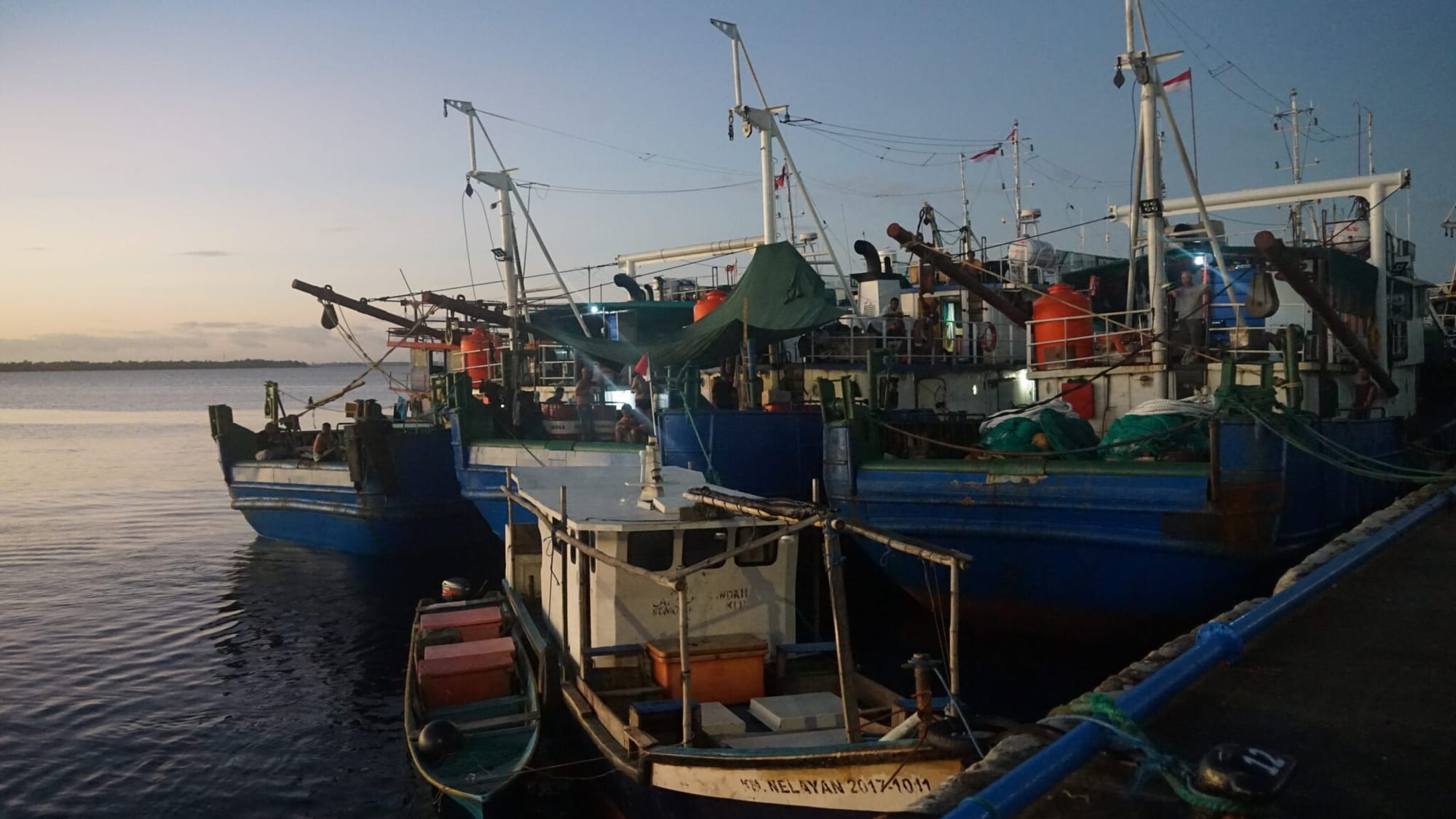
The presence of two vessels, designated TKG 01 and TKG 02, docked at the Merauke National Fishery Port (PPN) has become the talk of the town among local fishers. Several fishers noted that the two steel-hulled ships are easily recognizable; their size and structure differ vastly from the vessels that typically operate in Merauke waters. The hulls are massive, built with a design that mirrors industrial-scale shipping.
Rumors swirling among the fishers suggest that the twin vessels originated from China and are now operating under the Indonesian flag. “According to the owner, each unit carries a six-man crew. There are Chinese crew members who don’t speak a word of Indonesian, alongside three Indonesians,” said Taufik Latarissa, Chair of the South Papua chapter of the All-Indonesian Fishers Association (HNSI), when contacted on Saturday, April 25, 2026.
A tracking of maritime data conducted by Jaring.id via Global Fishing Watch and Marine Vessel Traffic platforms revealed that TKG 01 and TKG 02 departed from Jiantiao, Sanmen, Taizhou City, Zhejiang Province, China, on March 19, 2026. From that port, both vessels sailed through the South China Sea, crossed Philippine waters, entered the Halmahera region in North Maluku, and then moved toward Sorong and the Aru Islands before finally dropping anchor in Merauke on April 7, 2026.
This thousands-of-kilometers journey ended in one of Indonesia's most productive fishing grounds: the Arafura Sea. This area has long been dubbed the nation’s shrimp basket. Its nutrient-rich shallow waters serve as a prime habitat for various high-value shrimp species and demersal fish. It is this very abundance that has turned the Arafura Sea into a prime target for large-scale fishing corporations.
Nevertheless, a search of licensing documents on the website of the Ministry of Marine Affairs and Fisheries (KKP) Directorate General of Capture Fisheries up to May 14, 2026, yielded no records of fishing business permits or vessel permits under the names TKG 01 and TKG 02. Conversely, data from the Ministry of Transportation’s Directorate of Ships and Seafarers showed that both vessels have been registered since 2025. TKG 01 is registered under identifier number 2025 Ba No. 7495/N, while TKG 02 holds number 2025 Ba No. 7496/N.
Both are logged with a capacity of nearly 300 gross tonnages (GT) and are registered under a company named Tri Kusuma Graha. According to monitoring and evaluation analysis documents from Task Force 115—compiled during the foreign-made vessel moratorium era under former Maritime Affairs and Fisheries Minister Susi Pudjiastuti—the company was flagged for alleged violations in 2015. Furthermore, records show the company owns several other vessels: the Aru Pearl, Banda Pearl, Evia Pearl, Khamsin-A, Kusuma Pearl, Napier Pearl, Sawu Pearl, and Seram Pearl. The firm was also registered with the General Administration of Customs of China (GACC) up until 2022.
To outsiders, the arrival of these two ships might mean very little. But to Taufik Latarissa, the sight is an omen of a much larger crisis brewing in the Arafura Sea. “If they catch and hoard these fish, it will deplete incomes and ruin the marine ecosystem, including our coral reefs in South Papua,” Taufik said.
The HNSI South Papua Chair admitted that the sight instantly brought back memories of the long-standing debate over massive shrimp-catching vessels, which in recent years have once again been granted permits to operate in eastern Indonesia. According to Taufik, trawl ships are already running rampant in the Arafura Sea.
“Our fishing gear is being swept away by them. Local coastal fishers are deeply anxious. They are all indigenous Papuans. If these types of ships multiply, small-scale fishermen will be squeezed out completely,” he lamented.
Driven by these fears, on April 21, 2026, a group of South Papua fishermen marched to the South Papua Fisheries Office. They demanded the government immediately halt the operations of large vessels in the Arafura Sea, particularly those using double rig shrimp trawls (jaring hela udang berkantong or JHUB). “This is just a trawl by another name. The central government issues a permit for JHUB, but in reality, they are catching fish as well. We have video proof of them catching fish. The shrimp is just a formality,” Taufik asserted.
For decades, the Arafura Sea has been the lifeblood of coastal communities in South Papua. From these waters, thousands of fishers catch fish, shrimp, and various marine harvests to feed their families. Yet over the last few years, many complain they have to sail much farther out just to bring home the same amount of catch.
The encroachment of industrial vessels weighing hundreds of gross tonnages is widely blamed for worsening the situation.
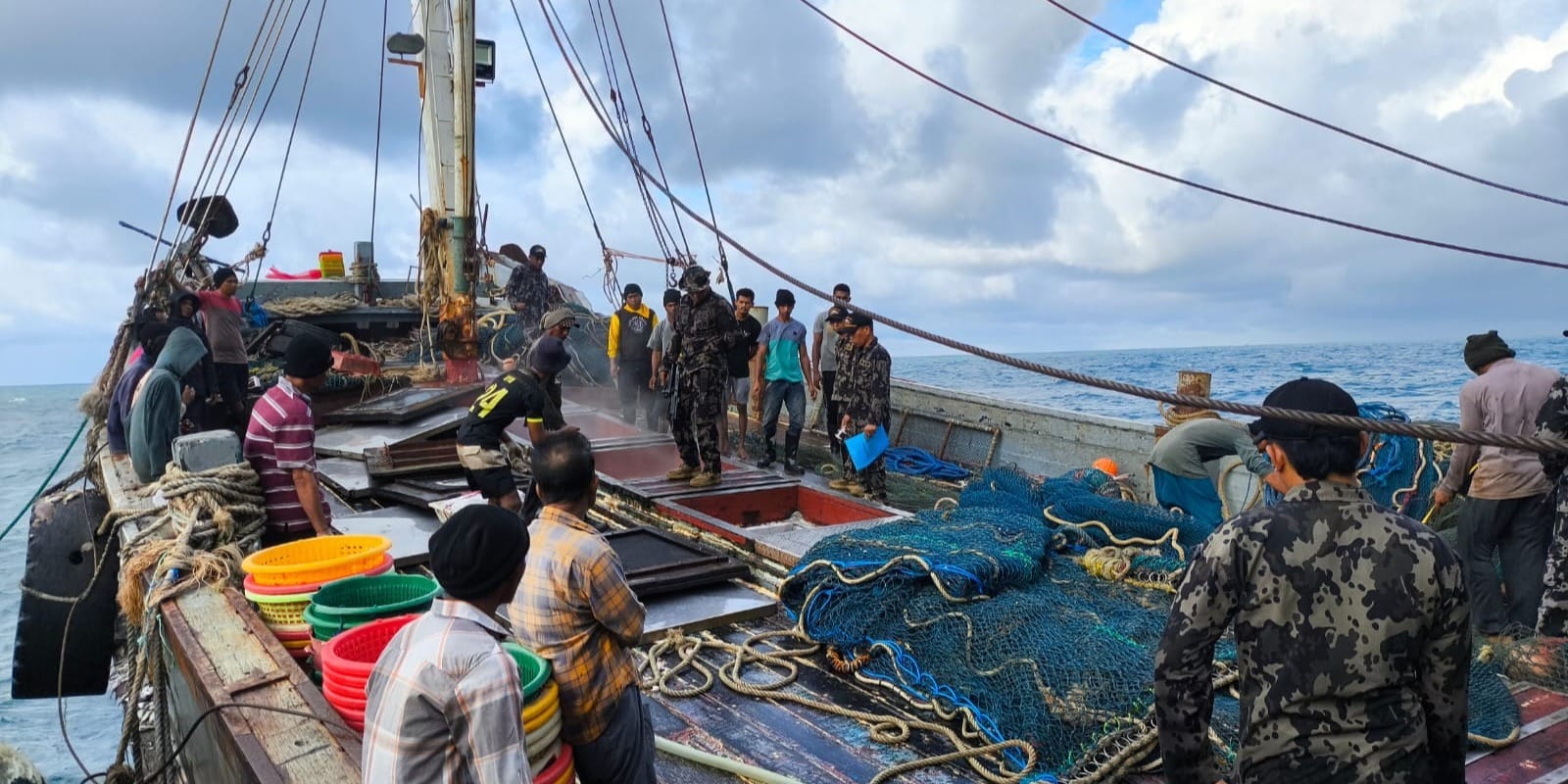
According to licensing data from the Ministry of Marine Affairs and Fisheries, at least 42 vessels are operating double rigg shrimp trawls (JHUB) within the Republic of Indonesia's Fisheries Management Area (WPPNRI) 718, which encompasses the Arafura Sea. The government maintains that this gear is not classified as a banned substance like the destructive bottom trawl (pukat harimau).
Among fishermen, however, the distinction is virtually invisible. They argue that the mechanics of a JHUB are identical to a traditional trawl because it scoops up massive quantities of various fish species, not just shrimp. These concerns are backed by scientific studies highlighting the high volume of bycatch generated by shrimp-trawling operations.
According to a 2023 study analyzing the productivity and composition of double rig shrimp trawl catches in the Arafura Sea by fisheries researcher Maman Hermawan, these trawl-like gears hauled in 74 tons of shrimp across six trips—averaging 12 tons per trip. In 2024, they caught 66.5 tons, averaging 11 tons per trip, and in 2025, they brought in 23.6 tons from two trips, maintaining the 11-ton average.
These numbers do not align with Ministerial Decree No. 98 of 2021 regarding Fishing Vessel Productivity, which dictates that a JHUB’s productivity should be about 1.32 tons. “Productivity per trip still vastly exceeds the standards set by the regulation,” Hermawan wrote in the study, which was presented at the 26th Indonesian Fisheries National Seminar at the Jakarta Fisheries Business Polytechnic (Politeknik Ahli Usaha Perikanan) on November 12, 2025.
Meanwhile, a 2024 study conducted by Leopold Tomasila, a researcher from the Capture Fisheries Program at the Bitung KP Polytechnic, titled "Catching Techniques Using Double Rig Shrimp Trawls on KM SPL IX Owned by PT Sinar Pesona Laut," revealed that the shrimp trawl gear produces far more bycatch than its primary target. The vessel KM SPL reportedly caught 18,219 tons of marine biota, where the main catch of shrimp accounted for only 8,068 tons, while the bycatch skyrocketed to 10,150 tons.
An investigation by Jaring.id revealed that the dozens of vessels registered with the KKP are entirely owned by foreign investment companies. Vessel capacities vary: 30 ships fall within the 201–300 GT bracket, three are between 151–200 GT, and two reach a massive 301–400 GT. The remaining seven ships are sized between 101–150 GT.
From the same dataset, we discovered that the companies owning these vessels were foreign direct investment status. Among them are Avona Mina Lestari, PT Insani Gemilang Pualam (which is affiliated with the Artha Graha Group), and the Samudera Mas Group. PT Avona Mina Lestari (PT AML) operates 14 vessels brought in from Fuzhou. These ships are owned by China’s Fuzhou Honglong Ocean Fishery Co. Ltd. Notably, this Chinese firm was slapped with sanctions by the US Department of the Treasury's Office of Foreign Assets Control (OFAC) on December 12, 2022, for ties to illegal, unreported, and unregulated (IUU) fishing and human rights abuses/forced labor.
The Indonesian government had also previously issued criminal rulings and revoked the permits of PT Dwi Reksa Abadi between 2015 and 2019—a company tied to Fuzhou Honglong Ocean Fishery and Pingtan Marine Enterprise.
Meanwhile, corporate deeds show that Samudra Mas Group (PT SMG) is majority-owned by a Thai conglomerate, Amphai Foods Co. Ltd. Several names are listed as owners of this entity, including Althea Louise Kelly, Mark Jefferson Tandiawan, Pongsakorn Phetpiroon, and Soewandi Haryanto Tandiawan, who doubles as the President Director. The latter, Soewandi Tandiawan, is the owner of PT Samudra Seafood Products, a shrimp processing company in Banyuwangi affiliated with Amphai Foods Co. Ltd.
Taufik hopes the government will take decisive action against these corporate fleets, primarily by revoking the permits of problematic vessels.
“The South Papua sea is an ancestral heritage, a source of life and income for indigenous Papuans,” he said. “The licensing policies handed out by the government in the Arafura Sea have created a colonial system for our fishermen. If local fishermen were prosperous, why would they cross borders only to get shot at or robbed?” Taufik added, noting that roughly 140 South Papuan fishers have been arrested in Papua New Guinea because there are no fish left in Indonesian waters, while another 13 remain detained in Australia.
According to Taufik, if trawlers are continuously allowed to ravage the Arafura Sea, around 1,000 local vessels with capacities of 5–20 GT in South Papua will be pushed out of existence. “Unemployment among fishermen will spike. Can the state guarantee our welfare? Right now, many fishermen can’t even sail because they are drowning in bank debt,” he said.
Jaring.id reached out to the Director General of Capture Fisheries at the Ministry of Marine Affairs and Fisheries, Lotharia Latif, via telephone and official letters, but received no response until the publication of this story. However, in a written statement published on the KKP website on Sunday, April 26, 2026, Latif did not deny the proliferation of large-scale vessels in the Arafura Sea. He reassured that these ships do not carry destructive pukat harimau (trawls) but rather JHUB, which supposedly do not disrupt the activities of traditional fishers. This, he argued, complies with Minister of Maritime Affairs and Fisheries Regulation No. 36 of 2023 regarding the placement of fishing gear and fishing aids in measured fishing zones and Indonesia's fisheries management areas.
The regulation explicitly outlines permitted and prohibited fishing gears. “One of the banned tools is the pukat harimau or trawl, due to its potential to destroy the sustainability of fish resources. Meanwhile, the double rig shrimp trawl (JHUB) is a permitted gear under the rule, featuring different specifications that are tightly regulated to ensure it does not damage resources or interfere with other fishing gear,” Latif stated.
Nevertheless, Latif noted that JHUB operations are not a free-for-all. There are several conditions that must be met, and operations are strictly restricted to specific zones and coordinates. “This is to ensure there is no overlap with the fishing grounds of small-scale fishermen,” he said.
The KKP has issued a Circular Letter from the Director General of Capture Fisheries (No. B.315/MEN-DJPT/PI.220/IV/2026) regarding the operation of fishing vessels utilizing double rig trawls (JHUB) in zone 03 of WPPNRI 718. The government mandates all business operators using JHUB to employ gear that matches the regulatory specifications, maintain safety and order during operations, and avoid potential conflicts with other fishermen in the area.
“Any violations of these provisions will face sanctions in accordance with prevailing laws and regulations,” Latif warned strictly.
Responding to the issue, Firman Soebagyo, a member of Commission IV of the House of Representatives (DPR), urged the KKP to tighten its oversight regarding the zoning regulations. Commission IV acknowledged that weak monitoring is partly caused by a lack of government facilities, a shortage of patrol fleets, and budgetary constraints.
“Nonetheless, all these natural resources should ultimately be used for the maximum prosperity of the Indonesian people. Our regulations must stick to that principle,” Firman told Jaring.id over the phone on Wednesday, June 3, 2025.
He disagreed with the issuance of JHUB permits in Indonesian waters. According to Firman, such active fishing gear puts domestic fishers at a severe disadvantage. “JHUB used to be banned. We in Commission IV want whatever permits the government grants to industrial fishers to never disrupt the activities of small-scale fishers. They fish to survive, not to build fortunes. Therefore, they must be protected,” the Golkar Party politician said.
Firman demanded that the strict vessel ban policies implemented during Minister Susi Pudjiastuti’s tenure be reinstated. He also opposed allowing foreign ships to enter Indonesia and re-register as domestic vessels. This practice, Firman argued, is no different than giving foreign ships a free pass into Indonesian waters. “Those steel ships from abroad that re-register in Indonesia were once banned by Bu Susi. I do not agree with re-registering foreign vessels. This is a serious issue. We are monitoring and following this closely. We will bring this up directly with the minister,” Firman stated.
Weighing in on the controversy, the Indonesia Ocean Justice Initiative (IOJI) highlighted the need for caution and rigorous oversight regarding the exploitation limits of fish stocks, given the presence of the 42 JHUB vessels, or outrigger trawlers, owned by corporations—several of which are backed by foreign investments from China, Thailand, and Japan.
IOJI Ocean Security Program Director Andreas Aditya Salim pointed out a high risk of injustice when quotas for local fishers have yet to be established, while permits for massive industrial vessels are handed out freely.
“More fundamentally, is there truly a surplus stock? And have the requirements to grant foreign parties access to surplus stocks—as regulated under UNCLOS—been verified and met?” Andreas said on Monday, May 25, 2026.
Local fishers in eastern Indonesia, the majority of whom operate small craft, are bound to lose against a 200 GT outrigger trawler, Andreas noted. “Not to mention that maritime surveillance and law enforcement remain suboptimal. The KKP once caught two JHUB vessels that had ‘modified’ their gear. How consistent is the surveillance in continuously catching violations like this?” Andreas added.
Several studies have shown that JHUB possesses only moderate selectivity. One study indicated that the catch of non-target species (bycatch) reached 32 percent, while another research pegged it as high as 55.7 percent. Pocket-designed nets dragged by ships will inevitably yield massive bycatch when operated in multi-species tropical waters. In this scenario, consistent and stringent law enforcement is the only remedy.
The IOJI emphasized that the government must get serious about stock assessments, comply with the United Nations Convention on the Law of the Sea (UNCLOS) before opening up surplus stocks to foreign interests, immediately set quotas for local fishermen, and ensure ironclad consistency in maritime enforcement.
“If the sanctions aren’t deterrent enough, it will just be viewed as a cost of business that gets passed down to consumers. Improvement will be hard to achieve, and social conflicts will inevitably erupt,” Andreas said.
With the permits already handed out, Andreas acknowledged that legal certainty for business operators must be maintained. However, for the upcoming fishing seasons, it must be explicitly clear whether over-exploitation is occurring. Furthermore, he added, efforts must be made to ensure that quotas for both industrial and local fishermen are firmly established by next year.
He admitted this is no easy task and requires a serious budgetary commitment. Catch data collection at landing ports and onboard vessels must be precise, and fisheries research must continue actively rather than relying solely on self-reported data from the fishing companies. “Lastly, involve local fishermen in every single stage of the quota-setting process,” he said.
Meanwhile, Suhana, a fisheries and marine expert from the Muhammadiyah University of Technology (UTM) in Jakarta, claimed that the Indonesian government is showing inconsistency in law enforcement. Ships currently operating in the Arafura Sea, he pointed out, were previously blacklisted and penalized by the government for forced labor, human trafficking, IUU fishing, illegal transshipment, and tax evasion. Now, the government is allowing these problematic vessels to return.
The UTM Vice Rector III added that issuing JHUB permits to these fleets deals a heavy blow to the country's fisheries trade sector. The global market today enforces strict requirements, demanding that seafood commodities be entirely free from IUU fishing, human trafficking, and forced labor.
“The trawl is a fishing gear that has yet to clear environmental sustainability hurdles. The government must not focus solely on boosting production while sweeping environmental aspects under the rug,” Suhana said. “This could trigger a backlash where Indonesian products get slapped with trade bans because they fail to meet eco-friendly, slave-free, and anti-IUU fishing standards.”
Hence, he urged the Indonesian government to stand firm on its legal principles. Vessels that were previously banned should never be allowed back into Indonesian waters. “The government must remain consistent with its policies. Do not repeat past mistakes,” said Suhana. “Forcing the legalization of eco-destructive vessels will trap Indonesian fish products out of the global market. This will hurt Indonesia in the long run. It is vital to respect environmental integrity and ensure the traceability of our seafood harvests.”
Before the appearance of TKG 01 and TKG 02, the attention of Merauke fishers had already been captured by a similar vessel, the KM IGP 08. The ship was reported to run aground in the Muara Kladar area, Waan District, Merauke, South Papua. The location sits near a coastal stretch blanketed by dense mangrove forests, closely bordering the Kolepom conservation area.
From a distance, the ship’s hull looked like an alien object wedged into the flat, muddy landscape of the Papuan coast. Video footage recorded by a local fisher showed the vessel sitting motionless for weeks. Some fishers began questioning how such a massive vessel could end up so close to the shoreline.
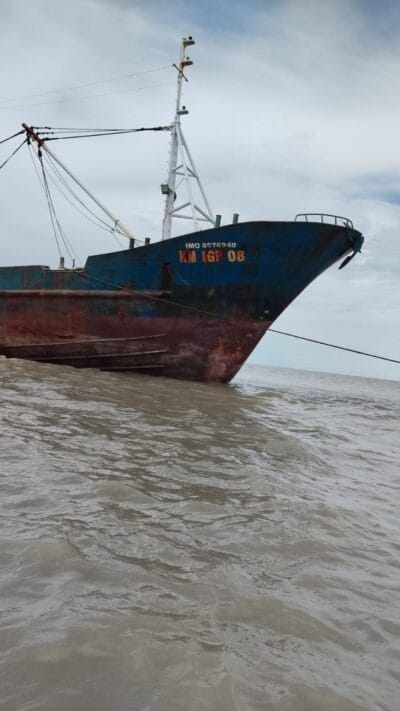
For the local community, the area is far more than just a shipping lane. The shallow coastal waters serve as the primary fishing grounds for traditional fishers and hold immense ecological value. “It’s been stuck there for almost a month,” a fisherman noted in a video clip received by Jaring.id.
Taufik suspects the ship ventured too close to the coast before hitting the seabed.
The same grievance is shared by fishermen from Indramayu, West Java, and Pati, Central Java, who travel all the way to the Arafura Sea to fish. Kamilin, a skipper from Indramayu, recounted how his nets frequently got snagged by industrial trawlers crisscrossing the fishing zones. When this happens, his gear is ruined and the fish inside are lost.
Kamilin witnessed firsthand how these trawlers operate 24 hours non-stop near Enu Island, the Aru Islands, and the Pomako region. On satellite radar, the trawlers can be seen operating between latitudes 6 and 9 degrees south—a border zone shared by Australia, Papua New Guinea, and Indonesia.
“So every type of fish gets trapped. Even though their permit says shrimp, everything from snapper, grouper, sharks, to rays gets swept up in their nets,” he described.
Another skipper, speaking on the condition of anonymity, shared a similar ordeal. His fishing gear was shredded after getting entangled with industrial trawl nets. He had warned the trawler via coastal radio communication to steer clear, but just 30 minutes later, the vessel cruised right back to its initial spot.
According to him, the ship captains often communicate that they are operating vessels like the KM IGP, KM Binama, and KM SPL. A look at the KKP’s licensing registry shows these ships are officially listed as using JHUB gear.
“There are more of them now. A single haul can yield 11 to 12 tons. When they pull up the nets, you can see all the fish. They report it as shrimp, but they are taking the fish too. The impact is that our catches are dwindling,” he said.
Two fisher associations have stated their firm rejection of the trawling activities, calling on the government to revoke permits for environmentally unfriendly fishing gear. The ongoing situation is projected to trigger a steep decline in traditional yields, pushing local businesses into financial ruin. “We have raised this issue at every single meeting with the government. We reject the presence of these trawlers. They are destroying the ecosystem,” said Kajidin, a local fisherman.
Purwadi, the representative in charge of PT Insani Gemilang Pualam, stated that KM IGP 08 encountered operational problems along the South Papua coast. According to him, the company is conducting an internal evaluation to trace the exact chronology of the grounding.
The company also vehemently denied allegations that its automatic identification system (AIS) and vessel monitoring system (VMS) were deliberately turned off while operating in the Arafura Sea.
“All vessel operations are conducted based on valid permits and strictly adhere to the fishing zones designated by the government through licensing documents and WPPNRI regulations,” Purwadi stated in a written explanation received by Jaring.id on Thursday, May 21, 2026. “The information currently circulating regarding the ship’s position still needs to be technically verified against official navigation data, logbooks, VMS, and the findings of authorized agencies. The company fully respects the oversight and evaluation process being carried out by the relevant authorities.”
PT Samudera Indo Sejahtera (SIS), the parent company managing the IGP vessels, also denied engaging in illegal mid-sea transshipments. “PT SIS respects the government's policies regarding transshipment governance and constantly aligns its operations with the latest regulatory developments,” Purwadi added.
Addressing allegations that their ships breached local zoning laws and encroached upon marine conservation areas, Purwadi firmly denied the claims. “Should there be any valid data or indications of zoning violations in conservation areas, the company remains open to clarification and coordination with the relevant agencies based on legally and technically verifiable facts,” he concluded.
* The original article was published on jaring.id on June 8, 2026.
**Director General of Capture Fisheries at the Ministry of Maritime and Fisheries, Lotharia Latif, sent a written explanation to Jaring.id on June 30, 2026, and can be read in the next article.