Rice, Sweet Potatoes, and the Web of Life
By Yulia Sugandi
I remember my late mother always reminding me never to leave a single grain of rice on my plate. “Do not make Dewi Sri cry,” she would say. As a child, I took her words literally. In the folklore she passed down, Dewi Sri was the goddess of fertility and the guardian of paddy, with rice being the physical manifestation of her sacred body. Consequently, rice had to be treated with absolute reverence.
At home, I witnessed how meticulously the rice was stored. No one wasted it. This simple domestic experience shaped my worldview about food. As I grew older, I realized that the value of a staple food does not lie solely in its ability to satiate hunger or in its nutritional content. Food carries narratives, memories, relationships, and values passed down across generations.
When we eat rice, what is present is not just taste and aroma, but the narrative of the living world that allowed the food to reach the dinner table. To borrow a term from the late Vietnamese Buddhist monk Thich Nhat Hanh, this experience taught me about savoring—the act of eating with mindfulness and appreciation for the interconnected web of life that sustains us.
This early understanding eventually helped me internalize the profound meaning of the seren taun ritual, which is still practiced by several Sundanese indigenous communities. The ritual is not merely a harvest festival; it is an expression of gratitude and a method of nurturing the relationship between humans, nature, ancestors, and the Almighty. There, rice is treated not as a mere commodity, but as a revered source of life.
The deeper I have traveled into the various food traditions across the Indonesian archipelago, the more I understand that many indigenous communities view staple foods as living entities. Food is not just an agricultural output; it is a custodian of collective memory, an intergenerational bridge, and a part of a cosmic order connecting humans to nature. I found a similar ethos thousands of miles away from the Sundanese lands.
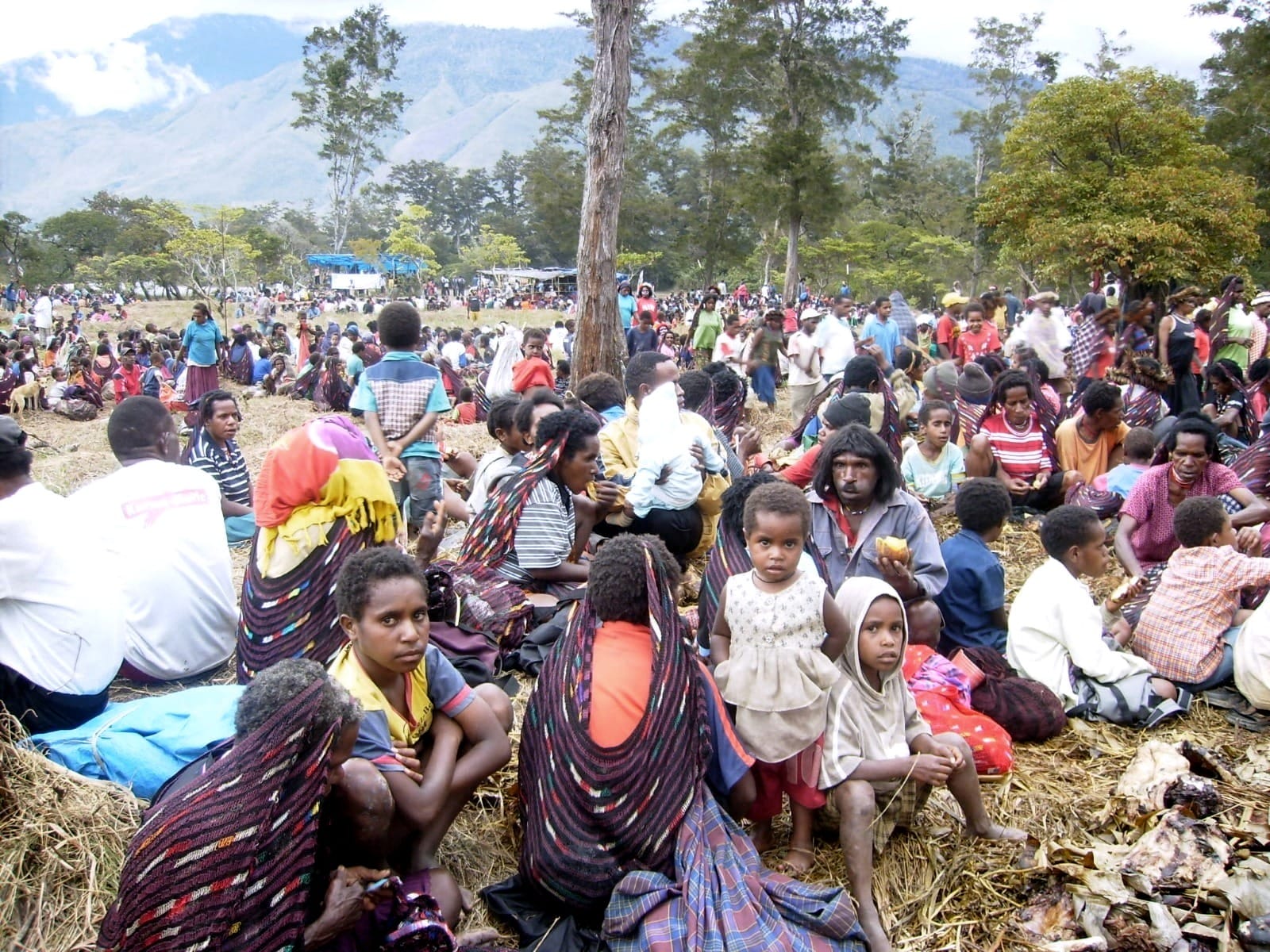
In the early 2000s, while conducting ethnographic fieldwork for my doctoral studies in the Palim Valley of the Papua highlands, I witnessed how the Hubula indigenous people perceive the sweet potato. In the Hubula language, the sweet potato is called hipere or hipuru. Much like rice in the narrative of Dewi Sri, the sweet potato for the Hubula goes far beyond its status as sustenance. It is a living food that stores the history of their origins, identity, social relations, and the values that sustain their communal life.
For the Hubula people, the sweet potato is the epicenter of existence. Alongside taro, this crop has been the primary food source for the Papuan highlands communities for centuries. Indeed, the sweet potato is often referred to as the "fuel" of life for the Papuan highlanders.
Yet, traditional sweet potatoes, known locally as hipere ai werek), are inextricably linked to the Hubula origin myth. Several varieties are believed to have originated from the body of Naruekul, the first human in their cosmology. Certain sweet potatoes are believed to have sprouted from his heels, his blood, the veins of his forehead, and even from the bamboo used in the tale of his death. Because of these connections, specific varieties are deemed sacred and form an essential part of various customary rituals.
The sweet potato is present in daily meals as well as through the kit talogo isan (bakar batu/stone-burning) tradition. It is also offered to ancestors and fed to customary pigs. Communal dining becomes a space for sharing food, stories, and solidarity. Through these practices, food acts as a social glue and a guardian of collective values.
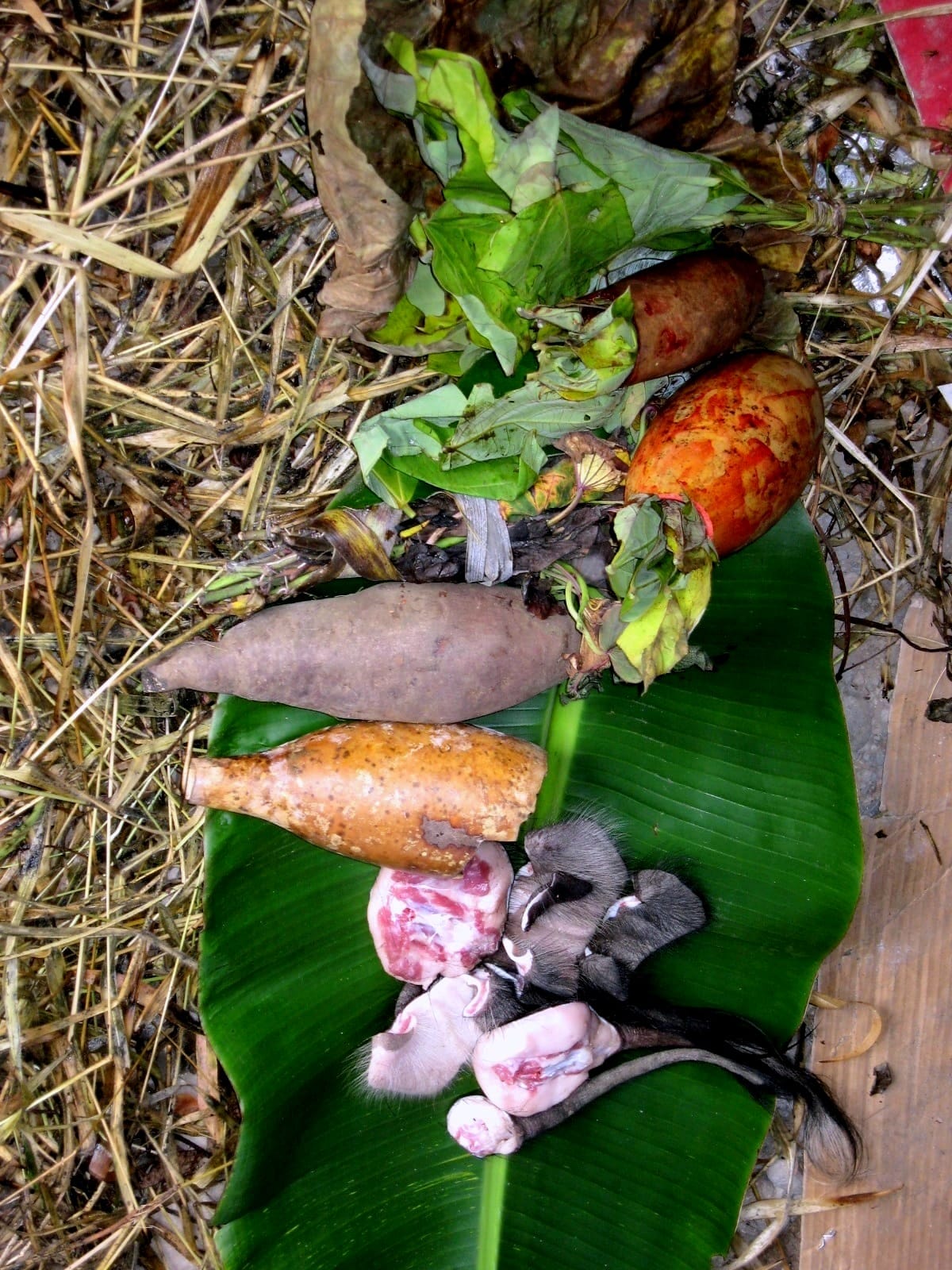
For the Hubula, cultivating sweet potatoes is not a mere production chore. Gardening is an act of care, keeping a living relationship between humans, the soil, the landscape, and the ancestors. They believe the soil fertility depends on the harmony of this relationship. Consequently, various rituals are performed throughout the agricultural cycle, from planting to harvest.
At the beginning of the planting season, pig blood is offered as a token of reverence to the ancestors. During the first harvest, a portion of the crops is intentionally left to rot in the ground as an offering to the "mother," a symbol of fertility and the source of life. These practices reflect the conviction that humans do not live separately from nature, but are part of a wider web of relations.
Hubula women hold a central role in maintaining this web of life. They plant, nurture, and process the sweet potatoes, tend to the pigs, preserve food knowledge, and ensure the continuity of relationships with the ancestors and customary lands (tanah ulayat). Through this often invisible labor of care, women become the guardians of food sovereignty and the sustainability of the ancestral landscape.
The Hubula philosophy is encapsulated in the proverb niniki hano rogo fago dogosak, which means "hold fast to the good life with our hands." In this framework, the land (agat) as the "mother" gives birth to the sweet potato. The sweet potato enables the rearing of pigs. Pigs become a vital component of social exchange and marriage alliances. From the families formed, a new generation is born to safeguard ancestral stories and care to the customary land. All these elements are interconnected, mutually sustaining, and inseparable.
Therefore, an encroachment on the sweet potato is not merely a threat to a food source. It erodes social relations, cultural identity, local knowledge, and the sustainability of a landscape that has been nurtured for centuries.
Regrettably, this life system faces escalating pressures. Since Papua was integrated into the Unitary State of the Republic of Indonesia in the 1960s, coupled with the continuous influx of transmigrants from outside the island, paddy cultivation has been aggressively pushed through various state development policies. The expansion of wet rice fields and the altering of the topography have gradually eaten away traditional sweet potato gardens. The Hubula elders view this shift with deep anxiety, because what is threatened is not merely a crop, but the entire existential framework that rests upon it.
This concern deepens as traditional sweet potato varieties are increasingly sidelined by new cultivars. Yet, it is the local varieties that possess characteristics aligned with the Hubula life system. Their vines can continuously sprout shoots after a harvest, serving as a constant source of seedlings and pig feed, thereby sustaining a long-established cycle of circular sustainability.
Witnessing the ongoing landscape alterations in Papua today, my memory drifts back to my mother's story of Dewi Sri. I realize that what is at stake is not only a matter of dietary choice or a shift in agricultural commodities. What is under threat is the narrative that binds humans to the soil, their ancestors, and the source of their existence.
It is at this juncture that I see a profound convergence between rice in the Sundanese tradition and the sweet potato in the Hubula cosmology. Both are living foods. Both preserve memory, knowledge, values, and ethics regarding how humans ought to engage with the world around them.
Consequently, the disappearance of the traditional sweet potato does not merely mean the loss of a food type. It marks the fading of indigenous knowledge, the fraying of social relations, and the severing of the ties that bind the current generation to their ancestral heritage. When a society loses the food at the center of its cosmology, it loses more than sustenance; it loses its way of understanding life and its capacity to care for the world that gives meaning to its existence.
*The author is an anthropologist and sociologist, and author of the book "Orang Hubula-Makna Martabat Kolektif Suku Hubula di Lembah Palim, Papua" published by PBK (The Notion of Collective Dignity among Hubula in Palim Valley, Papua published by MV-Verlag, Germany)