Sowing Seeds in Urban Lots
By Sapto Yunus
At first glance, the building appears unremarkable. Painted a dark hue, the structure once served as a film studio but is now relegated to a warehouse. Yet, something sets it apart from its surroundings. Flanking the 300-square-meter building is a burgeoning sprawl of flora—ranging from various rhizomes, mulberries, and moringa to fruits and assorted vegetables.
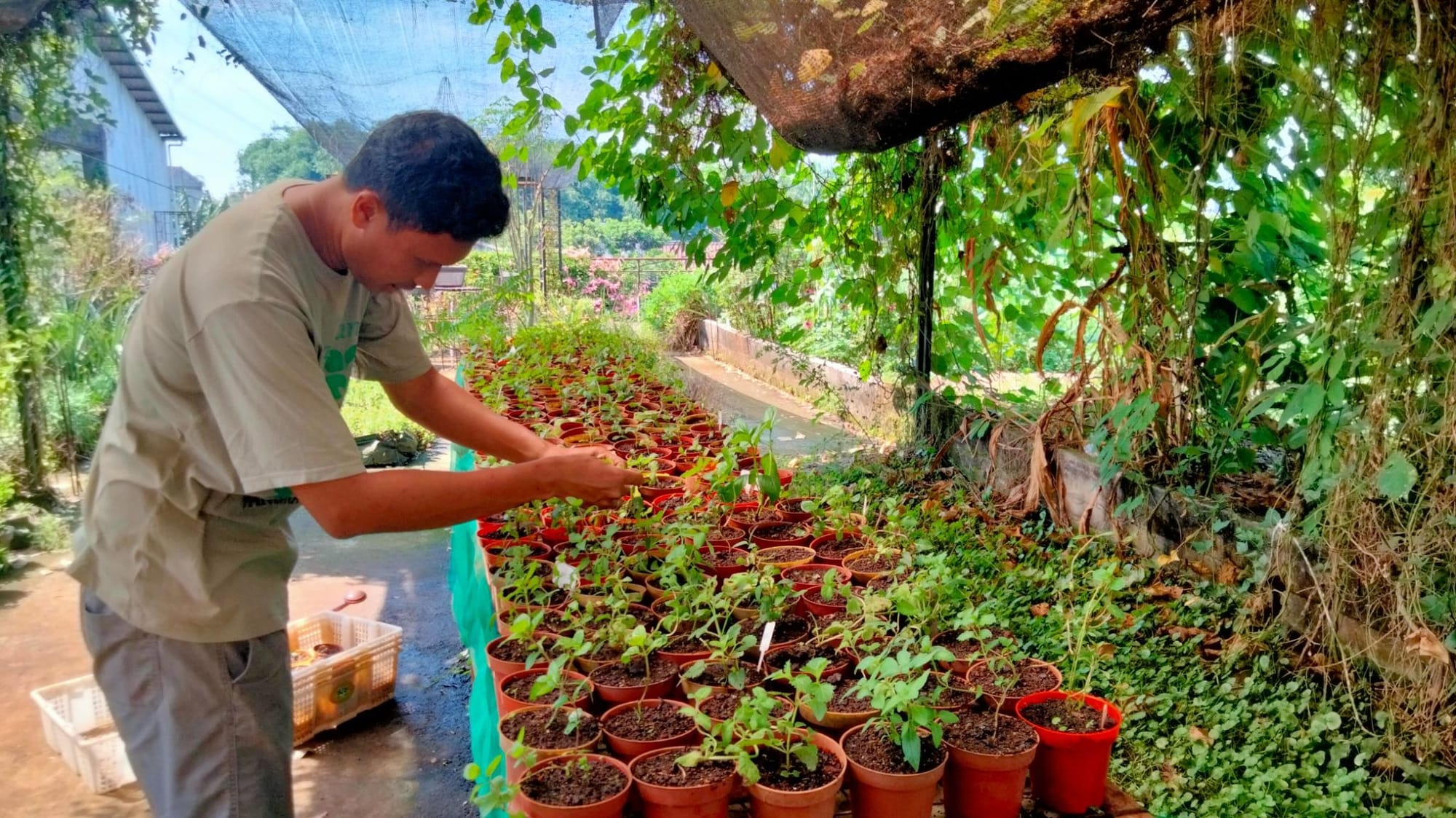
And that is not all. Perched atop the roof of the building in Sukmajaya, Depok, West Java, an array of crops thrives under the sun: pumpkins, king’s salad (kenikir), chilies, lemongrass, calamansi, and sweet potatoes. In one corner of the rooftop, dozens of seedlings are laid out in small pots neatly arranged on long racks. "There are 141 plant species here," said Gibran Tragari, the garden's owner, when met on his grounds on Thursday, May 21, 2026.
The repurposed studio is not the only structure on the 2,500-square-meter property. Tucked behind it are a residential house and a building used as an art gallery. However, Gibran utilizes only the warehouse rooftop and its immediate surroundings for cultivation, spanning a total gardening area of around 500 square meters.
Gibran established the garden on his parents’ vacant lot in early 2017. This was shortly after completing a three-month volunteer stint in late 2016 at Bumi Langit, a permaculture learning center in Imogiri, Bantul, Yogyakarta. At the time, he was job hunting after cutting short his studies in Food Technology at the Fulda University of Applied Sciences in Germany.
Noticing his son’s prolonged unemployment, Gibran's father suggested he learn from a friend at Bumi Langit. "But my father didn’t mention the words 'permaculture garden' or anything like that. He just said there was a garden in Jogja (Yogyakarta). 'Do you want to give it a try?'" Gibran recalled.
Following his training at Bumi Langit, Gibran decided to pack up and move from his parents’ home in Bintaro, South Tangerang, Banten, to Depok to pursue farming. He named his sanctuary Sendalu Permaculture. "After studying at Bumi Langit, I resolved to create a space with a vision of food self-sufficiency," he said.
Initially, his endeavors bore no fruit. Whatever he sowed failed to thrive. In the depths of his frustration, he recalled the words of Bumi Langit’s founder, Iskandar Waworuntu. "You’ve only learned for a brief moment, so make sure you find a place where you can keep learning," Gibran said, quoting his mentor.
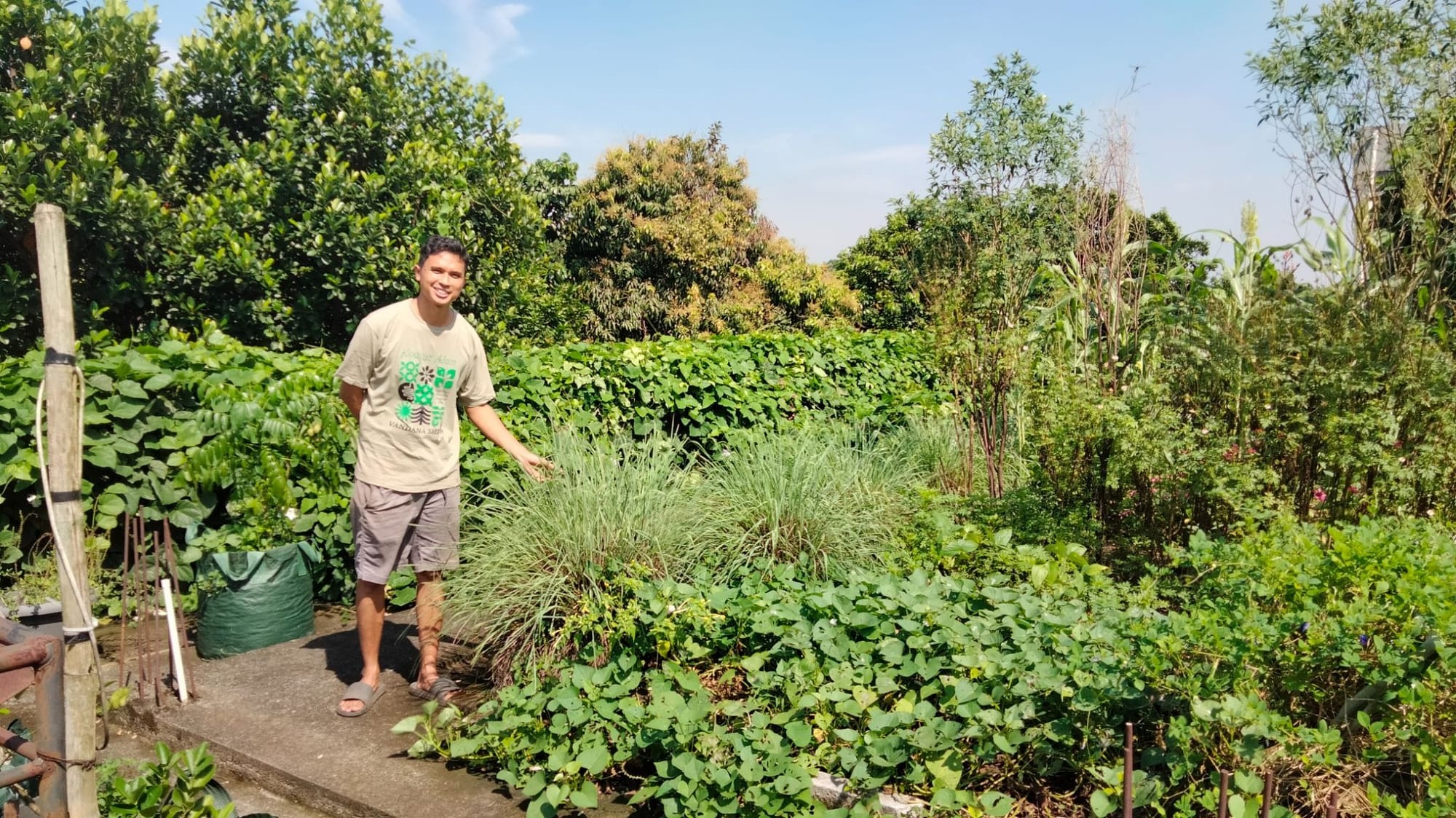
Gibran subsequently joined Jakarta Berkebun, an urban farming community that forms part of the wider Indonesia Berkebun network. There, he relearned the basics: how to garden, what crops were viable, and how to source seeds. He later applied this newfound knowledge to his own plot. Only after the garden stabilized did he gradually weave in permaculture principles.
He found himself deeply aligned with permaculture—a self-sustaining agricultural system modeled after natural ecosystems. For Gibran, the essence of farming lies in utilizing land and resources in harmony with nature. "Because if we follow natural patterns, it should inherently be easier for us," the 37-year-old observed.
Gibran manages the plot alongside his wife, Feby Hendola Kaluara. While he oversees the crops, his wife tends to 25 chickens—five of which are mature hens that yield one to two eggs daily. The harvest from the garden and the eggs have proven sufficient to meet the vegetable and partial protein needs of the small family, which includes one child.
Thus far, the garden's yield is strictly for personal consumption. Gibran has no plans to sell his produce fresh, noting that the monetary return does not yet match the labor invested.
Instead, he hopes to process his harvests, which occasionally yield a surplus. However, despite being a capable cook, Gibran feels he lacks the culinary creativity needed to transform his raw produce into visually appealing goods. To sharpen these skills, he has grown interested in attending cooking workshops and culinary discussions. "For a garden this size, with resources this vast, the food products derived from it ought to be turned into something of high value," he remarked.
For Gibran, a bountiful harvest is not the sole metric of success. One of his core objectives is to attract insects back to the land. "The goal is to welcome more living creatures," he said.
The garden has already drawn an array of insects, including katydids, black ladybugs, and bees. The return of these tiny creatures serves as a tangible indicator of a revitalized ecosystem.
In due time, Gibran noted, these insects might become pests to his crops. But eventually, their natural predators will emerge, balancing the ecosystem further. "A functioning food chain will establish itself," explained the coordinator of Depok Berkebun.
Beyond his daily farming routines, Gibran keeps busy conducting gardening courses and training sessions across various regions. Sendalu Permaculture has also doubled as an activity hub for the Depok Berkebun community.
A similar urban farming journey is shared by 41-year-old Warid. A lecturer in the Agribusiness Study Program at the Faculty of Science, Technology, and Design at Trilogi University, Jakarta, Warid has repurposed vacant land within the university campus. Alongside his students, he cultivates the plot using urban farming methods. "Why did we lean toward urban farming? Because food security is a pressing issue right now," said the founder and advisor of Trilogi Berkebun when met at the campus garden in mid-April.
On a 500-square-meter plot nestled in Pancoran, South Jakarta, they grow a diverse range of flora, spanning vegetables and secondary crops (palawija) to perennial plants.
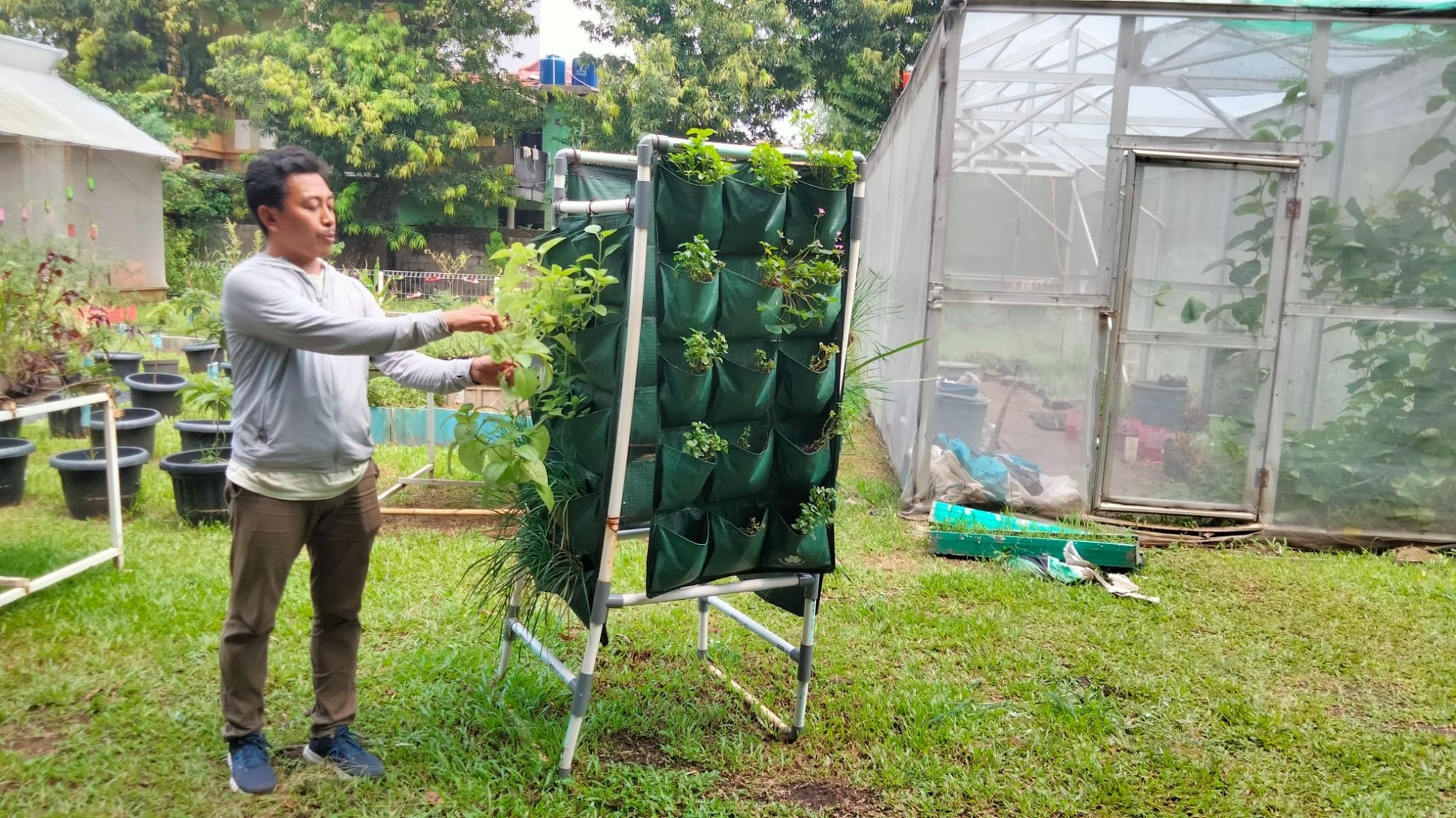
Through urban farming, Warid and his colleagues aim to educate the public on the reality of shrinking agricultural land. By gardening, he argued, people can at least harvest something for themselves. "Aiming for total food self-sufficiency might be a bit lofty. But at the very least, there is something tangible produced," he said.
Before establishing Trilogi Berkebun on his campus in 2016, Warid had joined the Bogor Berkebun community—another branch of the Indonesia Berkebun network—while pursuing his master's degree at the IPB University in 2013. He even served as the coordinator of Bogor Berkebun from 2014 to 2016. "Once I started teaching here [Trilogi University] and living in Jakarta, I left Bogor Berkebun behind."
Gibran and Warid represent a fraction of the urbanites actively farming by utilizing idle land in their neighborhoods. They remain pillars within their respective gardening communities, all under the umbrella of the Indonesia Berkebun urban farming network.
Warid noted that Indonesia Berkebun was founded in 2010 by Ridwan Kamil. The social movement aims to inspire citizens to convert vacant, urban spaces into productive land. "Particularly for growing vegetables. We are well aware that growing vegetables in the city carries risks of pollution exposure and the like. But if we don't utilize the land productively, it simply becomes a dumping ground. That was the underlying idea," the Indonesia Berkebun instructor explained.
Indonesia Berkebun operates on three core pillars: ecology, education, and economy. According to Warid, ecological restoration is achieved when neglected land is transformed into green spaces. "Eventually, butterflies and grasshoppers return. The land becomes more alive and generates oxygen."
Through urban farming, Warid added, the public is educated on the healthy food options readily available around them. Meanwhile, the economic aspect crystallizes once the garden begins to yield. "This ensures the activities can remain sustainable," Warid said.
He explained that Indonesia Berkebun operates through both city-based and campus-based chapters. According to its Instagram account, @idberkebun, as of Wednesday, June 10, 2026, the movement has expanded to 52 cities and campuses across Indonesia, garnering over 10,900 followers.
Warid added that Indonesia Berkebun maintains a communication network spanning the archipelago, from Aceh to Papua. The community periodically organizes joint initiatives, including urban farming competitions. "We have even held national conferences across several cities," Warid said via a WhatsApp message on Tuesday, June 9, 2026.
Their activities extend beyond internal community circles. Depok Berkebun, for instance, frequently collaborates with other environmental and agricultural groups. According to Gibran, the community—which was established in 2011—has previously teamed up with other collectives to host joint farmers' markets. Depok Berkebun, which currently counts around 30 active members, has also marked National River Day alongside the Eco Enzyme environmental network and organized activities with the Depok Ciliwung Community. Furthermore, they have collaborated with waste management activists for a festival along the Ciliwung River. "But those are event-based initiatives, not regular routines," Gibran clarified.
Gibran views the community as a gateway to spreading the gardening "virus." He wants to see everyone farming. Consequently, he designs the community to cater specifically to those genuinely eager to get their hands dirty.
In every community gathering, Gibran avoids delving too deeply into macro global issues. To him, the community should first and foremost be a space where people can find joy in the farming activities. "I believe that the more people take up gardening, the closer we get to food security and self-sufficiency. At the very least, it allows individuals to provide food for themselves."
By taking up gardening, he concluded, individuals naturally begin to think about waste management. "I think, holistically, people’s mindsets are already starting to shift in that direction."