Urban Farming Goes to Campus
By Sapto Yunus
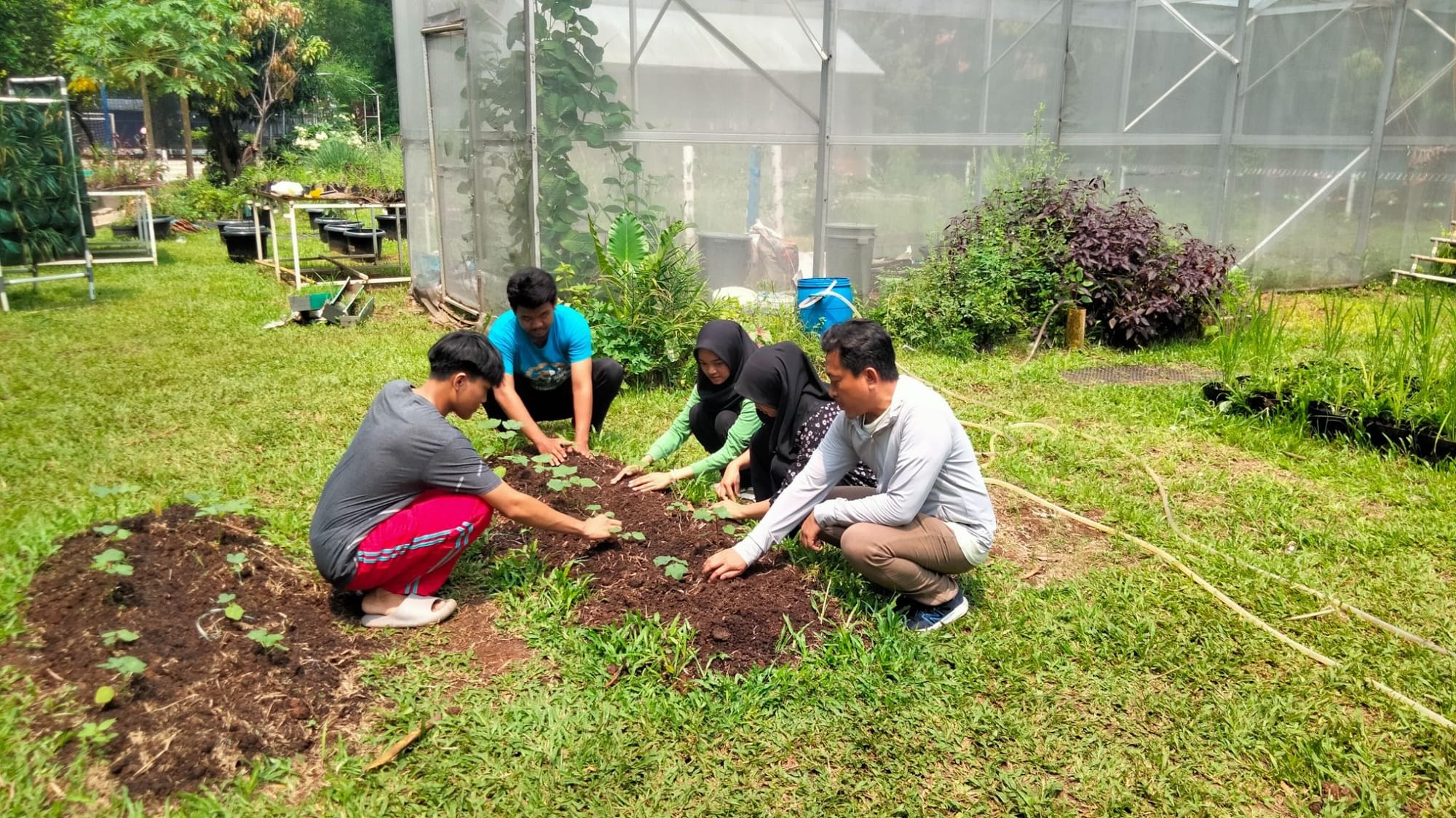
On a breezy Saturday morning, April 18, 2026, a group of university students gathered at a plot of land sprawling across the backyard of the Trilogi University campus in Duren Tiga, Pancoran, South Jakarta. Some huddled together to weed an okra bed, while others prepared adjacent plots for a new batch of crops.
Guiding the students that morning was Warid, a lecturer from the Agribusiness Program under the university’s Faculty of Science, Technology, and Design. Warid, alongside his colleagues and students, has been cultivating this vacant university-owned lot since 2015.
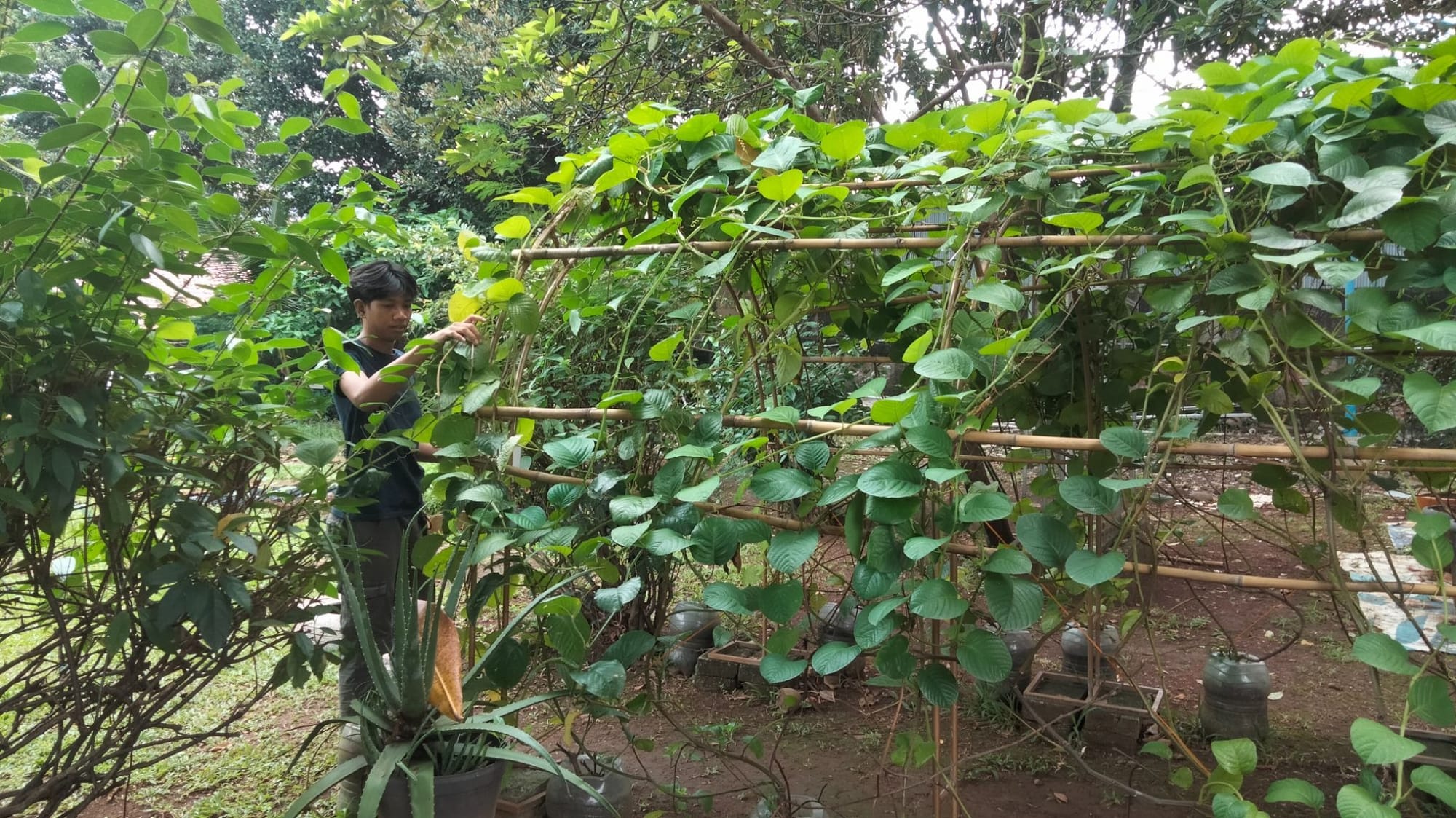
Together, they grow an eclectic mix of vegetation across the 500-square-meter space. The plot boasts various fruits and vegetables, including Brazilian spinach, okra, chives, coriander, scallions, and giant passion fruits. Interspersed among them are staple and perennial crops like rice, lemongrass, cumin leaves, corn, and avocado trees, alongside essential rhizomes such as ginger, turmeric, and galangal. While most are grown in traditional garden beds, some crops—like the Brazilian spinach—utilize space-saving wire mesh garden technology.
Warid recalled that the campus administration had initially planned to erect a lecture hall on the vacant lot. He and his fellow faculty members intervened, petitioning the university to hand over the space for agricultural use instead. "Since we have an agribusiness program that requires practical work, we requested the land," Warid said when met at the garden on Saturday morning, April 18, 2026.
Once management gave the green light, the lot was transformed into an experimental and research garden for undergraduate students working on their theses. Initially, Warid admitted, they farmed without a grand blueprint; they simply planted whatever they could. However, in 2015, a year after he began teaching at Trilogi University, Warid shifted the focus entirely toward urban farming, prompted by growing public concern over food security.
Another environmental issue that caught Warid's attention was the urban tendency for vacant lots to inevitably morph into illegal garbage dumps. He hopes local governments will pay closer attention to this urban blight. "If there are idle spaces, it’s much better to convert them into gardens. Once a garden is established, people think twice about throwing trash there," noted the IPB University alumnus.
A year later, Warid proposed the creation of a campus-based gardening network dubbed Trilogi Berkebun. Today, it stands as one of the campus chapters of the wider Indonesia Berkebun urban farming network. "We have around 25 committee members, comprising both lecturers and students. The structure is divided into management, core activists, and followers," explained the advisor of Trilogi Berkebun.
Aside from its campus roots, the Indonesia Berkebun movement operates city-wide chapters. According to its Instagram account, @idberkebun, as of Wednesday, June 10, 2026, the movement has sprouted across 52 cities and campuses throughout Indonesia.
Warid admitted that Trilogi Berkebun has never kept strict records of its activists and followers due to high turnover as students graduate. Nevertheless, by Wednesday, June 10, 2026, Trilogi Berkebun’s Instagram page (@trilogiberkebun) had amassed 2,056 followers. "Though, of course, not every digital follower has actually set foot in the dirt here," he chuckled.
On a regular basis, Trilogi Berkebun's core activists drop by to tend to the plants. Occasionally, these sessions double as forums to troubleshoot issues cropping up in the garden.
Warid's ties to the movement predate his time at Trilogi. He had previously joined the Bogor Berkebun community while pursuing his master's degree at IPB in 2013, even serving as its coordinator from 2014 to 2016. He relinquished the post upon taking up his lecturing position in Jakarta.
Beyond educating his own students on the nuances of urban farming, Warid intended the campus garden to serve as a classroom for the broader public. "We are reviving training workshops for the local community, having recently secured new collaborators," the 41-year-old said.
Through urban farming, Warid and his fellow activists aim to demonstrate to the public the stark reality of shrinking agricultural land. By growing their own food, he noted, urbanites can at least secure a basic harvest. Warid added that they provide examples and inspiration to locals of all ages—from children to seniors—proving that a bounty of food ingredients can be sourced right from their immediate surroundings.
Urban plots, he argued, also play a vital role in re-establishing local ecosystems. The campus garden regularly attracts insects and small wildlife, including butterflies, lizards, planthoppers, and rice ear bugs. On occasion, fireflies have even paid a visit. "We often worry that city kids nowadays don't know what a butterfly looks like except from YouTube. Here, they can see them firsthand. When they visit, they actually learn," he said.
He noted that when they first planted rice, they assumed urban isolates would shield them from pests like planthoppers and rice ear bugs. To their surprise, the pests appeared with every single rice harvest. "The students get to see them up close. They go, 'Oh, so this is a planthopper. This is a rice ear bug.' It gives them an instant, real-world case study," said the Indonesia Berkebun instructor.
When harvest season arrives, the garden opens its gates, inviting the university’s academic community and neighborhood residents for a collective harvest. "We tell them, 'Please, take the vegetables home.' The university’s administrative and support staff are usually the most enthusiastic participants. It's a free harvest, and they get seeds to take home too," Warid said.
He has also previously invited local residents to participate in the entire life cycle of the garden—from planting and nurturing to harvesting. "We would cook the harvest together and share a communal meal."
It is not uncommon for neighbors, particularly residents of the nearby Kalibata City apartment complex, to drop by to learn the ropes of gardening. "This garden serves as a source of inspiration and a space to share solutions whenever issues arise. I come here every Saturday," said Warid, who is currently brainstorming a program to allocate dedicated plots specifically for local residents to farm.
During periods of surplus, students occasionally sell a portion of the harvest, primarily to the faculty members. The produce is intentionally priced slightly above market rates. The goal, Warid explained, is to boost the students' morale. "It’s also a way for lecturers to show appreciation for the students' hard work. It gets the kids excited, realizing, 'Wow, we can actually grow this much, and it's profitable.' Though nowadays, we mostly just distribute the harvest for free," he added.
The student body has found the campus plot indispensable, particularly given the inclusion of a "Small-Scale Farming" course within the Agribusiness curriculum. Ranjip, a 20-year-old student, expressed his delight at being able to study urban farming right on campus grounds. "We gain firsthand knowledge on how to maximize agricultural yields in highly restricted spaces," said the Agribusiness student from the class of 2024.
Yet, the experience is not without its hurdles. Activists at Trilogi Berkebun note that global warming remains a formidable adversary, bringing unpredictable weather patterns that disrupt plant growth cycles. "It definitely affects the crops. Fortunately, sourcing seeds isn't an issue. We usually just get them from local nursery shops or order them online," said 19-year-old Alfarizi, Ranjip’s classmate.