Storing Tomorrow in the Leuit
By Purwanto Setiadi
Walking along the paddy path, where the standing stalks resembled clusters of vibrant green pennants, it took only 15 minutes to reach our destination. Yet, between our starting point and our destination, the difference felt like night and day. On that still-damp morning in the third week of last May, it felt as though we were traveling through time, stepping back into the past.
The end of the path we followed brought us to plots of fishponds, fed by a river running through the area. Rows of cages made from a blend of bamboo and wood were anchored in the riverbed. Goldfish of various sizes surfaced and submerged, accompanied by occasional splashes. Just a few steps from this spot lay a small settlement, or lembur.
Guradog Hamlet in East Citorek, our destination, is just one of many similar villages across five territories within the Wewengkon Adat Kasepuhan Citorek (Kasepuhan Citorek Indigenous Community Area), located in Cibeber Sub-district, Lebak Regency, Banten. Among its labyrinthine, winding alleys, only two small roads connect the village to the main highway—the "outside" world. Houses inside are tightly packed. Some still stand in their original forms: stilt houses with wooden walls and thatched or corrugated metal roofs—though the latter represents a modification. Others have already transformed into modern structures.
However, "modern" in this 7,431-hectare area surrounded by mountains and hills is difficult to define by conventional standards. Modernity in Kasepuhan Citorek is perhaps best viewed as a hybrid state.
Kasepuhan Citorek is a customary territory whose residents still practice traditions and local wisdom passed down through generations. Nevertheless, unlike the Baduy people—specifically the Inner Baduy—they do not entirely abstain from absorbing modern advancements. The highly revered traditions pertain to relationships within community life, relationships with nature, and relationships with the creator of life. This also holds true for several other indigenous communities in Banten and West Java provinces.
This approach allows the Citorek indigenous community to navigate life more flexibly for the collective good while facing contemporary challenges. "It isn’t always easy. But tradition can remain harmonious by opening ourselves up to modernity," said Abah Didi, the indigenous leader or oyok of the Citorek community, as he welcomed a small group of lecturers and students from a private university in Tangerang arriving for a brief experiential "live-in" stay to learn about life in Kasepuhan Citorek.
Thus, it is unsurprising to see them dress like people outside the Kasepuhan, or to find that some do not work as farmers. If indigenous attributes are visible in daily life, it is the use of the iket or totopong, the traditional Sundanese headcloth. They also adopt technological advancements that help ease daily life. The use of household electronic appliances is common. Mobile phones are daily gadgets, and Wi-Fi routers can be spotted in several locations. The same goes for transportation—nearly every household owns a motorcycle, or even a car.
Amid these deeply held traditions, wisdom in using natural resources for life and livelihood is an aspect that is immediately apparent. This is evident not only from the existence of wet rice fields (sawah), cultivated dry fields (huma), and protected forests around the Kasepuhan, but also from the balong, the fish cages, and, most notably, the leuit—the granaries used to store the rice harvest.
These leuit structures—generally built in a separate area away from residential quarters—can be seen everywhere around the settlements across the entire Kasepuhan. There are thousands in total. Their existence is closely intertwined with how the Citorek people view rice: not merely as a staple food, but as something sacred, the incarnation of Nyi Sri Pohaci Sanghyang Sri or Dewi Sri, the goddess of fertility. "Rice is life," said Iyad Jumiyadi, a Kasepuhan Citorek cultural activist who works as a teacher.
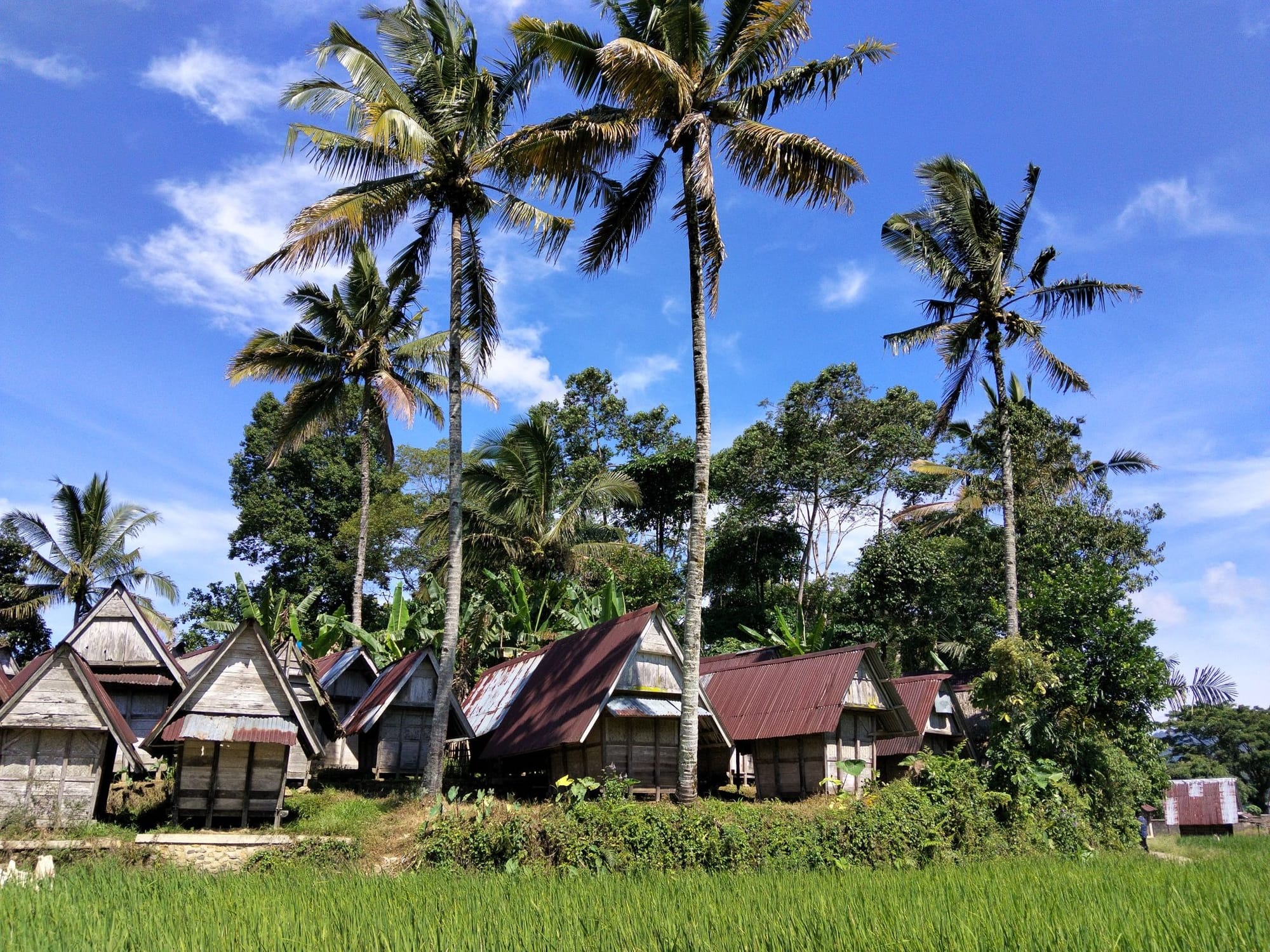
The sun had risen a spear’s length when we reached the area where dozens of leuit belonging to the residents of Guradog stood. The location was just a few dozen paces from the Imah Gede, the old stilt house that serves as the hub for customary activities and community governance, as well as the residence of the customary chief. The heat was already palpable. With no trees around, the sunlight hit us directly. Fortunately, the height of the simple—and mostly aged—leuit structures in this area provided enough shade, especially while we chatted with our accompanying guide.
Though they look ordinary at first glance, the leuit serves an extraordinary function. "The leuit is designed to protect the rice so it can last for years in storage," said Iyad, who took leave from teaching to guide us.
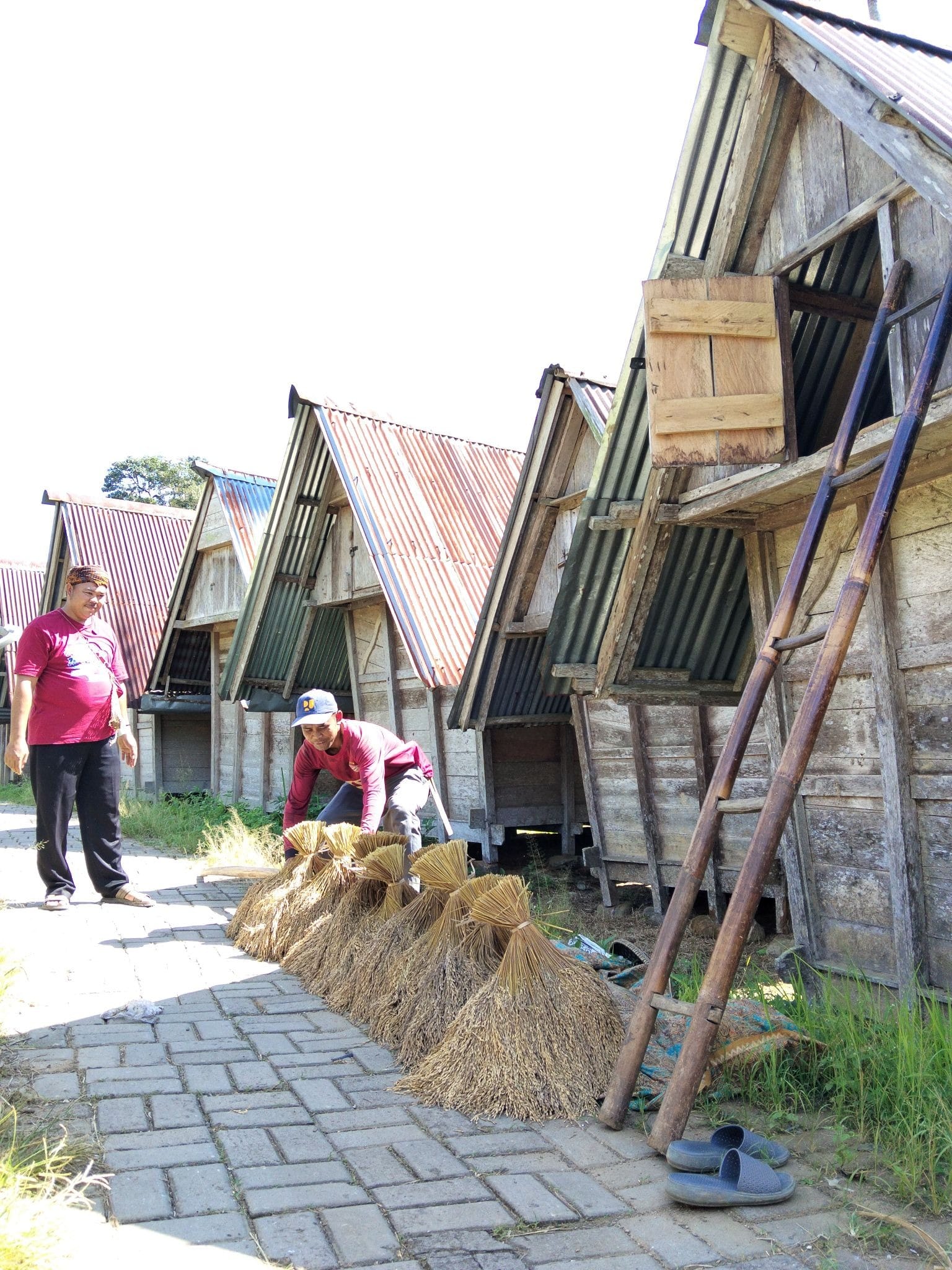
The shape of a leuit resembles an inverted limas (pyramid), wider at the top and narrower at the bottom. It is built like a stilt house, with a clearance that can be low or high from the ground. The height is not merely a design choice; it helps maintain air circulation so the rice remains dry and protected from pests. The roof is of the jolopong type, elongated like a saddle or an isosceles triangle.
The unique features of the leuit are its door and walls. The door is more like a window, located at the upper part of the front wall. Its high position makes access into the leuit less straightforward than entering a regular house. To enter through the door when storing or retrieving rice, people use a taraje (ladder).
As for the walls, they can be made of woven bamboo or wood. What distinguishes the walls of a leuit from those of a house is the lincar—a long board in traditional Sundanese stilt houses installed at the intersection of the floor and the wall. A house wall has only one lincar at the bottom edge; a leuit has many more, resembling ribs if one imagines the leuit as a human torso. The purpose of the lincar in a leuit, besides preventing the bamboo walls from bursting when filled with rice, is to reinforce the structure so it cannot be easily broken into by thieves.
"The size and capacity of a leuit vary depending on the needs and means of the owner," Iyad said, pointing to the leuit in front of us. "This one is about 2 by 2.5 meters, with a height of 3.5 to 4 meters. It can hold up to 2.5 tons of unhusked rice."
According to the traditions of the Citorek community, every family must own at least one leuit. In the past, a person's wealth was measured by the number of leuit they owned.
Yet the significance of the leuit goes beyond status symbols or reverence for Nyi Pohaci. Its main value lies in its ability to keep the harvest safe over the long term. This is where the generational knowledge of the Citorek people comes into play. The stored rice is not consumed all at once. A portion is always set aside for the following season. This is the tangible manifestation of the philosophy saeutik mahi, loba nyesa—a little is enough, a lot leaves a surplus.
Built as a physical representation of respect for Nyi Pohaci, the leuit practically functions to preserve the unhusked rice—the stalks of which are bundled together. The process uses absolutely no chemicals.
First, after being harvested, the rice stalks are tied into what is commonly called a sapocong, then hung on bamboo poles and dried under the sun for about 15 days until the moisture content is very low. Once dry, the rice is paraded in a customary procession called ngarengkong, and then placed one by one into the leuit.
The arrangement inside is done carefully; the rice is packed tightly and neatly, starting from the bottom layer until it fills the space. This entire sequence of activities is part of seren taun, a traditional thanksgiving festival marking the end of a planting season and the storing of the harvest inside the leuit.
However, not all the rice stored in the leuit is intended for food. And no part of it may be sold. A portion is deliberately set aside to become seed, or pare indung (mother seed), for the next planting season. Because the seeds come from their own harvest, the Citorek people do not rely on external, industrial seed supplies. It is from the leuit that their agricultural cycle, which features only one planting per year, begins anew.
This reliance on their own seeds sets the agricultural practices of the Citorek community apart from many contemporary rice cultivation patterns that depend on commercial seeds, chemical fertilizers, and pesticides. In the fields surrounding Guradog, as well as those scattered across other locations in all villages within Kasepuhan Citorek, the rice cultivation process still adheres to knowledge passed down through generations.
The entire agricultural process in Citorek is carried out through stages that are not only technical but also rich in ritual meaning. Farming is generally conducted on wet land (sawah) and dry land (huma). Before planting begins simultaneously, the elders or baris kolot hold a deliberation. This forum is convened to determine the best time to sow the seeds. The customary chief will initiate this stage first on communal land before all residents of Kasepuhan Citorek plant in their respective fields.
Nursery preparation is conducted alongside soil cultivation. During the nursery stage, local rice seeds are soaked to induce sprouting. Meanwhile, the soil is tilled manually using hoes or plowed using water buffaloes. This is done while clearing crop residues and neatening the dikes.
Only after all of this is complete does planting begin. Then, for the next six months, maintenance is carried out—weeding around the rice plants, clearing the dikes of pests and disruptive weeds, and applying natural fertilizers. The time to harvest arrives after the rice turns golden; the harvest is executed with a series of rituals and customary ceremonies, including deliberations to determine the timing, until the resulting rice eventually anchors inside the leuit.
The existence of a leuit indicates that the harvests of the Citorek community are not entirely consumed to meet daily needs. A portion is set aside and stored to secure the family's food supply throughout the year, while also ensuring the availability of seeds for the next planting season
"The leuit serves as a link between the past harvest and the future harvest," Iyad said.
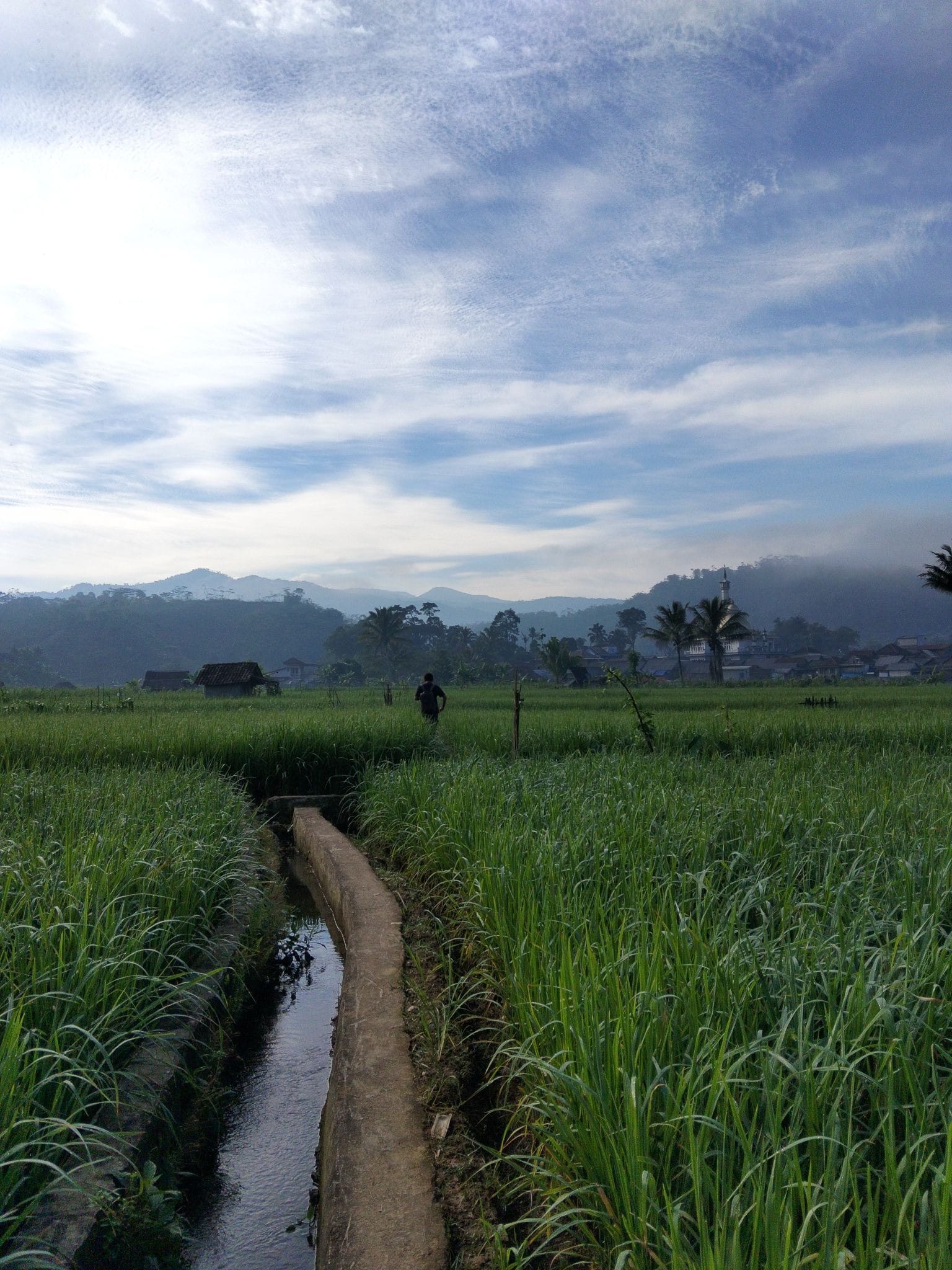
Moving from one village to another within the Kasepuhan Citorek at the start of this dry season, one witnesses an expanse of agricultural land that is truly a feast for the eyes. The rice stalks look lush. The harvest time will arrive in about two months.
The annual series of processions is drawing near. "We will let you know when the rice harvest and the seren taun event take place. You can join in cutting the rice in the fields," said Jajang Kurniawan, a Citorek customary figure who serves as the Executive Chair of the Indigenous Peoples Alliance of the Nusantara (AMAN) for South Banten.
Yet, that sea of green is only the visible part. What escapes the eye is what lies beneath: the workings of a system that prevents the harvest from being just food for a single season. There is knowledge of storage, seed selection, and resource management that allows this cycle to repeat year after year.
As we left Guradog Village near dusk, rows of leuit still stood quietly, while the sunlight in the distance began to turn crimson. Viewed from the outside, the structures appeared unassuming; it was only their distinct architecture and arrangement that made them impossible to miss. Yet that simplicity holds more than just bundles of rice: it holds food reserves, seeds for the next season, and the knowledge that has helped the Citorek community sustain their lives for generations.