The Mee Woman Behind Hundreds of Farmers in Central Papua
By Jafettin Jemme
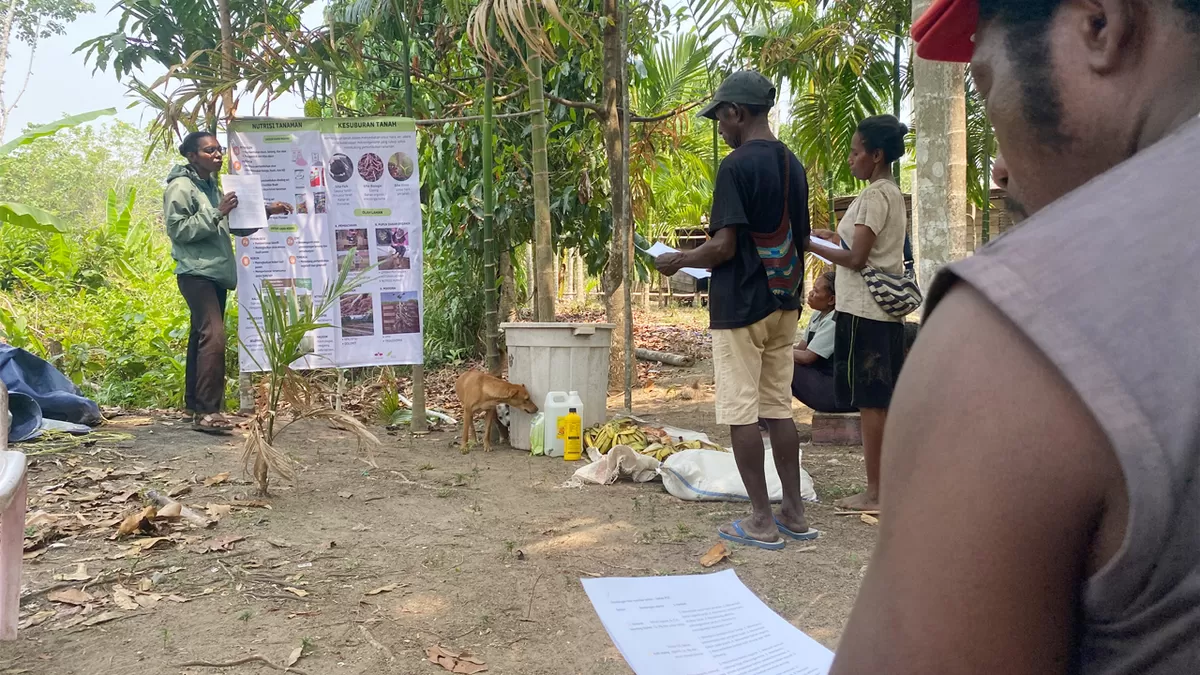
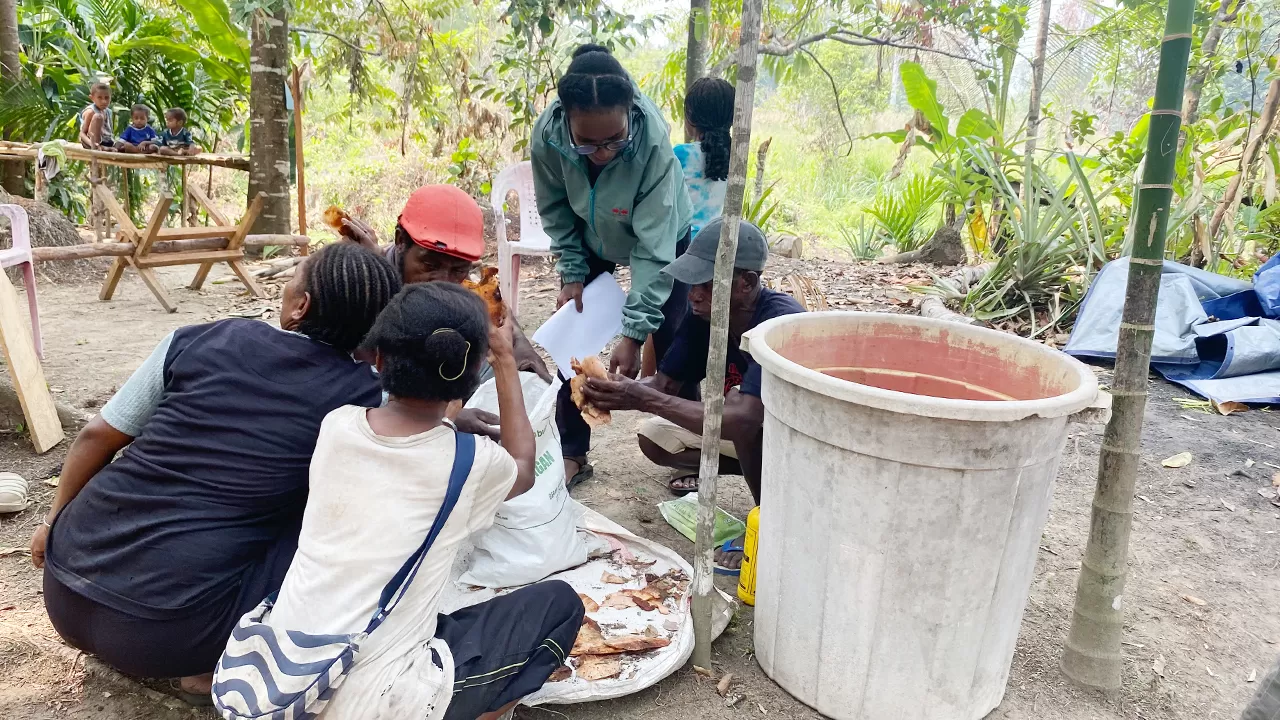
"ALL of these ingredients will be mixed together." Melan Yustina Pigai’s voice carried over the din of farmers at work in Waroki Village, West Nabire District, Nabire Regency, Central Papua, on September 30, 2026. The young woman from the Mee tribe stood among the members of the Anak Sorong (Children of Sorong-Ansor) Farmers Group, directing the production of organic liquid fertilizer while breaking down the steps involved.
Before the gathering of farmers, Melan offered far more than textbook theory. She demonstrated firsthand how everyday materials found right in their backyard—banana corms, banana peels, goat manure, and sugar water—could be transformed into nutrient-rich organic liquid fertilizer. The mixture is left to ferment for roughly two weeks before it is used.
"All of these ingredients will be stored in this drum. The fermentation process takes two weeks," Melan explained to the farmers.
Between demonstrations, Melan also emphasized the importance of understanding plant nutrient requirements and how they tie into soil fertility. She noted that farmers need to know how to apply inputs correctly, whether using commercial fertilizers or organic alternatives they can brew themselves.
Yet, beneath the surface of these lessons lies a stubborn, daily hurdle. The local soil is overwhelmingly sandy, meaning water and fertilizers leach away almost as fast as they are applied.
Frangky Waa, a member of the Ansor farmer group, spoke about this uphill battle during a break in the day’s activities. He explained that the makeup of the earth beneath their feet is precisely why they have to keep experimenting with different strategies.
"Our main obstacle here is simply our soil. That soil is what always makes us want to give up. It’s mostly sand," Frangky said, shifting his weight on a wooden bench.
He explained that the topsoil in his garden is barely 10 to 20 centimeters deep before giving way entirely to sand. As a result, any water they pour and any fertilizer they spread vanishes in no time.
"The water we pour, the fertilizer we spread,it just doesn't last," he said.
Frangky shared that he has called Melan on several occasions when his chili plants ran into trouble. True to form, whenever she got word, Melan made it a point to come straight out to the plot and inspect the crops herself.
"She never gets tired, she never complains, and she always rolls up her sleeves with us," Frangky recalled, reflecting on her guidance.
For Melan, tackling these headaches head-on is simply part of the job. Melan is a technical field officer with the Yayasan Bina Tani Sejahtera (YBTS), supporting roughly 500 to 600 farmers and managing dozens of demonstration plots.
BORN in Air Mandidi Village, Teluk Kimi District, Nabire Regency, Central Papua, Melan is the eldest of three siblings. Farming was woven into the fabric of her childhood. Every Sunday, the 24-year-old woman accompanied her mother, Maria Tigi, out to the gardens to harvest vegetables for sale at the local market. Taro, bananas, corn, spinach, mustard greens, and other crops formed the backdrop of her early years.
"Back then, we just went to the garden and harvested whatever was there. I had no idea it could amount to something much bigger," Melan recalled after finishing her extension session with the Ansor group.
At home, her parents maintained a strict household. Maria Tigi reminisced about raising her children with firm rules, particularly when it came to education and discipline.
"Our kids were always top of the class—from first grade all through elementary school, middle school, high school, and university too," Maria said, beaming as she recounted her children's academic path.
To Maria, education and discipline went hand in hand. From a young age, Melan was expected to keep up with her studies while pitching in around the house and farm.
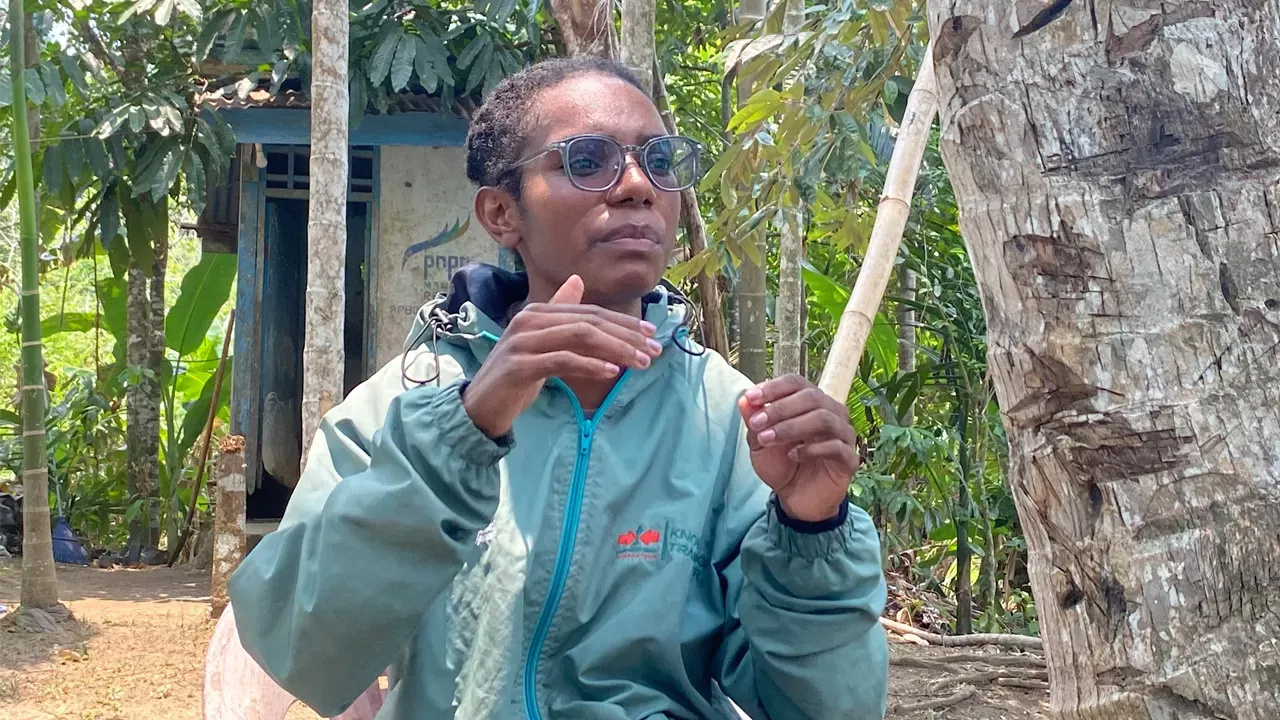
That dynamic shifted in 2020 when Melan’s father, who worked as an inland transport driver, fell ill. At the same time, Melan had just graduated from high school and faced the daunting task of figuring out how to fund her college education.
Suddenly, the garden was no longer just a place to help out the folks. It became Melan's primary avenue for earning an independent income.
She threw herself into farming with a new seriousness, determined to support her family while paying her own way through college. But, Melan did not take agriculture major. She studied public administration at Satya Wiyata Mandala University (USWIM) in Nabire.
However, she did not leave her farming. She taught herself through YouTube videos, tested various techniques in the dirt, and watched the results unfold right before her eyes. From the internet, she learned land preparation, organic fertilizer production, crop care, and troubleshooting common cultivation snags.
Melan immediately put it to the test in the dirt. The harvest proceeds helped cover household expenses and tuition fees. Through that trial-and-error process, she began to realize that farming demands far more than just planting a seed.
It takes grit, discipline, the courage to experiment, and the willingness to stomach failure. Through it all, one figure remained her greatest source of inspiration: her mother. For Melan, her mother’s resilience is more than a fond memory—it is the exact fuel she draws on when things get tough in the field or among farming groups.
"Because Mama’s fight was so much bigger," she said.
HER introduction to Bina Tani Sejahtera Foundation in 2021 proved to be a major turning point. At the time, Melan was still a university student and very much a novice grower. Sepriyason Kono, or Sepri, then working with YBTS, encouraged her to try growing vegetables in a more structured, methodical way.
Their first shared experiment was water spinach on a modest 200-square-meter plot. That simple project introduced Melan to the world of measured, data-driven farming. She learned not just how plants grow, but how to log progress, plan crop rotation cycles, calculate input costs, and track yields.
Her family's plot soon became a demonstration plot. From there, Melan interacted more frequently with seasoned growers, learning the delicate art of translating technical know-how into accessible advice for others.
"She wanted to learn and she wasn't afraid to ask questions," Sepri said, reflecting on how much Melan had evolved since they first connected over a mobile screen.
According to Sepri, that evolution is most evident in Melan’s newfound confidence. The once-quiet young woman gradually grew comfortable stepping in front of crowds of farmers, breaking down cultivation techniques, and troubleshooting real-time field problems.
By 2024, Melan stepped into the role of community farmer facilitator at the YBTS, putting her out in the fields on a regular basis.
She encountered growers of all stripes, each with distinct personalities and hurdles. Some needed pointers on fertilizers, others battled stubborn pests, and some stared helplessly at failing crops. She then became a technical field officer in 2025.
Her responsibilities scaled up dramatically. She now guides farmers through every phase of cultivation—from seedbed preparation and land shaping to planting, maintenance, and harvest.
Melan estimates she has shared her knowledge with roughly 500 to 600 farmers, alongside regular oversight of dozens of demonstration plots. Frangky is one of them. He said that the knowledge gained through YBTS coaching broke their reliance on traditional guesswork.
"From knowing nothing to actually understanding, we can now grow on our own," Frangky said.
He noted that farmers in his circle now have a firm grasp of chemical applications, fertilizer dosing, pest control, and broader cultivation techniques.
"Now we're progressing step by step. We know the right treatments, the right way to fertilize, and how to handle pests when they hit," he continued.
MELAN’S job doesn't stop at the edge of the farm beds. In her work with farming communities, she frequently navigates human friction and group dynamics.
At one point, she guided an all-women's group of eight members. Things started smoothly, but internal squabbles over division of labor fractured the group until only two members remained active. Still, Melan refused to walk away.
On another occasion, she even chipped in Rp800,000 of her own money to support the El Shadai farming group in Samabusa. Ultimately, however, she realized that community rifts can't always be patched up with cash alone. Communication, trust, and shared accountability are battles that have to be fought from within.
Another poignant case involved the Cenderawasih farming group. At one point, discouraged by group infighting, one of the members had pulled out his fishing nets, determined to return to the sea for good.
"When I arrived, Ibu Margareta’s husband was already fixing his nets. He told me, 'Melan, tomorrow I'm just going out to sea. I'm done with farming. People just take advantage of us,'" Melan recalled.
Melan refused to let him give up.
"Bapak, don't look at it that way. You have to keep planting. Your kids are still in school—who's going to pay their way if you stop?" Melan urged him.
She kept showing up, talking things through, and offering words of encouragement.
Slowly but surely, Mama Margareta’s husband picked up his tools and headed back to the farm.
MELAN admits she is naturally introverted. She isn't one for idle chatter and prefers the quiet company of her garden beds.
Ironically, the career path she chose forces her to do the exact opposite. She has to stand in front of crowds, lecture groups, field rapid-fire questions, field complaints, and manage a wide range of personalities.
That pressure has transformed her. From a quiet young woman learning the ropes on her family's plot, she has grown into a confident leader capable of addressing hundreds of growers.
Melan is no longer just tending her family’s plot. She is passing that hard-won knowledge on to anyone willing to learn.
The original article was published on nabirenews.com on October 7, 2026, and has been lightly edited for this publication.